
Excellential helped a 30%-market-share Indian tractor manufacturer lift cross-team trust 80% and speed up decisions 25% through a culture transformation program.
This culture transformation case study from India shows what it takes to turn fragmented teams into a united force.
“When departments work in silos, growth stalls. See how we turned a 30% market leader’s fragmented teams into a united force with trust, handwritten notes, and measurable results.”
This culture transformation case study from India’s manufacturing sector is one that stayed with us long after the engagement ended not because of the scale of the organization, but because of how quietly broken things had become, and how human the solution turned out to be.
The situation
Our client was a top-tier tractor manufacturer in India with over 30% market share, a genuine giant in their sector. On paper, they were thriving. On the ground, something else was happening.
R&D, Sales, and Production had stopped talking to each other in any meaningful way. These three functions, each critical to the business, operated like competing entities rather than collaborators.
- Teams delayed decisions.
- They missed opportunities to innovate.
- Agility, once a strength, had quietly disappeared.
The trust between teams hadn’t broken down in one dramatic moment. It had eroded slowly, meeting by meeting, email by email, until people stopped trying altogether.
The challenge they brought to us:
The leadership team didn’t just want a team-building event. They had tried those before. What they wanted was something that would actually stick a way to inject trust and co-ownership into the company’s DNA.
The challenge:
- Make teams want to collaborate.
- Not feel obligated to.
- Not because someone told them to.
- Actually, want to.
That’s a very different brief. And it required a very different approach.
What Excellential did – the human-first approach
We designed a series of interventions built on one belief: that collaboration is not a skill you teach in a classroom. It is a habit you build through shared experience, repeated over time.
Here is what we put in place:
A 2-day cross-functional outbound program, teams from R&D, Sales, and Production worked through challenges together. Not simulated HR challenges. Real business simulations, escape rooms, and strategy exercises where the connection between collaboration and KPI outcomes was made viscerally clear. When Sales and R&D solve a problem together under pressure, something shifts.
A buddy system across rival departments – We paired employees from functions that had the most friction for monthly joint projects. One early example: Sales and Engineering co-designed a farmer-friendly feature together. The output mattered less than the relationship it built.
“I Silently Admire You” Day – Handwritten notes, shared across hierarchies. A Production supervisor writing to an R&D engineer. A junior salesperson writing to a senior manager. Simple. Human. Surprisingly powerful. When people feel seen, they show up differently.
Hobby clubs – We launched informal groups around shared interests, such as photography and farming technology, to create bonds that existed entirely outside of work deliverables. People build the strongest professional trust in non-professional moments.
What changed – the results
Within the program period, the results were measurable and meaningful:
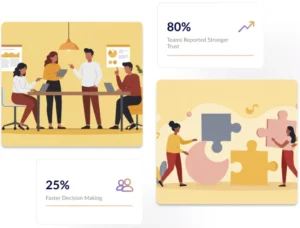
- 80% of teams reported stronger trust in post-program surveys
- Decision-making accelerated by 25% – R&D and Sales teams cut approval times that previously dragged on for weeks
- Teams pitched three cross-functional ideas to leadership within two months of the program ending.
- An organic culture shift took hold, teams celebrated birthdays company-wide, and kept hobby clubs running months later
But the result we were most proud of wasn’t in any survey. It was the fact that people started walking across the corridor to talk to each other again.
What this culture transformation case study teaches us
Silos don’t form because people are difficult. They form because systems, incentives, and physical or functional distance make it easier not to connect. Breaking them requires more than a workshop or a memo from leadership.
It requires experiences that remind people they are on the same team and structures that keep reinforcing that truth long after the consultant has left the building.
If your organization is experiencing the quiet cost of siloed teams, we’d be glad to have a conversation about what a culture transformation engagement could look like for you.