
Vikram runs a 300-person logistics company out of Hyderabad. Like most Indian founders, he had never built a leadership pipeline in India, and he paid the price for it.
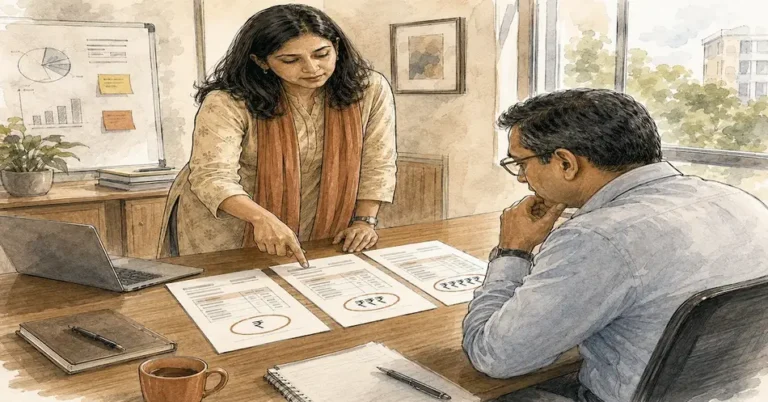
Last year, a competitor poached his VP of Operations, offering a package Vikram couldn’t match. The role sat empty for four months. Revenue dipped. The team wobbled. Vikram eventually hired an external candidate for ₹38 lakh per annum, plus a joining bonus.
“If I had someone ready inside,” Vikram told me over coffee,” I would have saved ₹15-20 lakh and three months of chaos.
This is the cost of not having a leadership pipeline. And it’s a cost most Indian companies pay repeatedly without realising it.
Here’s what makes it worse: when Indian business leaders hear “leadership pipeline in India,” they picture IIM executive programs at ₹4-8 lakh per person, or global consultancies quoting ₹50 lakh for a year-long leadership development engagement. They assume building leaders requires a budget they don’t have. So, they do nothing. And the next time a key leader leaves, they scramble again.
But a leadership pipeline in India is not a luxury item. It’s infrastructure. And like any good infrastructure, it can be built in layers with whatever resources you have today.
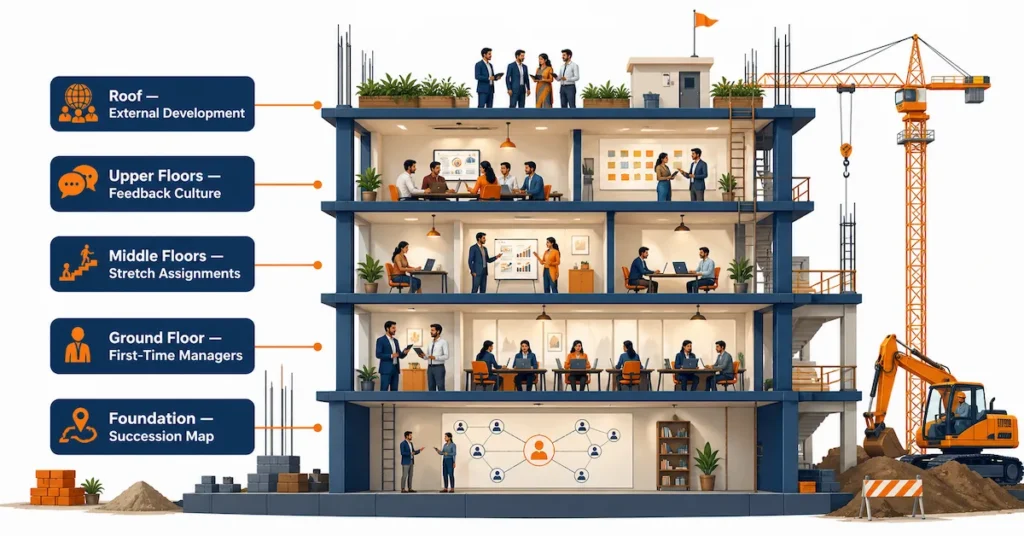
Think of it like constructing a building. You don’t start with the penthouse. You start with the foundation. And every layer you add makes the structure stronger.
A leadership pipeline in India is the structured, layered way a company identifies and develops its own future leaders, from first-time managers to senior successors, so the right people are ready to step up before key roles fall vacant.
Key Takeaways
|
Here’s the blueprint.
Layer 1: The Foundation – Identify Who You’re Building For
What it is: A simple, honest map of your current leadership bench and future needs.
Why most companies skip it: Because it feels like “HR work” rather than business work. Founders and CXOs want to jump straight to training without first understanding who needs developing, into what role, and by when.
What to do and it costs nothing:
First, you don’t need a ₹10 lakh talent management software. You need a spreadsheet.
To start, create a simple grid. Down the left side, list every role that’s one or two levels above your current team, the roles you’ll need filled in 12-24 months as the business grows. Across the top, list your current employees who could potentially fill those roles. In each cell, note two things: readiness (ready now, ready in 6 months, ready in 12+ months) and the biggest gap they’d need to close.
That’s it. One spreadsheet. One honest conversation with your leadership team. Zero rupees spent.
I’ve done this exercise with a 150-person fintech in Mumbai and a 40-person manufacturing unit in Coimbatore. Both times, the founders were stunned. “We had no idea we were three exits away from a crisis,” one said.
Cost: ₹0. Time: half a day with your senior team.
Layer 2: The Ground Floor – Train Your First-Time Managers
What it is: A structured program (even a short one) for people stepping into people-management roles for the first time.
Why it matters more than anything else: Because this is where leadership pipelines across India leak the most. Your best engineer gets promoted to team lead. Your top sales executive becomes a regional manager. They were never taught how to run a one-on-one, give developmental feedback, delegate without micromanaging, or handle a team member’s underperformance.
In India, this gap is especially large. Our education system doesn’t teach management. Indian companies promote people based on tenure or technical skill, not leadership readiness. And our cultural discomfort with direct feedback means new managers often avoid difficult conversations for months until the situation becomes a full-blown crisis.
Five things you need and how to get them cheap:
You don’t need a 5-day residential program at a resort in Lonavala. You need five things:
- A 90-minute kickoff session where you set expectations for the role: what changes when you become a manager, and what stays the same. This can be run internally by your HR lead, your founder, or even an experienced senior manager.
- A simple manager toolkit: a one-page guide covering how to run a one-on-one, how to give feedback using a simple framework (Situation-Behaviour-Impact works well), how to delegate effectively, and how to have a difficult conversation. You can build this yourself or find solid templates online for free.
- A peer cohort: group your new managers. Have them meet monthly (even over a video call) to share what’s working, what’s not, and what they’re struggling with. Peer learning is free and surprisingly powerful.
In Indian organisations, where new managers rarely admit struggle upward because vulnerability feels like a career risk, a peer group is often the only safe space to say, “I have no idea what I am doing.” That honesty is where the real learning begins.
- A mentor (not their boss): assign each new manager a senior leader from a different function. The mentor’s job isn’t to evaluate. It’s to listen, share experiences, and normalise the struggle of becoming a leader.
- A 90-day check-in: after three months, sit down with the new manager and ask: What surprised you? Where do you feel confident? Where do you still feel out of your depth? Use this to plan the next phase of their development.
Cost: ₹5,000-15,000 (if you create printed toolkits or use a facilitator for the kick-off). Otherwise, ₹0 with internal resources.
Layer 3: The Middle Floors – Develop Your Mid-Level Leaders Through Real Work, Not Classrooms
What it is: Stretch assignments, cross-functional projects, and structured exposure for managers who’ve been leading teams for 2-5 years and are ready for bigger responsibilities.
Why classrooms alone don’t work: I have seen companies spend ₹3-5 lakh per person to send mid-level managers to two-day leadership workshops. Initially, the managers come back inspired for a week. Then they return to the same systems, the same pressures, the same habits. Within a month, the workshop is a memory. Within three months, it’s a line item in the training budget that nobody can connect to a business outcome.
Building a leadership pipeline in India at this level cannot happen in a classroom. It’s built in the mess of real business challenges: a new market entry, a product pivot, a team restructuring, a client crisis. The classroom provides frameworks. But the growth happens on the job.
How real work replaces expensive classrooms:
Stretch assignments: Give a promising operations manager a 90-day project to lead the company’s first expansion into a new city. Give a strong product lead the task of mentoring two junior managers. Give someone from finance a seat at the table during a strategic planning session they’d normally never attend. These assignments cost nothing. They develop capability faster than any workshop.
Cross-functional rotations: Even short ones, a 4-week stint sitting in on a different department’s meetings, or a 2-month “shadow” assignment with a senior leader from another function. In Indian organisations, where silos run deep, this is one of the most effective (and cheapest) development tools available.
Action Learning Projects: Give a small group of mid-level leaders a real business problem to solve, not a case study, but an actual problem your company is facing. Have them present their recommendations to the leadership team. They learn strategic thinking, collaboration, and presentation skills, all while producing something useful for the business.
Cost: ₹0 for the assignments themselves. If you add an external facilitator to guide the Action Learning cohort, budget ₹25,000-75,000, depending on the facilitator.
Layer 4: The Upper Floors – Build a Feedback Culture That Replaces Expensive Assessments
What it is: Regular, structured feedback loops that tell your people where they stand, where they need to grow, and what’s expected of them at the next level.
Why this is the secret weapon: The most expensive part of most leadership development programs isn’t the training. It’s the assessment – 360-degree feedback tools, psychometric profiles, and leadership competency frameworks built by external consultants. These assessments cost ₹1-3 lakh per person.
But here’s what most companies don’t realise: you can build 80% of the assessment value with a simple, internally run feedback process.
Three free options that replace ₹3 lakh assessments:
Option A: DIY 360-degree feedback. Create a Google Form with 10-12 questions aligned to the leadership behaviours you care about, things like “Does this person communicate clearly?” “Do they develop their team members?”, “Do they handle conflict constructively?” Send it to the leader’s manager, three peers, and three direct reports. Compile the responses anonymously. Share the summary with the leader and their manager.
Admittedly, this isn’t as polished as a consultant-built 360. But it gives you directional insight, and that’s enough to guide development.
Option B: Quarterly development conversations. Replace the annual performance review (which, let’s be honest, nobody enjoys and nobody acts on) with quarterly 30-minute conversations focused entirely on growth. Two questions: “What leadership skill have you been working on this quarter?” and “What do you need from me to keep growing?” These conversations, done consistently, build more leadership awareness than any annual assessment.
Option C: The “leadership shadow” feedback loop. When a mid-level leader attends a senior-level meeting, the senior leader spends 10 minutes afterward giving them specific feedback: “Here’s what you did well. Here’s what you missed. Here’s what I’d do differently.” This kind of in-the-moment coaching is worth more than a 40-page assessment report.
Cost: ₹0 for all three options if run internally.
Layer 5: The Roof – Invest Selectively in External Development
What it is: Targeted, external programs for your highest-potential leaders, the ones who are 12-18 months away from senior roles.
Why “selectively” is the keyword: External programs are valuable. But they’re only valuable when you’ve already built Layers 1-4. Sending someone to an IIM executive program without first identifying their specific development gaps, without giving them stretch assignments to practice new skills, without a feedback system that tracks their growth, that’s like putting a roof on a building with no walls.
Where to spend the money and how to choose:
Short-format programs (2-5 days): Many Indian business schools- ISB, XLRI, IIMA, IIM Bangalore- offer focused executive education modules on specific topics: strategic thinking, leading change, negotiation, innovation, and leadership. These typically range from ₹50,000 to ₹2 lakh. Pick the module that addresses your leader’s specific gap, not the one with the most impressive brochure.
Online cohort-based programs: Platforms like Coursera, LinkedIn Learning, and Emeritus offer leadership programs from global institutions at ₹15,000-₹50,000. The quality varies, but if you choose carefully based on the specific skill gap you’ve identified, these can be excellent.
Industry peer groups and forums: YPO, TiE, CII, and NASSCOM all run leadership forums where mid-to-senior leaders interact with peers from other organisations. The learning that happens in these peer conversations is often more valuable than formal programs. Many of these forums have annual memberships under ₹1 lakh.
Executive coaching: If you have one leader who’s about to step into a critical senior role, a 6-month coaching engagement (typically ₹1.5-3 lakh in India) can be the highest-ROI investment in your entire pipeline. But importantly, coaching works best when you layer it on top of on-the-job development, not as a substitute for it.
Cost: ₹15,000 to ₹3 lakh per person, depending on the intervention. The key is: spend this money only on leaders who’ve already been developed through Layers 1-4.
The Full Blueprint – What This Actually Costs
Let’s add it up for a company with 200-500 employees building a leadership pipeline of, say, 15-20 future leaders:
|
Layer |
What |
Approximate Cost |
| Layer 1: Foundation | Succession mapping exercise | ₹0 |
| Layer 2: Ground Floor | First-time manager program | ₹5,000 – 15,000 total |
| Layer 3: Middle Floors | Stretch assignments + Action Learning | ₹0 – 75,000 |
| Layer 4: Upper Floors | Internal feedback systems | ₹0 |
| Layer 5: Roof | Selective external programs (for top 3-5 leaders) | ₹50,000 – 3,00,000 per person |
| Total for 15-20 leaders annually ₹1,00,000 – ₹5,00,000 | ||
| External hire replacement cost ₹15,00,000 – ₹40,00,000 | ||
Total for an annual leadership pipeline program: ₹1-5 lakh for 15-20 people.
Compare that to the cost of replacing one senior leader externally: ₹15-40 lakh (recruitment fees + higher salary + onboarding time + productivity dip).
The math isn’t even close.
Why Indian Companies Still Don’t Build a Leadership Pipeline
If the blueprint is this straightforward, why don’t more Indian companies build leadership pipelines?
Three reasons.
Reason 1: “We’ll do it when we’re bigger.” Startups and mid-sized companies assume leadership development is something large corporations do. By the time they realise they need it, they’ve already lost three key leaders, and their culture has cracks you could drive a truck through.
Reason 2: “Our people will leave anyway.” This is the most self-defeating belief in Indian business. Yes, some people you develop will leave. But the ones who stay will be dramatically more capable, and they’ll attract better talent in the next hiring cycle. The question isn’t “What if we train them and they leave?”
The real question is: “What if we don’t train them and they stay?”
Reason 3: “We don’t have an HR team to manage this.” You don’t need a 10-person HR department. You need one person, a founder, a senior leader, an HR generalist who owns the pipeline the way someone owns revenue or product. Leadership development isn’t an HR program. It’s a business strategy. Treat it like one.
Start Building Your Leadership Pipeline in India – One Layer at a Time.
You don’t have to build all five layers this quarter. Start with Layer 1, the succession map. It takes half a day and costs nothing. Once you see the gaps on paper, you’ll feel the urgency to build Layer 2. And once your first-time managers start getting better, you’ll want to invest in Layer 3.
That’s how infrastructure works. One layer at a time. Each one makes the next one possible.
Every leadership pipeline in India starts with one honest conversation about who is ready and who is not. The companies that win the next decade in India won’t be the ones with the biggest training budgets. They’ll be the ones who built their leaders before they needed them.
At Excellential, we have built a leadership pipeline in India for logistics companies in Hyderabad, fintechs in Mumbai, and manufacturing units in Coimbatore. We start with Layer 1, the spreadsheet that costs nothing and reveals everything. We build from there. Whether you have 50 people or 5,000, we will show you which layers matter most for where you are right now.
Book a Free Consultation with Excellential. Bring your succession map or tell us you do not have one yet. We will build it with you.
Frequently Asked Questions
What is a leadership pipeline, and why does it matter in India?
A leadership pipeline in India is the structured way a company grows its own future leaders, from first-time managers to senior successors, so it fills key roles from within. It matters because replacing one senior leader externally costs ₹15-40 lakh, while developing internal leaders costs a fraction and avoids months of disruption when someone leaves.
How do you build a leadership pipeline in India on a low budget?
Build it in five layers. Start with a free succession map showing who is ready and for which role. Then train first-time managers with internal toolkits and peer cohorts, develop mid-level leaders through stretch assignments, run feedback internally instead of buying assessments, and pay for external programmes only for your highest-potential few.
How much does a leadership pipeline cost in India?
Developing 15-20 future leaders internally costs roughly ₹1-5 lakh a year, and much of it is optional. The succession map and internal feedback systems cost nothing; only selective external programmes for your top three to five leaders carry real expense. Replacing a single senior leader externally costs ₹15-30 lakh.
Why do first-time managers matter most in a leadership pipeline?
First-time managers are where leadership pipelines leak most. Companies promote people for technical skill or tenure, then leave them to run one-on-ones, give feedback, and handle underperformance untrained. In India, cultural discomfort with direct feedback widens the gap. A simple programme, kickoff, toolkit, peer cohort, mentor, and 90-day check-in, closes it cheaply.
Why don’t more Indian companies build a leadership pipeline?
Three beliefs hold them back: we will do it when we are bigger, our people will leave anyway, and we have no HR team to run it. Each is self-defeating. You need one accountable owner, not a department, and the real risk is developing nobody and watching unprepared people stay.