
AI ADOPTION & IMPLEMENTATION
AI training for business leaders who need to make AI work for improved productivity
Your organisation has run twelve AI pilots. None has scaled. The board is asking why. Our AI training programme helps senior leaders make the strategy, governance, workforce, and adoption decisions that determine whether AI investment produces business value or stays stuck in pilot.
- Practical and business-focused. Built around your actual AI initiatives, your live pilots, your pending governance decisions, your real workforce questions, not abstract models or imported playbooks.
- Independent of any AI vendor. Excellential sells no tools and implement no systems. The roadmap Excellential helps you build serves your business, not a product licence, which is why Excellential can tell you which pilots to kill.
- Designed for Indian organisations. AI enthusiasm at the top. Scattered experimentation in the middle. Quiet resistance at the bottom. Excellential addresses what global programmes ignore.
- Training plus AI adoption guidance. Excellential does not stop at the workshop. Excellential helps build AI governance frameworks, use case prioritisation matrices, workforce planning approaches, and adoption tracking systems alongside the technical implementation work your AI partners do.
- 25 years of L&D and transformation experience. 20,000+ professionals trained across 85+ organisations.
- Flexible delivery across Bengaluru, Mumbai, Delhi NCR, Hyderabad, Chennai, Pune, Gurugram, Noida, Kolkata, and Coimbatore. In-person, virtual, or hybrid. English, Hindi, and regional languages.
Tell us about your current AI initiatives, and Excellential will design a programme around them.




































KEY TAKEAWAYS
Excellential’s AI training for business leaders helps senior teams make informed strategy, governance, workforce, and AI investment decisions.
- The programme serves CEOs, CHROs, CIOs, COOs, founders, transformation heads and leaders accountable for organisational AI adoption.
- Participants assess AI use cases by business impact, feasibility, adoption risk, data requirements and implementation readiness.
- Seven modules cover AI-led change, strategy, responsible governance, workforce planning, pilot scaling, value measurement and capability building.
- Leaders examine DPDP requirements, data and intellectual-property risks, vendor evaluation and responsible AI approval structures.
- Cross-functional leadership teams create a prioritised AI roadmap with governance actions, workforce decisions and 90-day commitments.
- Excellential tracks governance actions and pilot progression after 30 and 90 days, followed by a six-month outcome review.
Move AI initiatives from scattered experimentation to accountable business adoption.
Excellential can customise the programme around existing pilots, governance concerns, workforce implications, and the organisation’s AI maturity.
THE PROBLEM
Why most Indian organisations are not getting business value from AI yet
The models work. In a controlled pilot, with clean data and a willing team, almost any AI tool performs. What stalls is everything the pilot never touched: the workflow nobody redesigned, the governance call nobody made, the workforce conversation nobody wanted to start.
AI investment becomes business value when senior leaders make those decisions. That point is exactly where most Indian organisations are stuck.
After working with senior leadership teams across IT services, BFSI, manufacturing, pharma, retail, and startups, six AI adoption patterns repeat with predictable consistency.

1. Pilot purgatory
Twelve experiments. Two production deployments.
The pilots are technically successful. The models work in a controlled environment with clean data and willing users. But scaling requires data engineering investment, integration with legacy systems, and behaviour change from frontline employees. None of these were planned for. The pilot stays a pilot. A new one starts. The cycle repeats.
2. Tools without workflows
Licences purchased. Adoption is nowhere close to expectations.
A Procurement buys a productivity tool for the whole organisation after one CEO conversation. The team got a 90-minute training session. Six months later, 80% of licences sit unused. The tool is useful for the 20% who figured out how to weave it into their work. For everyone else, nobody redesigned the workflow that the tool was supposed to support.
3. AI policy that nobody understands
Rules written by lawyers, ignored by users.
A 14-page AI usage policy covers data privacy, IP risk, and approved tools. Most employees have never read it. They use AI tools anyway, often through personal accounts that IT cannot see. The policy creates a compliance paper trail but does not shape behaviour. Shadow AI usage compounds, and risk grows in places leadership cannot see.
4. Workforce anxiety as a comms problem
Posters while restructuring is underway.
Senior leaders communicate optimistic messages about AI augmenting human work. Meanwhile, restructuring announcements land the same week, and the IT team quietly implements a hiring freeze in functions where AI is being deployed. Frontline employees watch all of it. Cynicism spreads faster than any communication campaign can repair.
Excellential has written more on how the workforce is changing and what it means for capability planning.
5. The CHRO is the last to be involved
AI strategy made in IT and Finance. People’s impact was figured out later.
The CIO, CFO, and a strategy team build the AI roadmap. They bring the CHRO in once deployment has started and ask HR to “manage the change.” Workforce planning, role redesign, and capability building never entered the original conversation. HR ends up patching adoption gaps that the strategy team should have prevented at design.
6. The Indian context absorbed late
Imported AI playbooks are colliding with Indian reality.
The strategy team drafts the AI roadmap using McKinsey research and global vendor presentations. The DPDP Act, data localisation, multilingual customer interfaces, and the cultural patterns of Indian B2C buyers enter the conversation late or not at all. The Indian implementation context is different, and most strategies do not adjust until something breaks.
Every failed AI initiative creates a credibility deficit. The next time leadership announces an AI programme, employees think, “We have seen this before. It will pass.” Once that cynicism sets in, every future initiative starts at a disadvantage.
BCG’s 2024 global AI study found that 74% of companies still struggle to realise value from AI, and that about 70% of the difficulty traces to people and processes, only 20% to technology, and 10% to the algorithms themselves. The barrier was never mainly the technology. It was the leadership and adoption work around it.
The real cost shows up in licence spending on tools 80% of employees never open, hiring decisions made on outdated assumptions about what AI will or will not do over the next 18 months, vendor contracts signed before anyone validated the use cases, and senior leadership credibility eroded by repeated AI announcements that did not produce results.
The deeper cost is competitive. Organisations that get AI adoption right move 18 to 24 months ahead of competitors who treat AI as a technology project. The gap compounds. Those organisations also retain better talent, build stronger customer experiences, and free senior capacity for the next wave.
Your AI investment deserves more than 20% of pilots reaching production.
THE PROGRAMME
What this AI training for business leaders covers
Seven modules. Each targeting a leadership decision that determines whether AI investment produces value or stays stuck in pilot. Realistic scenarios that mirror the AI initiatives your organisation is actually running.
Module 1
Leading AI as an organisational change programme
- Why AI fails as a technology project and succeeds as a leadership programme
- The two questions every senior leader must be able to answer about their AI strategy
- Communicating AI direction with honesty that builds trust, not cynicism
- Surfacing resistance before it goes underground
Module 2
AI strategy for senior leaders
- Setting AI priorities tied to revenue, cost, or customer outcomes
- Evaluating AI use cases for impact, feasibility, and adoption risk
- Avoiding the “let us pilot everything” trap
- Defending the AI roadmap to the board
Module 3
AI governance and responsible use
- Designing approval frameworks that protect without paralysing
- Data and IP policies that actually shape behaviour
- Vendor evaluation criteria for AI tools and AI services partners
- DPDP Act, data localisation, and Indian regulatory considerations
Module 4
AI workforce planning
- Which roles will change, which will be augmented, which will be reduced
- The 18-month capability plan: build, hire, or partner
- Communicating workforce impact without triggering panic
- The conversation the CHRO and CEO need to have, but rarely do
Leaders who want the front-line version of this for their teams can pair it with AI Literacy Training, built for individual contributors rather than the leadership layer.
Module 5
Use case prioritisation and pilot-to-scale
- Choosing AI initiatives that can scale, not initiatives that demo well
- The handoff from pilot to production is most organisations’ bungle
- Resource planning, integration, and operating cadence
- Moving five use cases past prototype in 12 months
Module 6
Measuring AI value
- AI metrics that matter to the board, CFO, and operating team
- Distinguishing usage metrics from outcome metrics
- Building an AI dashboard that the CEO can actually use
- Setting baselines and tracking return on AI investment
Module 7
AI capability building across the organisation
- Designing L&D for senior leaders, middle managers, and frontline employees as three distinct programmes
- Why one-size-fits-all AI training fails
- Building internal AI champions and the operating cadence around them
- Sustaining capability as AI tools evolve faster than the curriculum can
Want a detailed module outline for your senior leadership team?
Excellential will customise the modules to your industry, your AI maturity stage, and your specific adoption challenges.
OUR APPROACH
How Excellential teaches AI adoption in AI training for business leaders that produces business value
If your senior team does not make different decisions about AI in the next quarter, the training has not worked. Every element of how Excellential designs and delivers this AI training programme is built for translation, not awareness.
Pre-programme strategic discovery
Before the workshop, the Excellential team spends half a day with your CEO, CHRO, CIO, and senior leadership team understanding your current AI initiatives, where pilots are stuck, and where governance gaps are surfacing. By the time the workshop starts, every scenario draws on your actual AI roadmap, not another company’s playbook.
Real AI initiatives as workshop fuel
Participants do not work on case studies from US technology firms. They work on your live AI initiatives, your actual pilots, your real governance gaps, and the workforce decisions waiting in your inbox. The output is a rebuilt AI plan ready to act on the quarter the workshop ends.
Indian regulatory and cultural context throughout
The DPDP Act. Data localisation. The linguistic complexity of operating across English, Hindi, and regional languages. The cultural patterns of how Indian employees absorb new tools and how Indian customers interact with AI-driven services. Excellential builds every scenario from the Indian operating reality.
Cross-functional senior cohort
Excellential recommends the CEO, CHRO, CFO, CIO, and COO attend together. AI adoption decisions cross every functional boundary. The shared language built during the workshop is what makes adoption move outside of it.
Action plan with 90-day commitments
Each leader leaves with a specific AI adoption plan: which three initiatives to prioritise, which to deprioritise, what governance gaps to close in 30 days, and which workforce conversations to hold in 60. Excellential follow-ups at 30 and 90 days to track what has changed.
Decisions get made differently in the next quarter, or the training has not worked.
See how our approach moves senior teams past AI pilot purgatory.
RESULTS
What changes after AI training for business leaders
For senior leaders
- Confidence to make AI investment decisions based on a structured framework, not reactive responses to vendor pitches.
- Clarity on which AI initiatives to fund, pause, or kill, instead of running 12 simultaneous pilots that all stay pilots.
- Ability to hold honest workforce conversations without triggering panic, because the underlying plan has been thought through.
- A reputation for leading AI adoption rather than chasing it.
- Stronger credibility the next time an AI initiative needs board buy-in.
For the organisation
- A higher proportion of AI initiatives is moving from pilot to production within reasonable timelines.
- AI governance that protects data, IP, and compliance without blocking experimentation.
- Workforce capability that scales with AI deployment, not lagging behind it.
- Reduced waste in licence spending, vendor contracts, and stalled pilots.
- A leadership culture where leaders treat AI as the cross-functional change programme it is.
Ready to move beyond AI experimentation?
Tell us about your current AI initiatives, and Excellential will design a programme around them.
Testimonials
DELIVERY
Format and delivery options
Every organisation has different constraints. Excellential adapts to your reality, not the other way around.
| Format | Duration | Best for |
|---|---|---|
| Senior team intensive | 2 full days (in-person) | CXO and senior leadership teams are making AI strategy decisions for the next 12 to 18 months |
| Virtual programme | 4 half-day sessions over 3 weeks | Distributed leadership teams across multiple cities |
| Blended journey | 1-day workshop + 4 virtual follow-ups + 90-day check-in | Sustained behaviour change with reinforcement at quarter boundaries |
| Custom programme | Flexible | Organisations with active AI transformation programmes or specific governance gaps |
Excellential delivers across India: Bengaluru, Mumbai, Delhi NCR, Hyderabad, Chennai, Pune, Gurugram, Noida, Kolkata, and Coimbatore. Virtual delivery available anywhere. English and Hindi are standard, with regional language support on request. Recommended cohort size: 10 to 18 senior leaders for the intensive format. Effective for groups as small as 6 and as large as 25.
WHO IS IT FOR
Who should attend this AI training for business leaders
Designed for senior leaders accountable for translating AI investment into organisational outcomes, not for technology specialists or general workforce audiences.
CEOs and Managing Directors
Of organisations where the board is asking for AI strategy clarity, where pilots have not scaled, and where the next 18 months will define competitive position. The leader is ultimately accountable for AI adoption outcomes.
CHROs and Heads of HR
Responsible for workforce planning, capability building, and the change management programme that determines whether AI deployment produces adoption. This programme moves that conversation upstream from where HR usually inherits it.
COOs and operating leaders
Translating AI strategy into operational reality across business units. The role that sits at the intersection of AI investment and AI delivery.
CIOs and Chief Digital Officers
Leading the technology side of AI strategy, but recognising that the bottleneck is no longer technology. It is organisational adoption, governance, and capability. For the technology leader ready to engage on the human side of AI.
Founders of growth-stage companies
Where AI is changing the competitive landscape faster than the leadership team can respond, and where the wrong AI decision in the next 12 months could materially affect the next funding round.
Heads of Strategy and Transformation
Whose remit includes AI as part of broader transformation programmes, and who must align technology, workforce, and operating-model decisions into one coherent plan.
Not sure if this fits your AI maturity stage?
Excellential will help you assess where your senior team is and recommend the right entry point. No hard sell.
WHY EXCELLENTIAL
Why senior leaders choose Excellential for AI training for business leaders
You have options. Global business schools, cloud vendor certifications, Indian B-school executive programmes, and online course platforms. Here is what makes working with us different.
Not an AI vendor or implementation firm
Excellential does not sell AI tools, implement AI systems, or have a product to push. Excellential’s role is leadership capability and adoption guidance, sometimes alongside the implementation work other partners do, never in place of it.
Built for the leadership decision, not the technology layer
Excellential does not teach prompt engineering or model selection. Excellential teaches the priority setting, governance, workforce planning, and capability design decisions that only senior leaders can make.
25+ years in Indian organisations
Hierarchy, seniority, promoter-led realities, and the regulatory environment specific to operating in India. DPDP Act, data localisation, multilingual interfaces. Excellential adapts every framework to these realities.
Cross-functional facilitation, not silos
AI adoption fails when the CHRO, CIO, CFO, and CEO are not aligned on the same plan. Excellential brings them into the same room. The shared language built during the workshop is what makes adoption move.
Your AI roadmap, not a textbook one
Your team does not work on case studies from US technology firms. They work on the AI initiatives currently sitting in your roadmap and pilot portfolio.
Measurable impact
Aligned to the Kirkpatrick Model. Excellential tracks behaviour change at 90 days and business outcomes at 6 months, not just participant satisfaction scores.
THE PATTERN
Why AI initiatives fail without structured AI training for business leaders
Most AI programmes do not fail on the technology. They fail on the organisation around it: governance left loose, workforce planning lagging behind deployment, the 18-month competitive window quietly closing while the budget line stays open. Excellential unpacked the same dynamic outside AI in our analysis of why most change initiatives in India fail: the people side gets neglected, and it undoes the plan.
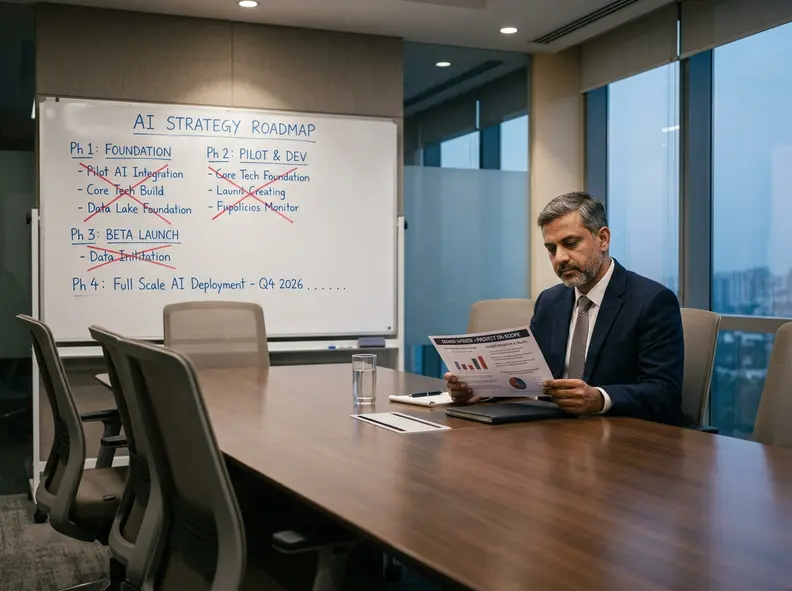
Your AI investment deserves better than pilot purgatory
If your last twelve AI pilots delivered limited business value, if the workforce conversation keeps getting deferred, and if the next board update is approaching faster than your AI strategy is maturing, the issue is not the technology. It is the leadership and adoption muscle around it. 25+ years. 20,000+ professionals trained. 85+ organisations across India.
FAQS
Frequently asked questions
What is AI training for business leaders?
AI training for business leaders is a structured program that helps senior leadership teams make better decisions about how AI is adopted across their organisation. The focus is on the leadership decisions that determine whether AI investment produces business value: strategy, governance, workforce planning, change management, and capability design. It is not technical AI training. It is leadership and adoption training built around the decisions only senior leaders can make.
What makes Excellential's AI training different from other providers in India?
Three things. First, we are not an AI implementation firm or technology vendor. We do not sell AI tools, implement AI systems, or compete with the partners doing that work. Our role is leadership capability and adoption guidance. Second, every program starts from your live AI initiatives, your roadmap, your pilots, your governance gaps, not from prepared case studies. Third, every framework accounts for Indian operating realities: DPDP Act, data localisation, multilingual customer interfaces, hierarchy that suppresses dissent, and the cultural patterns of how Indian employees absorb new tools.
How is this different from a technical AI course or generative AI bootcamp?
Technical courses teach prompt engineering, model architectures, or AI development skills. This program is for senior leaders making decisions about AI strategy, governance, workforce, and adoption. Different audience, different content. We do not teach prompt engineering or AI tool usage. Those are different programs for different audiences.
How is this different from an executive education programme at HBS, Wharton, or MIT?
Global business school AI programmes are excellent for individual senior leaders looking for broad exposure to global AI thinking. This programme is for senior leadership teams looking to apply an AI strategy inside one specific Indian organization. Different goal, different format. Many of our clients send individual leaders to global programmes and bring us in to translate that exposure into action inside their organisation.
Is this a generative AI training programme?
No. This programme covers AI adoption broadly, including generative AI, predictive AI, and traditional machine learning. The leadership decisions, strategy, governance, workforce, and change management are common across AI types. We have a separate focused programme for generative AI applications in business, available on request.
Will this work for our specific industry?
We have worked with senior teams across IT services, BFSI, manufacturing, pharma, retail, FMCG, logistics, and quick commerce. The leadership frameworks are common. The application is industry-specific, and we customize the scenarios, regulatory considerations, and use cases accordingly.
Is this relevant for startups or only for large enterprises?
Both. For startups, the focus is on AI investment prioritisation under capital constraints, building capability before scale, and avoiding the wrong AI decision in the 12 months before the next funding round. For larger enterprises, the focus is on cross-functional alignment, governance, and capability at scale.
What does the programme cover across governance, workforce, and scaling?
Governance sits in Module 3 (approval frameworks, data and IP policy, vendor evaluation, and the DPDP Act and data-localization considerations specific to India). Workforce planning sits in Module 4 (which roles change, which are augmented, the 18-month build-hire-partner plan, and how to communicate impact without triggering panic). Pilot-to-production sits in Module 5 (choosing initiatives that scale rather than demo well, and the operating cadence that moves several use cases past prototype).
What AI adoption frameworks do you use?
We draw on established change adoption thinking, including principles from the ADKAR model, Kotter’s 8-Step Model, and organizational design research, adapted for the AI context. We apply them as practical lenses within simulations and action planning, not as standalone theory or certification curriculum.
How do you measure the impact of this training?
We align measurement to the Kirkpatrick Model. Level 1 is participant reaction during the workshop. Level 2 is whether participants demonstrate the skills in simulations. Level 3 is behaviour change at 90 days post-program: are senior leaders making AI investment decisions differently, are governance gaps being closed, are workforce conversations happening? Level 4 is business outcomes at 6 months: the proportion of AI initiatives moving past pilot, measured against a baseline you and we agree upfront.
Can this be customised for our specific AI maturity stage?
Yes. We customize scenarios, simulations, and exercises to your industry, your AI maturity stage (just starting, mid-pilot, scaling, or mature), and your specific adoption challenges. We do not run generic workshops.
Do you support us after the workshop?
Yes, as reinforcement of the training. We follow up with each leader at 30 and 90 days, tracking which governance gaps are closed, which workforce conversations happened, and where adoption is drifting. Alongside the workshop, we also help shape governance frameworks, prioritisation matrices, and adoption-tracking approaches. What we never do is implement AI systems or write your AI strategy for you that works with your implementation partners and in-house teams. Our role is to help your senior leaders make the decisions that determine whether their work pays off.
Do you deliver AI training across Indian cities?
Yes. We deliver across India, including Bengaluru, Mumbai, Delhi NCR, Hyderabad, Chennai, Pune, Gurugram, Noida, Kolkata, and Coimbatore. Virtual and hybrid formats are available for distributed leadership teams. Programs can be delivered in English, Hindi, and regional languages.
What is the ideal group size?
We recommend 10 to 18 senior leaders for the intensive format. This size allows for meaningful peer discussion, group simulations, and individual attention. We have run effective sessions for groups as small as 6 and as large as 25.
How long is the programme?
The senior team intensive runs 2 full days in-person. The virtual programme covers 4 half-day sessions over 3 weeks. The blended journey combines a 1-day workshop with 4 virtual follow-ups and a 90-day check-in. Custom formats are available based on the complexity of your AI initiatives.