
CHANGE MANAGEMENT TRAINING
Organisational change management training made simple
Your change initiative has a plan. The next challenge is securing adoption across the organisation.
Organisational change management training prepares leaders and managers to communicate the change, address resistance and support adoption.
- Practical and business-focused. Built around your actual change initiative, ERP rollout, post-merger integration, restructuring, or cultural shift, not abstract models.
- Designed for Indian organisations. Where hierarchy can restrict open feedback and resistance may remain unspoken. The programme prepares middle managers to address concerns and explain the change clearly.
- Training plus change management consulting. Excellential does not stop at the workshop. Excellential helps build communication plans, stakeholder maps, adoption tracking frameworks, and leadership alignment strategies.
- 25+ years of L&D and transformation experience. 20,000+ professionals trained across 85+ organisations.
- Flexible delivery. Across Bengaluru, Mumbai, Delhi, Hyderabad, Chennai, Pune, Gurgaon, Noida, Kolkata, and Coimbatore. In-person, virtual, or hybrid. English, Hindi, and regional languages.
Tell us about your team, and Excellential will customise a programme.

































KEY TAKEAWAYS
- Excellential’s organisational change management training supports leaders, managers, HR teams, project managers, and change champions responsible for implementation.
- The workshop can be built around an ERP rollout, digital transformation, restructuring, merger integration, or culture-related initiative.
- Delivery options include a one- or two-day intensive, two to four virtual half-day sessions, a four- to six-week blended journey, and customised formats.
- Participants use the current initiative to develop stakeholder, communication, and reinforcement actions.
- Excellential can separately scope consulting support for leadership alignment, communication planning, and adoption tracking.
- The recommended batch size is 15 to 25 participants, with adjusted facilitation available for other group sizes.
Prepare managers to lead a current change initiative
Share the initiative, affected employee groups, and adoption concerns. Excellential will recommend the right training and implementation support.
WHO IS IT FOR
Who should attend this organisational change management training?
The programme supports professionals responsible for implementing change and building employee adoption.
Senior leaders
Driving transformation initiatives and setting direction for the organisation.
Mid-level managers
Responsible for translating strategy into team-level execution.
HR and L&D leaders
Supporting change programmes and building organisational capability.
Project managers
Handling large-scale rollouts (ERP, digital transformation, process changes).
Startup founders
Scaling teams, processes, and culture through rapid growth.
Change champions and change agents
Responsible for driving adoption across departments.
THE PROBLEM
Why change initiatives fail (and why training alone will not fix it)
Change happens in processes and systems. Adoption happens in people. Organisations often invest heavily in processes and systems while giving less attention to employee adoption.
Every business transformation, digital, structural, or cultural, runs on two parallel tracks. The strategy track gets attention, budget, and executive sponsorship. The adoption track gets a project manager and hope.
After working with 85+ organisations across IT, BFSI, manufacturing, pharma, and startups, the same five patterns show up with striking consistency.
1. The "why" is missing
Compliance, not commitment.
Employees need to understand how the change affects their work, responsibilities and future expectations. Without a personal “why,” people comply at best, but they never commit.
2. Managers become bottlenecks
The middle layer, nobody prepared.
Nobody consulted the middle managers during planning. They do not fully understand the rationale. They cannot answer their team’s questions. So they default to “just do what they said.”
3. Communication is one-way and one-time
Announce once and assume alignment.
A town hall announcement. A company-wide email. Then silence. Change requires sustained, two-way communication. Most organisations announce once and assume alignment.
4. Resistance goes underground
In Indian workplaces, people push back by not adopting.
Employees do not push back in meetings. Instead, they push back by not adopting. They attend the training, nod along, and go back to the old way. The post-meeting corridor conversation is where resistance actually lives.
5. No reinforcement after launch
Go-live is not the finish line.
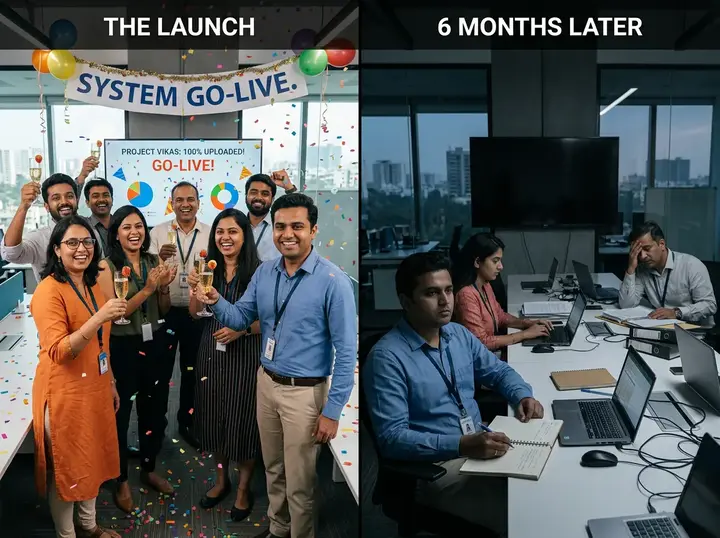
The go-live date is celebrated. Then the project team moves on. But adoption is a 6-to-12-month process, not a launch event. Without sustained reinforcement, old habits return within weeks.
The real cost of a stalled initiative
Every failed initiative creates a credibility deficit. The next time leadership announces a change, employees think, “We have seen this before. It will pass.” Once that cynicism sets in, every future initiative starts at a disadvantage.
Resistance to change costs Indian organisations more than failed rollouts; it also erodes the ability to attempt the next one. Excellential has looked at why this failure rate holds steady across industries in Organizational Change Management: Why 70% of Transformations Fail.
A Harvard Business Review analysis found that roughly three in four change efforts either fall short of their goals or get abandoned outright, not because the strategies were wrong, but because the people side was neglected.
The real cost shows up in sunk ERP investments sitting underused, post-merger integrations that stall at the 12-month mark, and transformation programmes that leaders quietly stop talking about because adoption never happened.
Your change initiative deserves more than a 30% adoption rate. Enquire Now→
OUR APPROACH
How Excellential delivers organisational change management training
If people do not accept the change, it fails. That principle shapes everything about how Excellential designs and delivers this organisational change management training.
Pre-programme discovery
Before the workshop, the Excellential team spends 2-3 hours with your leadership team understanding the specific change initiative that is being rolled out, what has gone well so far, where resistance is surfacing, and who the key stakeholders are. Excellential also reviews any change communication already sent out. Participants complete a short self-assessment on their comfort with leading change. By the time the workshop starts, Excellential knows what your cohort needs, not what a generic syllabus assumes.
Real business scenarios
ERP rollouts, post-merger integrations, restructuring, cultural shifts, and digital transformation. Participants work on scenarios drawn from their actual organisational context, not textbook case studies.
Simulation-based learning
Participants practice handling resistance, running communication cascades, and managing middle-manager conversations before they do it for real. The workshop is a safe place to get it wrong.
Frameworks as practical tools, not curriculum
Excellential’s approach draws on widely used change frameworks, including principles from the ADKAR model, Kotter’s 8-Step Model, and the Kübler-Ross change curve. Excellential applies them as lenses within simulations and exercises, adapted for how Indian organisations actually operate. Excellential does not deliver them as certification programmes.
Emotional intelligence woven throughout.
Every module integrates self-awareness, empathy, and emotional regulation. You cannot drive adoption through logic alone. The emotional side of change is where most initiatives stall.
Action planning
Each participant develops a stakeholder map, 30-day communication plan, resistance-response script, and reinforcement checklist for the current initiative.
ERP rollouts, restructuring, process changes, cultural shifts
Participants practise handling resistance and communication
Understanding multiple perspectives
Why change fails, and how to fix it
Participants create a clear change implementation approach
THE PROGRAMME
What this organisational change management training covers
Seven modules address the capabilities needed to lead a current change initiative. Participants practise through scenarios drawn from the organisation’s context.
Module 1
Understanding change & human behaviour
- Why do people resist change
- Emotional and psychological responses to change
- Common mistakes leaders make during transformation
Module 2
Leading change effectively
- Role of leaders and managers in change initiatives
- Driving clarity, alignment, and direction
- Building trust during uncertainty
Module 3
Communication during change
- Structuring clear and consistent communication
- Addressing concerns and resistance
- Avoiding mixed messaging across teams
Module 4
Stakeholder management
- Identifying key stakeholders
- Mapping influence and impact
- Managing expectations proactively
Module 5
Overcoming resistance to change
- Recognising visible and hidden resistance
- Handling pushback constructively
- Converting resistance into participation
Module 6
Emotional intelligence in change management
- Managing emotions during transitions
- Responding to uncertainty with empathy
- Supporting teams through discomfort
Module 7
Sustaining change & driving adoption
- Reinforcing new behaviours
- Tracking adoption and engagement
- Avoiding relapse into old habits
CASE STUDY
When a leading financial services firm needed to change how senior leaders operated
The mandate was clear: move from individual execution to team empowerment. But senior managers had spent years succeeding as individual performers. Delegation felt like losing control. They understood the change intellectually, but they could not make it work practically.
Excellential designed a four-month engagement combining discovery workshops, EI-focused modules, and 1:1 coaching with 24 senior managers. Excellential focused on the emotional barriers and behavioural habits preventing adoption, not just the delegation mechanics.
Delegation success rates measured through monthly behavioural observation by direct managers and 360-degree feedback from direct reports moved from a 35% baseline at programme start to 92% by month three.
The change stuck because Excellential addressed the human side, not just the process side. That is the difference between announcing change and managing change.
KEY OUTCOMES
What changes after this training
Excellential agrees on relevant adoption indicators before delivery and reviews progress after 30 and 90 days.
For leaders and managers
- Ability to lead change with clarity instead of relying on authority
- Stronger, more consistent communication during transitions
- Practical skills for handling resistance without escalation
- Better team alignment and reduced uncertainty
- Higher credibility when the next change initiative arrives
For organisations
- Faster adoption of change initiatives
- Reduced resistance and disruption during transitions
- Improved employee engagement during transformation
- Better return on investment from change projects
- Stronger organisational agility for future changes
Excellential has seen these outcomes across industries. IT companies in Bengaluru are navigating digital transformation. Manufacturing firms in Pune are restructuring operations. Startup founders in Mumbai are scaling from 50 to 500. Pharma companies are rolling out new compliance processes. When change is managed well, it stops being a disruption and becomes a growth lever.
Testimonials
WHY EXCELLENTIAL
Why organisations choose Excellential for change management training
You have options. Global certification bodies, boutique trainers, and online courses. Here is what makes working with us different.
Excellential’s programme is designed for workplace application
Prosci, ADKAR, and PMI certifications train change management practitioners. Excellential trains the leaders, managers, and teams who need to make a specific change initiative succeed. If you need your people to adopt change, not become certified change consultants, this is the right fit.
Real business focus, not model-heavy theory
Excellential adapts exercises, simulations, and discussions to the organisation’s current initiative. These may include an ERP rollout, restructuring, digital transformation, or merger implementation.
Built for Indian organisations
A hierarchy that limits open communication. Silent resistance instead of vocal pushback. Middle managers caught between leadership mandates and team realities. Every scenario and framework is designed for how Indian companies actually work.
Emotional intelligence is built in
Change is not a rational process. It is an emotional one. Excellential integrates EQ, self-awareness, and empathy into the methodology because you cannot drive adoption through logic alone.
Excellential goes beyond the workshop
Most companies that provide change management training deliver a session and leave. Excellential also helps organisations build change communication plans, stakeholder maps, adoption tracking frameworks, and leadership alignment strategies. If you need hands-on support alongside training, Excellential does both.
25+ years of cross-industry experience
Excellential has worked with startups and established organisations across IT, BFSI, manufacturing, pharma, retail, and more. 85+ organisations. 20,000+ professionals trained.
Measurable impact
Excellential aligns the measurement plan with the Kirkpatrick Model and tracks agreed behavioural and business indicators.
DELIVERY
Format and delivery options
Every organisation has different constraints, so Excellential adapts to your reality.
| Format | Duration | Best for |
|---|---|---|
| Intensive workshop | 1-2 full days (in-person) | Deepest skill-building and practice |
| Virtual programme | 2-4 half-day sessions | Distributed or hybrid teams |
| Blended journey | 1-day workshop + virtual follow-ups over 4-6 weeks | Sustained behaviour change |
| Custom format | Flexible | Organisation-specific change initiatives |
Excellential offers all formats in English and Hindi as standard, with regional language delivery on request. Excellential can deliver the programme on-site, at an off-site venue or virtually. The recommended batch size is 15 to 25 participants, with custom formats available for other group sizes.
THE PATTERN
Why change fails without the right approach
A new initiative gets launched. Teams attend a kickoff meeting. Processes get documented. The go-live date passes.
And nothing really changes.
People go back to old habits. Managers avoid the tough conversations. Leaders assume alignment because nobody is complaining.
This is not a strategy failure. It is a change management failure.
Without structured organisational change management training, communication breaks down, resistance increases, adoption drops, and the organisation loses time, money, and momentum.
Excellential has written about this pattern in detail: why most training fails to change behaviour at work. The same dynamics apply to change initiatives. Without reinforcement, systems pull people back to old habits.
The same adoption problem shows up in culture change work: the strategy is right, but the behaviour underneath it never shifts.
Check out more here Read the blog →
Build adoption into your next change initiative
Every transformation comes at a cost. Make sure it delivers results. Excellential will understand your context, align your leaders, and help your teams adopt change effectively.
FAQS
Frequently asked questions
What is organisational change management training?
Organisational change management training helps leaders, managers, and teams develop the skills to drive successful transitions, whether it is a new system rollout, a restructuring, a cultural shift, or a merger integration. It covers how to communicate change, manage resistance, align stakeholders, and sustain adoption. Good change management training focuses on people and behaviour, not just processes and timelines. It is designed to reduce the gap between a change being announced and a change being adopted.
What makes Excellential's change management training different from other providers in India?
Excellential combines training with practical change-management support. This can include communication plans, stakeholder maps, adoption measures, and reinforcement frameworks. Second, our workshops are built around your specific change initiative, ERP rollout, post-merger integration, restructuring, or cultural shift, not generic change theory. Third, we focus on Indian organizational realities: hierarchy that silences dissent, resistance that goes underground, and middle managers caught between leadership mandates and team pushback. Imported global programs rarely account for these dynamics.
How is this approach different from Prosci or ADKAR certification?
Prosci and ADKAR certifications are individual certification programs designed to train change management practitioners. Our workshop is designed for leadership teams, managers, and project teams who need to make a specific change initiative succeed. We draw on established frameworks, including principles from the ADKAR model and Kotter’s 8-Step Model, but we apply them as practical tools within your context, not as a certification curriculum. If you need your teams to adopt change, not become certified change consultants, our program is the right fit. ADKAR® is a registered trademark of Prosci, Inc.; we are not a Prosci-licensed training partner.
What change management frameworks do you use?
We draw on widely used change frameworks, including principles from the ADKAR Model, Kotter’s 8-Step Model, the Kübler-Ross change curve, and stakeholder analysis methods. However, we do not teach them as a standalone theory. We use them as practical lenses within simulations, exercises, and action planning. The frameworks serve learning. They do not define it.
How do you measure the impact of this training?
We align measurement with the Kirkpatrick Model. Level 1 is the reaction of participants engaged during the workshop. Level 2 is learning if they demonstrate the skills during simulations. Level 3 is behaviour change, and for change management, this is where most programs fall short. We measure at 30 and 90 days post-program: Are managers holding the conversations? Are communication cascades reaching the frontline? Is resistance surfacing early rather than after go-live? Level 4 is business outcome adoption rates against the baseline, time to full competency on new systems, and reduction in change-related attrition. Success metrics are defined upfront with your leadership team, not decided after the fact.
Does this cover digital transformation change management?
Yes. Digital transformation is one of the most common change initiatives we work on ERP migrations, cloud adoption, HRIS rollouts, CRM implementations, and AI tool rollouts. The principle is the same: the technology works; the people adopting it are where most programs stall. Our workshops address the adoption side specifically.
Do you offer change management training for post-merger integration?
Yes. Post-merger integration is one of the hardest change scenarios because you are managing two sets of cultures, two sets of processes, and two sets of people’s assumptions at the same time. We design M&A-specific workshops covering cultural integration, leadership alignment across the two organizations, communication strategies for uncertain employees, and resistance management during integration.
Who should attend this workshop?
Senior leaders driving transformation; mid-level managers responsible for team execution; HR and L&D leaders supporting change programs; project managers handling large-scale rollouts; startup founders scaling operations; and change champions or change agents responsible for driving adoption. The program is designed for people who need to make change work, not just plan it.
Do you deliver change management workshops in Bengaluru and other Indian cities?
Yes. We deliver change management training across India, including Bengaluru, Mumbai, Delhi, Hyderabad, Chennai, Pune, Gurgaon, Noida, Kolkata, and Coimbatore. Virtual and hybrid formats are available for distributed teams. All programs can be delivered in English, Hindi, and regional languages.
Can this training be customized for our specific change initiative?
Absolutely. We customize the scenarios, simulations, and exercises to reflect your industry, company culture, and the specific change you are managing. If you are going through an ERP rollout, a post-merger integration, a digital transformation, or a cultural shift, the program is built around that context. We do not run generic workshops.
What is the ideal group size?
We recommend 15 to 25 participants for the best learning experience. This size allows for meaningful simulations, small group discussions, and individual attention. We have run effective sessions for groups as small as 8 and as large as 40.
How long is the programme?
It depends on the format. The intensive in-person workshop runs for 1 to 2 full days. The virtual programme covers 2 to 4 half-day sessions. The blended learning journey combines a 1-day workshop with virtual follow-ups over 4 to 6 weeks. Custom formats are available based on your business needs and the complexity of the change initiative.
Do you offer change management consulting beyond training?
Yes. We offer hands-on consulting alongside training, including change communication plans, stakeholder mapping, leadership alignment, adoption tracking, and reinforcement frameworks. We have done this for organizations handling rapid scaling, digital transformation, and operational restructuring. If you need strategic support beyond the workshop, we do both.
Is this relevant for IT change management (ITIL/ServiceNow)?
Our focus is on the people side of change, which applies to any type of transformation, including IT system rollouts. If your concern is getting employees to adopt a new platform, process, or way of working, this training addresses that directly. For ITIL-specific process training, we would recommend a dedicated ITSM provider.