
CUSTOMER SERVICE TRAINING
Customer service training for employees in India
Excellential customises customer service training to help teams in India improve the customer experience. The programmes are designed for support, contact centre, retail and customer success teams.
Participants practise listening, explaining solutions clearly, resolving complaints and taking ownership of customer issues. They work through situations from phone calls, emails, live chats and face-to-face conversations.
Training can include classroom workshops, live virtual sessions and follow-up practice. Excellential scopes support for customer experience operations separately.
- Practical from day one. Tools your team can apply to their very next customer interaction.
- Training + CX operations. Excellential can also support SOPs, scripts, escalation frameworks, quality scorecards, and performance dashboards.
- 25+ years of HR and L&D expertise. 20,000+ professionals trained across 85+ organisations.
- Flexible delivery. Available across Bengaluru, Ahmedabad, Mumbai, Delhi, Hyderabad, Chennai, Pune, Gurugram, Noida, Kolkata, and Coimbatore. In-person, virtual, or hybrid. English, Hindi, and regional languages.
- Built for Indian customers and Indian workplaces. Real scenarios around regional expectations, communication styles, and cultural nuances.
Tell us about your team, and Excellential will design a customer service training programme around your needs.












































KEY TAKEAWAYS
- Excellential’s customer service training can be adapted for support teams, contact centres, retail staff, customer success teams, relationship managers, and helpdesk professionals.
- Delivery options include a one- or two-day workshop, two to four virtual half-day sessions, a four- to six-week blended programme, and customised formats.
- The recommended batch size is 15 to 25 participants, with adjusted facilitation available for other group sizes.
- Excellential can review selected customer interactions and participant inputs before finalising the practice scenarios.
- Organisations can add CX operations support covering SOPs, scripts, escalation frameworks, quality scorecards, and performance dashboards.
- Success measures are agreed before delivery and can include customer-interaction behaviour, CSAT, NPS, first-contact resolution and escalations.
Improve the customer interactions that matter most
Share the team size, customer channels, and recurring service situations. Excellential will recommend the right diagnostic and delivery format.
THE PROBLEM
Why customer service requires more than product and process knowledge
Customer-facing teams are often trained on two things: the product and the process. Know the features. Follow the script. Log the ticket.
Product and process knowledge alone may not prepare employees for difficult or unexpected customer situations.
A customer calling about a delayed delivery does not want a tracking number recited back to them. They want to feel heard. A user emailing about a billing error does not want to be transferred three times. They want someone to own the problem. A walk-in customer with a complaint does not want a policy quoted to them. They want the person in front of them to care.
The gap between what companies train for and what customers need is where service falls apart.
When training stops at product refreshers and process updates, CSAT scores may stay flat.
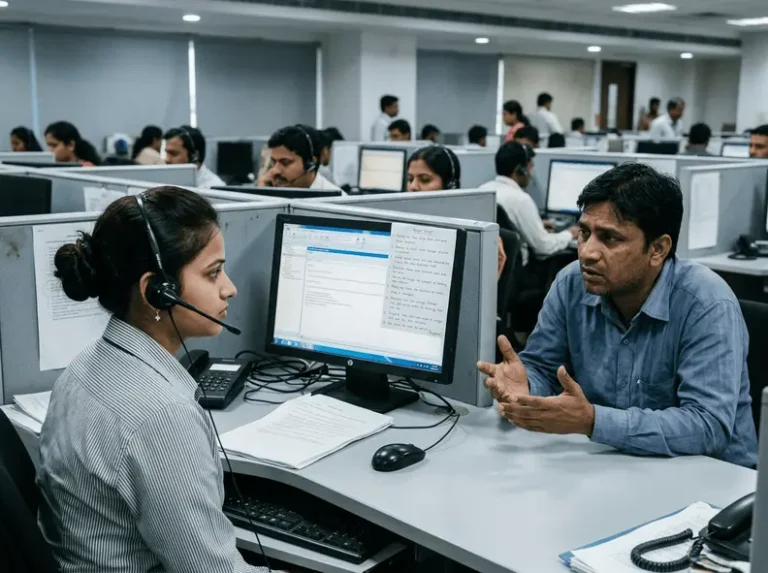
A customer who leaves because of poor service does not fill out a feedback form. They just leave. And they tell others. A customer who leaves after poor service rarely fills in a feedback form. Replacing that customer costs time and money, and service quality is one of the factors that decide whether customers stay.
Excellential has written about exactly this kind of turnaround in How We Doubled CSAT for an E-Commerce Contact Centre.
The patterns that Excellential sees across every industry
After working with 85+ organisations across e-commerce, IT services, BFSI, healthcare, retail, and startups, the same five problems show up with striking consistency:
The empathy vacuum
Scripts pretending to be empathy.
Companies tell customer-facing teams to ‘be empathetic,’ but never show them what that looks like in practice. Empathy is treated as a personality trait rather than a trainable skill. The result: robotic responses that technically address the issue but leave the customer feeling like they spoke to a wall. “I understand your concern,” repeated four times in a conversation, is not empathy. It is a script pretending to be empathy.
The escalation reflex
Employees may freeze, escalate too quickly, or respond defensively when a customer becomes frustrated.
When a customer raises their voice or expresses frustration, most agents default to one of two responses: they either go silent and escalate, or they match the customer’s energy and make things worse. Neither works. De-escalation is a specific, teachable skill that involves tone control, acknowledgment sequencing, and solution framing.
The channel inconsistency problem
Great on the phone. Terrible over email.
A company might deliver excellent service over the phone but terrible service over email. Or their chat support is fast but impersonal. Customers do not think in channels. They think in experiences. When the quality of interaction changes depending on whether someone calls, emails, or walks in, trust erodes. Most teams are never trained to adapt their communication for different channels while maintaining a consistent standard.
The ownership gap
“Let me transfer you to the concerned department.”
When no one on the team feels personally responsible for resolving a customer’s issue, when the instinct is to pass it along rather than solve it, customers notice. They do not come back.
Ownership can be affected by skills, decision rights, workload and escalation rules. Excellential helps the organisation identify which barriers training can address and where process support is needed.
Teams may pass issues on when they lack the skills or the authority to resolve them.
Excellential worked through a similar service turnaround in an AI and empathy-driven contact centre transformation, where CSAT more than doubled.
The post-resolution blind spot
Ticket closed. Customer lost.
Most teams focus entirely on closing the ticket. Issue raised, issue addressed, ticket closed. But the interaction after resolution is where loyalty is built. The follow-up. The check-in. The proactive communication. A customer whose problem was solved competently will stay. A customer whose problem was solved and who then received a thoughtful follow-up will refer others. Many teams are never trained to think beyond resolution.
THE PROGRAMME
What this customer service training programme covers
This customer service training and customer experience training programme is designed for teams that handle customer interactions, including daily support agents, call centre staff, retail teams, and customer success professionals.
Six modules. Each targeting a specific area where customer-facing teams consistently struggle. No lectures. No 80-slide decks. Just realistic scenarios that mirror actual customer interactions.
Module 1
Customer mindset and service orientation
Understanding customer expectations in Indian markets. Moving from “task completion” to “customer experience.” Taking ownership of interactions instead of passing the issue. Recognising the difference between resolving a ticket and retaining a customer.
Module 2
Communication skills for customer handling
Listening actively, not just waiting for the customer to finish. Asking the right questions to understand the real issue. Structuring clear, confident, and warm responses. Adapting communication for phone, email, chat, and in-person interactions.
Module 3
Handling difficult customers and de-escalation
Managing angry, frustrated, or unreasonable customers.
De-escalation techniques: tone control, acknowledgment sequencing, solution framing. Staying calm and professional under pressure. Drawing the line between empathy and enabling abusive behaviour.
Excellential explores this specific skill set further in Escalation Handling Training That Actually Works.
Module 4
Emotional intelligence in customer service
Understanding customer emotions and what drives them. Responding with empathy that feels genuine, not scripted. Managing your own emotional reactions during tough interactions. Building the self-awareness that prevents burnout in high-volume roles.
Teams that need to go deeper on this specifically can pair this module with Excellential’s dedicated Emotional Intelligence Training
Module 5
Problem-solving, ownership, and service recovery
Moving from “passing the issue” to solving it. Thinking beyond scripts. Handling situations the playbook does not cover. Turning complaints into recovery moments that build loyalty. Proactive follow-up: what to do after the issue is resolved.
Module 6
Professional communication across channels
Email etiquette for customer communication: clarity, tone, and structure. Chat and messaging best practices. Speed without sacrificing quality. Voice tone, pacing, and clarity in phone interactions. Maintaining consistent service quality regardless of channel.
Choose the practice around your customer channels
Call and contact centre teams can practise listening, complaint handling, and escalation decisions. Retail and branch teams can work on face-to-face explanations and service recovery. Customer success and helpdesk teams can practise expectation-setting and written follow-up. Excellential selects scenarios after reviewing the roles, channels and recurring problems.
Illustrative practice: a delayed refund has reached its third contact. The participant acknowledges the history, checks the facts, explains the next step, and agrees who will follow up. Feedback examines clarity, ownership, and the use of escalation rules
THE EXCELLENTIAL APPROACH
How Excellential delivers customer service training
If your team cannot apply it to the next customer, it does not belong in the workshop. Every element of Excellential’s approach is designed to produce visible shifts in how your team handles customers.
Pre-programme diagnostic
Before the training, Excellential runs a short diagnostic, a combination of mystery calls or mystery shopping (where relevant), a sample of 20-30 real customer interactions reviewed by Excellential’s facilitators, and a 15-minute per-participant self-assessment on their confidence across different customer scenarios. Your team arrives with baseline data. Excellential arrives knowing exactly where the gaps are, not what a generic syllabus assumes.
Role plays with real customer scenarios
Angry customers, escalations, delays, refund disputes, and unclear complaints. Participants practise the situations they face.
Live simulations
Participants handle real-time customer situations, receive immediate feedback, and iterate on the spot.
Peer learning
Teams learn from each other’s experiences. What worked, what did not, and why.
Feedback and coaching
Facilitators provide immediate, specific feedback during the session. Not vague encouragement. Concrete improvement.
Action planning
Every participant leaves with clear steps for improving their customer interactions in the first 30 days.
Explore a visual case on putting customers first when customer promises compete with capacity or deadlines. Teams discuss the trade-offs and agree what responsible service should look like in practice.
Beyond training: CX operations support
For organisations that need more than a workshop, Excellential also helps build the supporting systems: SOPs, scripts, escalation frameworks, quality scorecards, and real-time dashboards. Operational support can reinforce the service behaviours practised during training.
LEARNING OUTCOMES
What participants will be able to do after the programme
- De-escalate angry or frustrated customers using tone control, acknowledgment sequencing, and solution framing without going silent, escalating, or matching the customer's energy.
- Demonstrate empathy that customers feel, not scripted phrases that sound hollow.
- Take ownership of customer issues instead of transferring them, and know when transferring is genuinely the right call.
- Adapt their communication style across phone, email, chat, and in-person channels while maintaining consistent service quality.
- Handle complaints that the script does not cover, using structured problem-solving rather than improvisation.
- Turn service recovery moments into loyalty-building interactions through deliberate follow-up.
- Draw the line between customer empathy and accepting abusive behaviour, with specific language for setting that line.
- Recognise their own emotional reactions during tough interactions and manage them before they affect the customer.
- Write customer emails that are clear, warm, and professional without sounding robotic or over-apologetic.
- Apply a 30-day action plan tied to specific improvements in their daily customer interactions.
RESULTS
What changes after this training
For customer-facing teams
- Greater confidence in handling all types of customers.
- Improved communication that is clear, warm, and professional.
- Ability to de-escalate difficult situations without freezing or escalating.
- Stronger empathy and listening skills that customers feel.
- Higher ownership. Solving problems instead of transferring them.
For the organisations
- Improved customer satisfaction (CSAT) and Net Promoter Score (NPS).
- Higher customer retention and loyalty.
- Reduced escalations, complaints, and repeat contacts.
- More consistent customer experience across channels and team members.
- Stronger brand perception driven by service quality.
CASE STUDIES
The results that Excellential has delivered
Declining NPS to growth lever
A leading online furniture marketplace was seeing its NPS steadily drop. Excellential mapped their entire customer journey, re-engineered processes, trained 250+ employees, built new SOPs, and implemented real-time NPS dashboards. Result: NPS and customer satisfaction improved significantly within months, costs dropped, and the brand expanded into new markets.
112% CSAT increase for e-commerce contact centre
A fast-growing online retailer handling 20,000+ monthly interactions was struggling with high agent attrition, inconsistent service, and rising costs. Excellential combined AI-powered Tier-1 automation with empathy and de-escalation training for agents, standardised SOPs, and built a real-time feedback loop. Result: CSAT scores more than doubled, cost per interaction dropped 53%, and agent attrition fell 35%.
Transforming Customer Satisfaction for a Quick Commerce Giant
When 68% CSAT Becomes a Brand Crisis
Customer satisfaction in quick commerce is harder to maintain than in any other retail format. The promise is speed and accuracy, and every failure is visible immediately.
DELIVERY
Format and delivery options
Every organisation has different constraints. Excellential adapts to your reality, not the other way around.
| Format | Duration | Best for |
|---|---|---|
| Intensive workshop | 1–2 full days (in-person) | Deepest skill-building and practice |
| Virtual programme | 2–4 half-day sessions | Distributed or remote teams |
| Blended programme | Workshop + follow-ups over 4–6 weeks | Sustained behaviour change |
| Custom format | Flexible | Organisation-specific needs |
All formats are available in English and Hindi as standard, with regional language delivery on request. Excellential delivers on-site at your office, at an off-site venue, or through its virtual platform. Recommended batch size: 15–25 participants, though Excellential has run effective sessions for groups of 8 to 40.
Excellential delivers customer service training, call centre training, and contact centre training across India, including Bengaluru, Chennai, Hyderabad, Mumbai, Pune, Gurugram, Delhi, Indore, and Coimbatore.
Testimonials
WHO IS IT FOR
Who should attend this customer service training
Designed for any team or professional whose work directly shapes the customer’s experience.
Customer support and service teams
Handling queries, complaints, and issue resolution across phone, email, chat, and in-person channels.
Call centre and contact centre teams
Managing high-volume phone, chat, and email interactions where consistency and speed both matter.
BPO and outsourced service teams
Handling customer interactions at volume, where consistency and quality are non-negotiable.
Sales and relationship managers
Whose customer conversations directly impact retention and revenue.
Frontline staff and retail teams
Interacting with customers face-to-face in stores, branches, and service centres.
Customer success teams
Responsible for onboarding, adoption, and long-term account health.
IT support and helpdesk professionals
Those who need to translate technical information into clear, patient customer communication.
Startup teams and small businesses
Where everyone handles customers, and no one has received formal service training. Excellential offers a condensed format built for how small teams work.
HR professionals
Managing internal service delivery, because employees are customers too.
Operations and CX leaders
Looking to combine team training with customer experience process improvement.
Not sure which format fits your team?
Excellential will help you assess the need and recommend the right approach. No hard sell.
WHY EXCELLENTIAL
Why organisations choose Excellential for customer service training
You have options. Large global training firms, boutique consultants, and online platforms. Here is what makes Excellential different.
Training + CX operations, not training alone
Most training companies deliver a workshop and leave. Excellential also builds SOPs, scripts, escalation frameworks, quality monitoring, and NPS/CSAT dashboards. Done this for 26+ startups and scaling businesses across India.
Real customer scenarios, not textbook exercises
Every role play, case study, and simulation is built from actual customer situations. Drawn from your industry, your channels, and the interactions your team handles daily.
Behaviour + skill integration
Excellential combines communication skills with emotional intelligence, cultural understanding, and structured problem-solving. This includes regional expectation gaps and Indian communication styles.
Specialist facilitators, not generalists
Each module is led by someone with deep expertise in that specific area: customer experience, behavioural training, communication, or operations.
Measurable impact
Aligned to the Kirkpatrick Model. Excellential tracks behaviour change and business outcomes (CSAT improvement, escalation reduction, retention impact), not just participant happiness on the day.
Startup-friendly, enterprise-ready
Whether you have 30 employees or 30,000, the experience scales without losing quality or relevance.
Build teams that customers remember.
Whether you need customer service skills training for frontline teams, call centre training for agents, or contact centre training for large operations, Excellential can help. Excellential also delivers customer experience workshops for managers, communication skills training, and EQ-based service training.
FAQS
Frequently asked questions
What is customer service training?
Customer service training is a structured programme that builds the communication, empathy and problem-solving skills customer-facing teams need. Also called customer service excellence training or service excellence training and coaching, it goes beyond product knowledge to the behavioural side of calls, emails, chats and in-person interactions, so customers receive consistent, confident service.
What makes Excellential’s customer service excellence training different from other providers in India?
Excellential pairs training with SOPs, scripts, escalation frameworks, quality scorecards and CSAT or NPS dashboards, where the client wants that support. Every role-play comes from real customer situations in your industry, not generic decks. Baseline CSAT is recorded before the training and re-measured at 90 days against an agreed target, so behaviour change is tracked, not assumed.
What kind of results can we expect? How do you measure them?
Excellential agrees a baseline before delivery and reviews comparable interaction samples for listening, clarity, ownership, and escalation decisions. Where suitable data exists, customer satisfaction, repeat contacts, and resolution measures are reviewed alongside any process changes. Training alone cannot guarantee those business outcomes, so measures are agreed for each engagement.
Who needs this training?
Any team that interacts with customers can benefit, including support teams, call centre agents, retail staff, customer success managers, sales teams and helpdesk professionals. Customer service training is especially valuable if complaints are rising, service quality is inconsistent, or CSAT and NPS scores are declining. Excellential tailors the depth to each role.
How is this different from generic soft skills training for customer service?
Generic soft skills training covers broad workplace communication. Excellential builds every scenario, role-play and framework around real customer situations from your business. Beyond training, Excellential supports CX operations, including SOPs, scripts, escalation frameworks and measurement dashboards, so the skills taught in the room are backed by the systems your team uses daily.
Do you offer call centre training and CX consulting along with this programme?
Yes. Excellential helps organisations redesign customer experience operations alongside training, including call centre scripts, SOPs, escalation frameworks, quality monitoring and NPS or CSAT dashboards. This work has supported 26+ startups and growing businesses across India. Some providers stop at the workshop, whereas Excellential combines training with the operational structure.
Do you offer BPO training for customer service teams?
Yes. Excellential trains BPO and outsourced customer service teams across voice and non-voice processes, covering calls, chats, emails and tickets. The BPO training combines communication skills with the process discipline that high-volume operations need, and role-plays reflect your clients, queues and escalation paths. It suits call centres in consumer goods and other sectors.
Is this available in Bangalore, Mumbai, and other cities?
Yes. Excellential delivers customer service training across India, including Bengaluru, Ahmedabad, Kolkata, Mumbai, Coimbatore, Chennai, Hyderabad, Gurugram, Delhi, Pune and Indore. Virtual and hybrid formats are available for teams anywhere, so distributed customer service teams can train together without travelling to one location. Share your locations and Excellential will suggest a format.
Can this training be customised for our industry?
Yes. Excellential customises role-plays, case studies and scenarios to reflect your industry, customer base and service channels, whether you work in e-commerce, BFSI, healthcare, IT services, retail, hospitality, diversified consumer services or consumer goods. Scenarios come from your real customer interactions, so the learning applies directly to the next customer conversation.
How long does the programme take?
Duration depends on the format. The in-person customer service workshop runs one to two full days. The virtual programme spans two to four half-day sessions. The blended format combines a workshop with follow-up sessions over four to six weeks. Excellential also builds custom formats around your team size, shift patterns and service channels.
What is the ideal group size?
Excellential recommends 15 to 25 participants per batch, which allows role-plays, live feedback and individual attention. Effective sessions have run with groups as small as 8 and as large as 40. For larger teams, Excellential suggests running several batches, so practice time per person stays meaningful.
Do you offer training in Hindi or regional languages?
Yes. English and Hindi are standard delivery languages, and regional language delivery is available on request. Excellential can run role-plays in the language your customers use, so frontline teams practise real conversations. Share the languages your team works in, and Excellential will confirm the facilitator and material options.
Is this suitable for small businesses?
Yes. Excellential offers a condensed format for small businesses and teams where everyone handles customers. It covers the same core skills, delivered in shorter sessions that do not pull the entire team away from the business for days. Growing companies can begin with one batch and add follow-up sessions later.
Do you offer de-escalation training as a standalone programme?
Yes. De-escalation training can run as a standalone module for teams that handle angry customers, abuse or high-conflict interactions. It covers tone control, acknowledgement sequencing, solution framing and the line between empathy and accepting abusive behaviour. It suits BPO teams, call centre agents and customer support staff handling high-volume interactions.
Can one programme cover phone, email and chat support?
Yes. Excellential adapts the practice to the channels your team uses. The design states which channels receive practice and feedback, so a short workshop is not stretched across every channel. Phone, email, chat and face-to-face scenarios can each be built from your real customer situations.
What affects the cost of customer service training?
Cost depends on team size, delivery format, diagnostic work, custom scenarios, follow-up sessions and any customer experience operations support. Share your team size, channels, goals and the number of batches, and Excellential will propose a scope and quote that fits your needs.