CONFLICT MANAGEMENT TRAINING
Expert conflict management training for managers in India
Every week your team avoids a conflict is a week of productivity you’ve already lost.
Conflict management training teaches managers and teams to recognise, address, and resolve workplace disagreements before they escalate into lost productivity, attrition, or HR cases.
Your teams are spending real hours every week navigating unresolved tension instead of doing the work that matters. Excellential’s conflict management training gives managers, leaders, and teams the skills to address disagreements directly, resolve them fairly, and come out stronger.
- Practical and scenario-driven. Role plays, mediations, and escalation simulations your people will recognise. Not theory slides.
- Built for Indian workplaces. Every exercise incorporates hierarchy, seniority, face-saving, and indirect communication.
- 25+ years of L&D expertise. 20,000+ professionals trained across 85+ organisations.
- Flexible delivery. In-person, virtual, or hybrid. English, Hindi, and regional languages.
Tell us about your team’s conflict challenges, and Excellential will design a programme around them.























KEY TAKEAWAYS
- Built primarily for people managers and supervisors who handle team conflicts and performance disagreements daily, alongside HR professionals and senior leaders.
- Excellential names five recurring patterns: silent-treatment avoidance, small issues left to become crises, normalised cross-functional friction, escalations turning personal, and managers who see conflict as someone else's job.
- The programme runs eight modules built on the Thomas-Kilmann Conflict Mode Instrument: self-awareness, conflict anatomy, de-escalation, interest-based negotiation, mediation, cross-functional conflict, hierarchy conflict, and recovery.
- Managers gain the confidence to mediate disputes within their own teams, so fewer conflicts escalate to HR or senior leadership.
- Excellential measures results in escalation volume and attrition from high-conflict teams, tracked at 60 days, not in feedback survey scores.
- For teams facing active conflict, Excellential offers mediation and coaching support after the training ends.
Share where friction shows up most, within teams, across departments or with clients, and Excellential will build the modules and role plays around it.
THE PROBLEM
Why workplace conflict costs more than you realise
Two departments that refuse to cooperate. A manager and a team lead who have not spoken directly in three weeks. A client escalation that started as a miscommunication and turned into a threat to the entire account.
Conflict is everywhere. The issue is not that it exists. The issue is that most people have no idea how to handle it when it shows up.
In Indian companies, conflict carries extra weight. The hierarchy, the relationship dynamics, the expectation that you will keep things smooth: all of it makes conflict harder to address and easier to bury. And buried conflict does not go away. It festers.
After delivering workplace conflict management training across IT, BFSI, manufacturing, pharma, and startups, the same patterns surface with striking regularity.
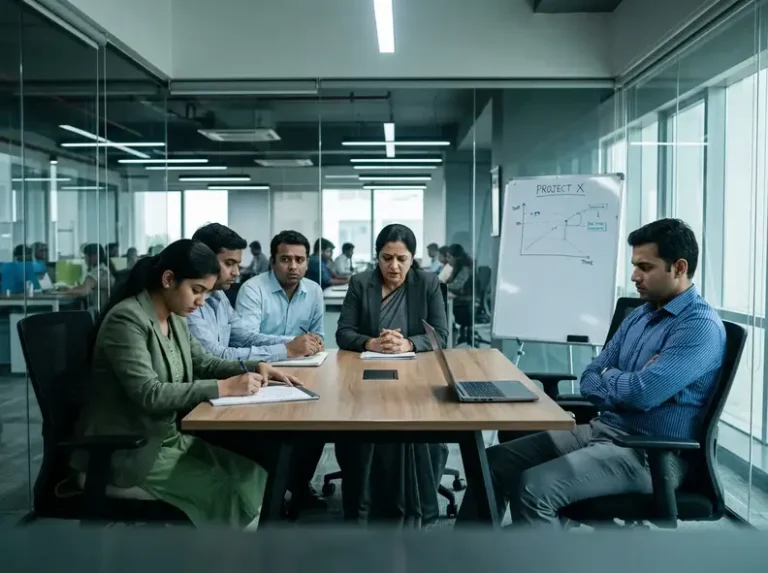
The patterns that Excellential sees across every industry
Five conflict patterns that repeat in almost every engagement, across every industry, every time.
1. The silent treatment passes for professionalism
Avoidance dressed up as maturity.
Two colleagues disagree. Instead of resolving it, they stop talking. Emails replace conversations. CCs multiply. Everyone can feel the tension, but nobody names it. Without conflict management training, most professionals default to avoidance and call it keeping things professional.
Excellential has written more on this exact dynamic in Building Psychological Safety: Why Your Team Won’t Speak Up.
2. Small issues become organisational crises
Five-minute conversations that wait two months.
A missed deadline. An offhand comment. A credit that went to the wrong person. These are quick conversations if handled immediately. Left alone, they become full-blown interpersonal crises that HR has to mediate. Managers who lack conflict resolution skills do not ignore problems because they do not care. They ignore them because they do not know how to intervene.
3. Cross-functional friction gets normalised
Dysfunction dressed up as departmental loyalty.
Sales blames delivery. Delivery blames the product. Product blames engineering. Everyone has a version where they are right. This is not a healthy debate. This is organisational dysfunction that costs you speed, quality, and the people caught in the middle.
Excellential worked through exactly this kind of cross-functional dysfunction in how a tractor manufacturer broke down its silos.
4. Escalations become personal
The issue stops mattering. The ego takes over.
A professional disagreement about a deadline becomes about respect, ego, and hierarchy. In Indian workplaces, where seniority carries enormous social weight, that shift happens fast. Once it does, the original issue stops mattering. The relationship damage takes over.
5. Managers treat conflict as someone else's job
The most expensive pattern of all.
They see the tension. They know two people are not getting along. They hope it resolves itself. It never does. By the time they step in, if they step in at all, the unresolved tension has already damaged team morale, productivity, and sometimes the careers of people who had nothing to do with the original disagreement. This is precisely why conflict management training for managers is not optional. It is a core leadership skill.
A CPP Global study found that employees spend 2.8 hours per week on conflict. That is nearly one full working day per month, per person, lost to friction. Across a 100-person team, that is 100 working days every month. Gone. Add the talent cost: good people leave when nobody addresses the elephant in the room. And the decision cost: when teams avoid conflict, decisions get made by whoever is loudest, not whoever is right. Read more →
WHAT THIS COVERS
What this conflict management training programme covers
Eight modules. Each targeting an area where managers and teams consistently struggle in Indian workplaces. Every module uses the Thomas-Kilmann-aligned Conflict Mode Instrument as a foundation, adapted for Indian workplace dynamics.
Module 1
Conflict styles and self-awareness
Every participant takes the licensed Thomas-Kilmann assessment and works with their results in real time. They discover their default conflict style, understand when it serves them, when it backfires, and how to flex deliberately.
Module 2
Anatomy of workplace conflict
What triggers conflict, how it escalates, and where the intervention points are. The critical difference between task conflict (productive) and relationship conflict (destructive). Recognising escalation patterns before they pass the point of easy resolution.
Module 3
De-escalation in real time
How to lower the temperature of a heated conversation without dismissing the other person’s concerns. What to say, what not to say, and how to create space for resolution when both sides are activated.
Module 4
Interest-based resolution and negotiation
Moving past positions (“I want this”) to interests (“Here is why I want this”). This is where conflict management and negotiation skills training intersect. Participants learn to negotiate outcomes that hold because both sides feel heard. If the friction shows up mainly as avoided high-stakes conversations rather than open conflict, Excellential’s Managing Difficult Conversations Training may be the better starting point.
Module 5
Mediating as a manager
A structured mediation framework for people managers. How to step into a conflict between team members without making it worse, remain neutral, and facilitate resolution without creating dependency on you. The core of conflict management training for managers.
Module 6
Cross-functional and departmental conflict
Alignment conversations, shared accountability frameworks, and escalation protocols for when the problem lives between departments, not individuals, and how to rebuild collaboration between teams that have stopped trusting each other.
Module 7
Conflict across hierarchy
A junior employee disagrees with a senior leader. A peer now manages former equals. A manager gives corrective feedback to someone older and more experienced. These are the hardest conflicts in Indian organisations, and textbook frameworks do not survive them.
Module 8
Recovery and rebuilding after conflict
Resolution is step one. Rebuilding the relationship is step two, and most programmes skip it. Techniques for restoring trust, ensuring agreements hold, and creating a team environment where disagreement is safe going forward.
Want a detailed outline tailored to your team?
Excellential will customise the modules to your industry and specific conflict challenges.
ADDITIONAL FOCUS AREAS
Specialised topics that Excellential builds in based on your needs
Conflict in remote and hybrid teams
Misread tone in Slack messages. Delayed responses read as passive aggression. Invisible workload resentment between office and remote staff. Specific techniques for conflicts that originate in digital communication.
Client escalation management
When conflict involves a client, the stakes shift; Excellential simulates escalation calls and teaches a de-escalation framework that protects both the relationship and the business outcome.
Post-restructuring conflict
After a restructuring or merger, conflict spikes. Roles are ambiguous, trust is low, and people operate from fear. Excellential design exercises for this specific context.
OUR APPROACH
How does Excellential teach conflict resolution that lasts
If the training does not change how people behave in their next disagreement, it has not worked.
Thomas-Kilmann-aligned Conflict Mode Assessment
Licensed TKI assessment taken during the session. Not a personality label. A diagnostic tool that shows each participant exactly what to work on.
Real workplace simulations
Cross-departmental standoffs, client escalation calls, feedback conversations gone sideways, post-restructuring team dynamics. Every role play is customised based on pre-session conversations with your HR team and managers.
Guided reflection
Understanding why conflict follows certain patterns, not just what to do when it arrives. Building the muscle of pausing before responding.
Practice and feedback loops
A safe environment to experiment with new responses. Excellential’s facilitators have years of experience mediating Indian workplace conflicts. Feedback is specific, immediate, and grounded in pattern recognition from hundreds of situations.
Post-workshop support
For teams dealing with active, serious conflict, wExcellential offers mediation and coaching support after the training.
Behaviour change, not just awareness.
See how Excellential’s conflict resolution training approach works for teams like yours.
RESULTS
What changes after this conflict resolution training
For the individual
- Confidence to address friction early, before it spirals into something much harder to resolve.
- The ability to mediate disputes within their own team without escalating to HR or leadership.
- Lower personal stress from carrying unresolved tension that used to sit for weeks.
- Stronger professional relationships even after disagreements.
- A reputation as someone who brings resolution, not drama.
For the organisation
- Fewer conflicts escalating to HR or senior leadership because managers resolve them at the source.
- Better cross-functional collaboration and less blame-shifting between departments.
- Reduced attrition caused by toxic team dynamics that nobody was addressing.
- A culture where disagreement is productive and expected, not something people avoid.
- Faster decision-making because issues get addressed when they arise, not buried.
Ready to give your teams the skills to handle conflict?
Tell us about your situation, and Excellential will recommend the right format.
Testimonials
DELIVERY
Format and delivery options
Every organisation has different constraints. Excellential adapts to your reality, not the other way around.
| Format | Duration | Best for |
|---|---|---|
| Intensive conflict management workshop | 2 full days (in-person) | Deepest skill-building with extensive role plays and mediation practice |
| Virtual programme | 4 half-day sessions over 2 weeks | Remote or distributed teams, with practice between sessions |
| Blended journey | 1-day workshop + 3 virtual follow-ups over 4 weeks | Sustained behaviour change |
| Custom programme | Flexible | Organisation-specific conflict patterns and dynamics |
Excellential delivers workplace conflict management training across India: Bengaluru, Mumbai, Delhi, Hyderabad, Coimbatore, Chennai, Pune, Gurgaon, Kolkata, and Noida. Virtual delivery available anywhere. English and Hindi as standard, regional languages on request. Recommended batch: 15 to 25 participants.
WHO IS IT FOR
Who should attend this conflict management training
Designed for professionals at career stages where the ability to resolve conflict becomes as important as the ability to deliver results.
People managers and supervisors
Who deal with team conflicts, performance disagreements, and interpersonal friction daily. The core audience for conflict management training is managers and supervisors.
HR professionals and HRBPs
Those who mediate disputes and need mediation and conflict resolution training that goes beyond standard HR protocols.
Senior leaders and department heads
Those who need to resolve inter-departmental friction and model healthy conflict resolution. Conflict management training for leaders who set organisational tone.
Sales and account management teams
Those who handle client escalations where unresolved conflict directly affects revenue and retention.
Cross-functional project leads
Those who navigate competing priorities across departments without formal authority.
Anyone who avoids conflict
And knows it is damaging their effectiveness, their relationships, and their career progression.
Not sure if this fits your team?
Excellential will help you assess the need and recommend the right approach. No hard sell.
WHY EXCELLENTIAL
Why organisations choose Excellential for conflict management training
You have options. Large global platforms, boutique trainers, and online certificate courses. Here is what makes working with us different.
Specialist facilitators, not generalists
Behavioural development is Excellential’s core expertise. Each session is led by a facilitator who has spent years mediating Indian workplace conflicts, not someone reading from a trainer manual.
25+ years in Indian and MNC organisations
IT, BFSI, manufacturing, retail, pharma, startups. 20,000+ professionals trained. 85+ organisations. Excellential has seen every type of workplace conflict and knows what actually resolves it.
Built for Indian workplace dynamics
Hierarchy, seniority, face-saving, indirect communication. Every scenario reflects how Indian professionals actually work. No imported Western frameworks applied without adaptation.
Thomas-Kilmann framework assessment
Data-driven starting point for every participant. They work on their specific conflict patterns, not generic skills. The TKI gives the training a precision that generic programmes cannot match.
Measured in fewer escalations, not feedback scores
Excellential’s Kirkpatrick measurement for conflict training is outcome-specific. Level 3 (behaviour): At 60 days, Excellential team survey managers on whether they are addressing conflicts earlier and resolving them without escalation. Level 4 (results): Excellential partners with HR to track escalation volume, attrition from high-conflict teams, and cross-functional friction scores. If conflict keeps escalating to your HR desk, the training has not worked. Excellential reports those numbers back to you honestly.
Post-workshop support
For teams dealing with active, serious conflict, Excellential offers mediation and coaching after the training. Some situations need more than a workshop.
THE GAP
Why most managers fail at conflict without structured training
A manager avoids a difficult conversation for weeks. By the time they address it, the issue has compounded into resentment and a formal complaint. Two team leads run a cold war for months, while both teams feel it, and productivity dips. A senior leader shuts down dissent so effectively that the team stops raising issues entirely.
Without structured conflict resolution training, managers default to avoidance or dominance. Avoiders let problems fester into crises. Dominators shut problems down in ways that create new ones. Neither resolves anything. Both erode trust.
Technical skills get people promoted. Conflict management skills determine whether they succeed once they are there.

Conflict is inevitable. Damage from conflict is optional.
Your people are losing one full working day every month to tension that structured conflict management training can fix. Excellential gives them the skills to address conflict directly, resolve it fairly, and move on stronger.
FAQS
Frequently asked questions
What is conflict management training?
A structured programme that teaches professionals to recognise, address, and resolve workplace conflicts. It covers conflict styles, de-escalation, mediation, negotiation, and post-conflict recovery. The goal is to turn unproductive friction into productive problem-solving, with practical skills your people can use immediately.
How is this different from crucial conversations training?
Crucial conversations focus on one-on-one high-stakes dialogues. Conflict management training covers a broader scope: team conflicts, cross-functional disputes, escalation management, and mediation. If crucial conversations are about what you say, conflict management is about how you resolve.
Can this help with a specific ongoing conflict in our team?
Yes. We regularly work with teams that have active conflicts. We adapt the program to address the underlying dynamics and offer post-workshop mediation support for complex situations.
Is this available as a conflict management workshop in Bengaluru, Mumbai, and other cities?
Yes. We deliver in-person conflict management workshops across India: Bengaluru, Mumbai, Delhi, Hyderabad, Chennai, Pune, Gurgaon, Kolkata, and Noida. Virtual and hybrid formats available for distributed teams.
Is this a certification programme?
No. This is a practical conflict management training programme for working teams. Your people leave with real skills and a working toolkit, not exam preparation.
Can this help with the conflict between departments?
Absolutely. Cross-functional conflict is one of the most common reasons organizations bring us in. We cover alignment conversations, shared accountability frameworks, and escalation protocols that prevent inter-departmental blame games.
Do you cover conflict resolution for HR professionals?
Yes. We include a dedicated mediation framework for HRBPs, covering neutrality, surfacing real issues behind stated complaints, and facilitating resolution without creating dependency on HR. For deeper commercial or procurement negotiations, we also offer a separate Negotiation Skills Training program.
How long does the programme take?
Two-day intensive workshop (in-person), four half-day sessions over two weeks (virtual), or a blended format with a one-day workshop plus follow-ups over four weeks. Custom formats available.
Is this relevant for technical teams?
Very much so. Technical teams often have the widest conflict gaps because promotions have historically been skills-based. We include scenarios for technical dynamics: code review disagreements, sprint planning friction, and technical debt politics.
What results can we expect?
Fewer escalations to HR, better cross-functional collaboration, reduced attrition from toxic dynamics, and faster decision-making. We align with the Kirkpatrick Model and can partner with you to track behaviour change over time.
How do you measure whether conflict management training actually worked?
We use the Kirkpatrick framework, adapted for conflict-specific outcomes. Level 1 is the workshop reaction. Level 2 is capability– can each participant apply the Thomas-Kilmann framework, run a structured mediation, and recognize escalation patterns? Level 3 is behaviour at 60 days- are managers addressing conflicts earlier, and are team conflicts being resolved at the source instead of escalating to HR? We gather this information through manager self-report and stakeholder check-ins. Level 4 is organizational outcomes– Are HR escalation volumes going down, cross-functional friction scores improving, and attrition from high-conflict teams reducing? Most conflict programs in India measure how engaging the workshop was. We measure whether conflict is being handled differently in your organization three months later.