
AGILE & SCRUM TRAINING
Agile and Scrum training to fix broken sprints quickly
Agile is not a process you install. It is a way of working you build.
Practical agile training and scrum training focused on principles, frameworks, and iterative delivery. Not exam preparation.
Built for product teams, software teams, and innovation teams in Indian companies.
- Simulation-driven, not lecture-driven. Your team runs two full sprint cycles in two days. The learning is visceral, not theoretical.
- Built for Indian workplaces. Offshore-onshore dynamics, client-driven scope changes, and hierarchical decision-making. Every scenario reflects how Indian teams actually work.
- 25 years of L&D expertise. 20,000+ professionals trained across 85+ organisations.
- Flexible delivery. In-person, virtual, or hybrid. English, Hindi, and regional languages.
Tell us about your team, and Excellential will customise a programme.








































KEY TAKEAWAYS
- Built for product, engineering, and QA teams already running Scrum ceremonies without results, plus Product Owners, Scrum Masters, and engineering managers.
- Excellential names five patterns behind fake agile: ceremonies without iteration, Scrum roles hollow in practice, waterfall delivery relabelled as sprints, estimation nobody believes in, and retrospectives that produce complaints instead of fixes.
- The programme runs six modules: agile foundations, the Scrum framework, user stories and estimation, backlog prioritisation, running effective ceremonies, and managing non-agile stakeholders.
- Teams report faster time to market and less waste from building features nobody uses, tracked against their prior sprint history.
- For teams already running Scrum, Excellential diagnoses what is working and what is broken before the workshop, so the training targets specific dysfunctions rather than a generic syllabus.
- Every team leaves with a specific action plan for their next three sprints, tied to the exact dysfunctions uncovered during the simulation.
Share where your sprints are breaking down- planning, ceremonies, or delivery- and Excellential will build the simulation around your team’s real patterns.
Not looking for a Scrum certification?
This is not a CSM, PSM, or SAFe certification programme. This is a practical, hands-on agile workshop designed for entire teams, product, engineering, QA, and business, who need to actually work in agile. Not just pass an exam.
If your team already has Jira, standups, and sprints but still ships late and builds the wrong things, this is for you.
THE PROBLEM
Why agile fails in most Indian companies
The company adopted Scrum. They have sprints, standups, and a Jira board. They renamed their project manager “Scrum Master.” They are still shipping late, still missing requirements, and still spending three months building features nobody asked for.
India’s IT and product ecosystem has embraced agile terminology wholesale. The results have been uneven at best. Teams run the rituals without understanding the principles. Managers say “agile” but still demand fixed scope, fixed timeline, and fixed budget. The standups happen, but nobody is adapting.

The patterns that Excellential sees across every industry
Here is what Excellential sees across product companies, IT services, and internal tech teams.
1. Agile became a set of meetings, not a mindset
The ceremony problem
Teams have standups, sprint planning, and retrospectives. They go through the motions. But nobody is iterating, nobody is reprioritising, and the sprint backlog was decided by a manager who is not in the room.
Excellential examines a similar execution gap in Performance Improvement Training: Where Execution Fails.
2. Scrum roles exist in name only
The accountability gap
The Scrum Master has no authority. The Product Owner is unavailable. The development team has no say in the sprint scope. The roles are filled, but the responsibilities are hollow.
3. Waterfall with agile labels
The process disguise
Requirements are still gathered upfront, locked down, and handed over to development. The only difference is that delivery happens in two-week chunks instead of one six-month block. This is iterative delivery. It is not agile.
4. Estimation is a fiction
The velocity trap
Teams commit to story points they do not believe in, miss sprint goals regularly, and nobody adjusts. Velocity becomes a pressure tool rather than a planning aid.
5. Retrospectives produce complaints, not improvements
The most expensive pattern of all
The team lists what went wrong. Nobody owns the fixes. The same issues surface sprint after sprint. The retrospective becomes a venting session with no teeth. And leadership starts wondering whether “this agile thing” was worth the effort.
When agile is performed rather than practised, you get the overhead of the ceremonies without the benefit of the approach. The real cost is a missed opportunity.
Agile, done properly, gives teams the ability to respond to market changes, customer feedback, and new information fast. When it is reduced to rituals, that responsiveness disappears. You are paying the agile tax without collecting the agile dividend. Enquire Now →
THE PROGRAMME
What this agile and scrum training programme covers
Six modules. Each targeting a capability where teams consistently break down. No slides-and-lecture format. No certification exam prep. Realistic exercises that mirror how your teams actually work.
This programme teaches principles first and Scrum mechanics second. Because if your team understands why agile works iterative delivery, continuous feedback, self-directed teams, and ruthless prioritisation the ceremonies become meaningful instead of mechanical.
Module 1
The agile foundation
Why was agile created? What problems does it solve? The manifesto and its four values applied to daily work, not in theory. Why copying the practices without the principles produces agile theatre.
Module 2
The Scrum framework
Roles (Product Owner, Scrum Master, Development Team), events (Sprint Planning, Daily Scrum, Sprint Review, Sprint Retrospective), and artefacts (Product Backlog, Sprint Backlog, Increment). Clear, practical, no jargon inflation.
Module 3
User stories, estimation, velocity
Writing user stories that development teams can work with. The INVEST criteria. Splitting large stories into deliverable slices. Story points, planning poker, and velocity as a planning tool rather than a performance metric.
Module 4
Backlog management and prioritisation
Prioritisation frameworks (MoSCoW, value-effort matrix). Keeping the backlog lean. Saying no to features that do not earn their place. Making trade-off decisions visible to the team and to stakeholders.
Module 5
Running effective ceremonies
How to run standups in 15 minutes, sprint planning in 2 hours, and retrospectives that produce change. The common anti-patterns and how to fix them. This module alone changes how most teams operate week to week.
Module 6
Agile beyond the team
How to keep non-agile stakeholders informed and engaged without letting them micromanage the sprint. Managing expectations around scope, timeline, and delivery. Kanban fundamentals for teams where Scrum is too heavy.
Want a detailed programme outline for your team?
Excellential will tailor the modules to your team’s current agile maturity and specific pain points.
LEARNING OUTCOMES
What your team walks away with
- Understand the agile manifesto and its four values, and how they apply to daily work. Not as a philosophy recitation. As a decision-making tool.
- Run an effective sprint from planning through review and retrospective.
- Write user stories that are clear, estimable, and testable.
- Estimate work using story points and planning poker without turning it into a guessing game.
- Facilitate a standup that takes fifteen minutes and surfaces real blockers.
- Manage a product backlog that reflects priorities, not a wish list of every feature ever requested.
- Run retrospectives that produce specific, owned action items. Not a list of complaints.
- Handle the three most common Scrum dysfunctions: absent Product Owner, overcommitted sprints, and no-authority Scrum Master.
- Explain agile to non-technical stakeholders in business terms they understand and care about.
- Distinguish between agile as a delivery method and agile as a way of working, and apply both.
OUR APPROACH
How does Excellential teach Agile and Scrum
If agile training does not change how your team works on Monday morning, it does not work. Awareness without application is a motivational seminar with a framework diagram. Every element of Excellential’s approach is designed for transfer to the workplace.
Full Scrum simulation
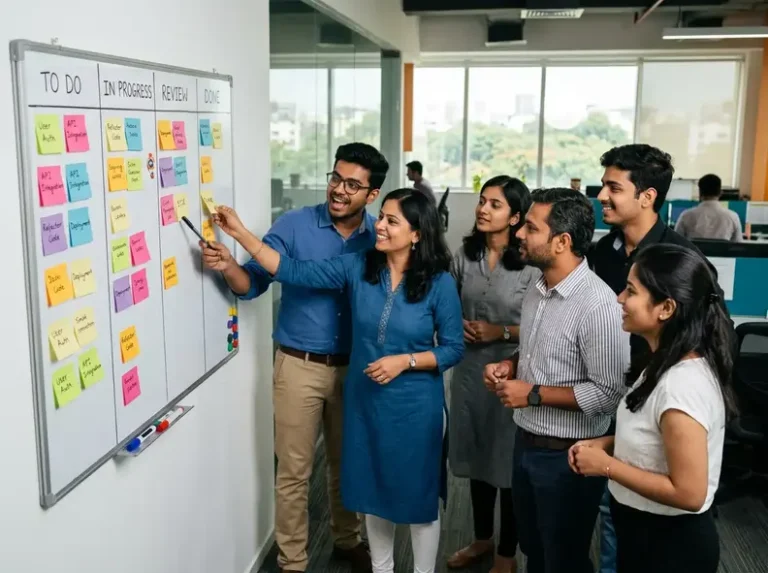
Teams form, select a Product Owner and Scrum Master, write user stories, estimate, plan a sprint, build (using a non-code simulation exercise), hold a review, and run a retrospective. Then they do it again. Two full sprint cycles in two days.
Pre-training diagnosis
If your team is already using Scrum, Excellential assesses what is working and what is broken before the training begins. The workshop addresses your specific dysfunctions, not a generic curriculum.
Real-time coaching
Our facilitator provides agile coaching during the simulation. Pointing out patterns, teaching corrections, and helping teams self-correct as dysfunctions emerge. Not watching from the sidelines.
Post-workshop action planning
Every team leaves with a specific plan for what changes in their next three sprints. Concrete actions tied to the dysfunctions uncovered during the workshop. Measurable markers to track progress.
Behaviour change, not just knowledge transfer.
See how Excellential’s approach works for teams like yours.
RESULTS
What changes after Agile and Scrum training
For the team
- Sprints that deliver usable increments, not half-finished features
- Ceremonies that are productive, not performative
- Estimation that is realistic and improves over time
- Retrospectives that produce measurable improvement
- A shared understanding of agile that goes beyond the vocabulary
For the organisation
- Faster time to market for new features and products
- Better alignment between what is built and what customers need
- Reduced waste from building features nobody uses
- More predictable delivery and fewer missed deadlines
- Teams that adapt to change instead of resisting it
Ready to fix your team's agile practice?
Tell us about your team, and Excellential will recommend the right format.
Testimonials
DELIVERY
Format and delivery options
Every organisation has different constraints. Excellential adapts to your reality, not the other way around.
| Format | Duration | Best for |
|---|---|---|
| Two-day agile and scrum workshop | 2 full days (in-person) | Full Scrum simulation with two sprint cycles. Deepest skill-building. |
| Virtual programme | 4 half-day sessions over 2 weeks | Remote or distributed teams. Theory + practice with team exercises between sessions. |
| One-day essentials | 1 full day (in-person or virtual) | Teams that need the core framework quickly. |
| Custom programme | Flexible | Tailored to your team's current agile maturity and specific pain points. |
Excellential delivers Agile and Scrum training across India, including Bengaluru, Mumbai, Delhi, Hyderabad, Chennai, Pune, Gurgaon, Noida, and Kolkata. Virtual and hybrid formats available for distributed teams. All programmes are available in English and Hindi as standard; regional languages on request. Recommended batch: 12 to 25 participants.
WHO IS IT FOR
Who should attend this agile and scrum training
Designed for teams and professionals at the point where agile vocabulary is no longer enough and applied capability becomes critical.
Product teams, software teams, and QA teams
Transitioning to or already using Scrum. Especially teams that have adopted the ceremonies but are not seeing the results.
Product Owners and Scrum Masters
Those who need structured training in their roles. Not a certification, but a practical understanding of what their role demands and how to do it well.
Engineering managers
Who oversees agile teams and needs to support the process without undermining it. The most common dysfunction Excellential sees is well-intentioned managers who inadvertently break Scrum by making decisions that belong to the team.
Managers newer to the role generally may also want Excellential’s First-Time Manager Training alongside this.
Innovation and R&D teams
That needs an iterative framework for experimentation and rapid delivery. Agile principles apply beyond software when the work involves uncertainty and discovery.
Non-technical teams
Marketing, HR, operations, and business teams that want to work in iterative, collaborative ways. Excellential adjusts the language, examples, and simulation exercises for non-technical contexts.
Non-technical stakeholders
Those who work with agile teams need to understand how to engage with the process without disrupting it.
Not sure if this fits your team?
Excellential will help you assess the need and recommend the right approach. No hard sell.
WHY EXCELLENTIAL
Why organisations choose Excellential for agile and scrum training
You have options. Global certification bodies, online platforms, and boutique consultancies. Here is what makes working with us different.
Simulation-based, not lecture-based
Your team experiences Scrum by doing it. Two full sprint cycles in two days. Most agile training programmes teach frameworks. Excellential makes teams practise them under realistic pressure.
Excellential diagnose before it trains
If your team is already using Scrum, Excellential assesses what is working and what is broken before the workshop. The training addresses your specific dysfunctions, not a generic syllabus.
Built for Indian IT and product teams
Offshore-onshore dynamics, client-driven scope changes, hierarchical decision-making. Every scenario reflects how Indian teams work. No imported Western frameworks.
Practical, not certification-focused
Excellential teaches agile skills, not exam preparation. If individuals want to pursue CSM or PSM certification afterwards, the practical understanding they gain here makes that process easier.
Measurable impact
Aligned with the Kirkpatrick Model. Excellential tracks behaviour change and business outcomes, not just satisfaction scores.
25+ years of cross-industry experience
IT, BFSI, manufacturing, retail, pharma, and startups. 20,000+ professionals trained. 85+ organisations. Excellential has seen what works and what produces agile theatre.
Your sprints are running. Your standups are happening. But nothing is improving.
Agile is a competitive advantage, but only when it works. Every sprint your team goes through the motions without adapting, learning, or improving is a sprint wasted. Excellential helps your teams understand agile from the inside out, so the process serves the work instead of the other way around.
Excellential covers a related capability-building theme in How Training Got a Fun, Tech-Savvy Makeover.
FAQS
Frequently asked questions
Is this a Scrum certification programme?
No. This is a practical agile training programme focused on applied agile and Scrum skills. We do not offer CSM, PSM, or SAFe certification. Excellential trains your team to work in agile effectively, not to pass an exam. If individuals want to pursue certification afterwards, the practical understanding they build here makes that process significantly easier.
Can this help a team that is already using Scrum but not getting results?
This is one of our most common engagements. We diagnose where your current Scrum implementation is breaking down: absent Product Owners, meaningless retrospectives, estimation that nobody believes in, and sprints that feel like mini-waterfalls. The workshop is designed around fixing those specific dysfunctions. Your team does not need more Scrum theory. They need their Scrum practice corrected.
Is this agile project management training?
It covers the project management aspects of agile: sprint planning, estimation, backlog prioritization, stakeholder management, and delivery tracking. But unlike traditional agile project management courses, we focus on how teams work together, not just how projects are tracked. If your teams already use Jira and still deliver late, the problem is not the tool. It is how the team operates. That is what we fix.
Do you cover SAFe or other scaled agile frameworks?
This program covers Scrum and Kanban. For teams working at scale, multiple Scrum teams coordinating across a programme or portfolio, we offer a separate program on scaled agile practices. Talk to us about your context, and we will recommend the right approach.
Can non-technical teams benefit from this training?
Yes. We regularly deliver agile training for non-technical teams: marketing, HR, operations, and business teams that want to work in iterative, collaborative ways. The principles of agile apply far beyond software development. We adjust the language, examples, and simulation exercises for non-technical contexts so the learning is immediately relevant.
How is this different from CSM or PSM certification?
CSM and PSM certifications train individuals to pass an exam and earn a credential. Our program trains entire teams to work in agile effectively. Your team leaves with practical skills, a completed simulation experience, and specific fixes for their current agile dysfunctions. Not exam preparation material. If individuals want to pursue certification afterwards, the practical understanding they gain here will make that process easier and more meaningful.
What is the ideal group size for this workshop?
We recommend 12 to 25 participants for the best learning experience. This size allows for realistic Scrum team formation, meaningful simulation exercises, and individual attention from the facilitator. We have run effective sessions for groups as small as 8 and as large as 30, depending on the format and objectives.
How long does the agile and scrum training programme take?
It depends on the format. The intensive in-person workshop runs for two full days with a complete Scrum simulation. The virtual programme covers four half-day sessions over two weeks. The one-day essentials programme covers the core framework quickly for teams with limited time. We also offer custom formats for organisations with specific constraints or teams at different agile maturity levels.
Is this available in Bengaluru, Mumbai, and other Indian cities?
Yes. We deliver agile and scrum training across India, including Bengaluru, Mumbai, Delhi, Hyderabad, Chennai, Pune, Gurgaon, Noida, and Kolkata. Virtual and hybrid formats are available for distributed teams anywhere. All programs are available in English and Hindi as standard, with regional language delivery on request.
What results can we expect after the training?
Teams that complete this program typically see more predictable sprint delivery, fewer missed deadlines, better alignment between what is built and what customers need, and retrospectives that actually produce change. Leaders report clearer communication with stakeholders, more realistic estimation, and reduced friction between product, engineering, and business teams. We align our programs to the Kirkpatrick Model and can partner with you to track behaviour change and business outcomes over time.