
TRAIN THE TRAINER PROGRAMME
Train the trainer programme that builds confident internal trainers
Your subject matter experts know the content. Nobody taught them how to teach it. Excellential’s train-the-trainer programme gives your internal trainers the design, delivery, and facilitation skills to run sessions people actually learn from. Excellential builds capability, not certificates. Built for real Indian workplaces, not a curriculum factory.
- Practical facilitation, not theory. Every participant delivers at least three live practice sessions with recorded review and structured feedback.
- Built around your actual training content. Your trainers redesign and deliver their real product, compliance, or onboarding sessions during the workshop, not hypothetical case studies.
- Designed for Indian corporate realities. Mixed seniority groups, post-lunch energy crashes, resistant participants, large batch sizes, and virtual sessions with cameras off.
- 25+ years of L&D experience. 20,000+ professionals trained across 85+ organizations. Now Excellential teaches your people to do what it does.
- Capability, not certifications. Almost every train-the-trainer programme in India sells you an accreditation badge. Excellential sell you trainers who can actually run a room. If you need a credential alongside, Excellential can recommend appropriate certification pathways separately.
- Flexible delivery. Across Bengaluru, Mumbai, Delhi, Hyderabad, Chennai, Pune, Gurugram, Noida, Kolkata, and Coimbatore. In-person, virtual, or hybrid. English, Hindi, and regional languages.
Tell us about your internal trainer pool, and Excellential will design a programme around your context.












































KEY TAKEAWAYS
- Built for subject matter experts who deliver internal training without formal facilitation background, plus L&D professionals and managers who train their own teams.
- Excellential names five patterns behind weak internal training: content overload, facilitation skills assumed rather than taught, the post-lunch energy crash, virtual sessions run like in-person ones, and no measurement of whether anything changed.
- The programme runs four modules: instructional design, facilitation skills, virtual training delivery, and measuring training impact using the Kirkpatrick model.
- Organisations report reduced dependency on external trainers for routine programmes, with measurable behaviour change tracked at 30 and 90 days.
- Before the workshop, Excellential spends two to three hours with the L&D team to learn exactly where current sessions fall short, rather than assuming a generic syllabus.
- Each participant leaves with a personal facilitation plan naming three habits to break and a 60-day practice schedule, reviewed in a follow-up touchpoint.
Share who trains today and where sessions fall flat, and Excellential will build the practice rounds around your team’s real content.
THE PROBLEM
Why most internal training programmes fall flat
Your company has brilliant subject matter experts. They know the product inside out. They understand the process better than anyone. So you ask them to train others. Logical, right?
Three sessions in, the feedback forms tell a different story. Too much content. Could not follow. The trainer just read from slides. It felt like a college lecture.
The problem is not knowledge. Your SMEs have plenty of that. The problem is that nobody taught them how to teach. They default to what they know: open PowerPoint, start talking, cover everything, hope something sticks. That is not training. That is a monologue with slides.
After building internal training capability across 85+ organisations in India, Excellential sees the same five patterns repeat across IT, BFSI, manufacturing, pharma, and startups with striking consistency.
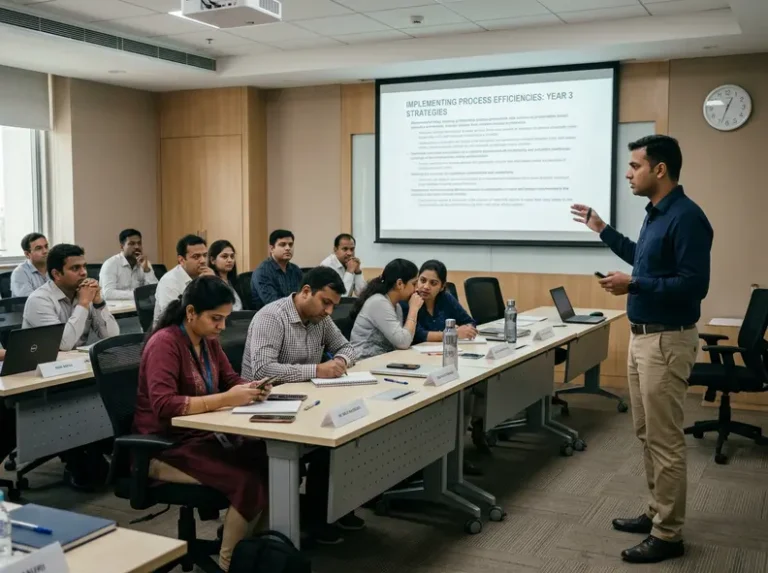
1. Content overload kills learning
The curse of expertise: the more you know, the harder it is to teach.
Internal trainers try to cover everything they know in one session. Three hours of non-stop information. No interaction. No practice. Participants leave overwhelmed and retain almost nothing. The trainer feels good because they covered the syllabus. The participants forget 80% of it by Friday.
2. Facilitation skills are assumed, not taught
Knowing the most is not the same as being able to teach it.
Running a room of 25 people requires specific skills. Managing energy, handling difficult participants, reading body language, adjusting pace, and asking questions that prompt thinking rather than silence. Your SMEs were never trained in any of this. They were promoted into training because they knew the most, not because they could teach. (Same pattern shows up when high-performing individual contributors get promoted into management knowing the work and being able to lead others through it are two different skills.)
3. The post-lunch session is a graveyard
2 PM, full stomachs, warm room, dimmed projector.
Every internal trainer in India dreads the post-lunch slot. Half the room is fighting sleep. The trainer speeds up to finish early. Nobody learns anything. This is a solvable problem, but only if someone teaches your trainers how to design for energy, not just for content.
4. Virtual training is just like in-person on Zoom
Cameras off. Muted participants. Zero interaction.
Your trainer talks for 90 minutes to a grid of initials. Virtual facilitation requires a fundamentally different toolkit: shorter segments, polling, breakout rooms, and chat-based participation. Most internal trainers have never been taught any of it, so they replicate their in-person session on Zoom and watch engagement collapse.
5. No measurement, no improvement
The most dangerous pattern of all.
Sessions happen. Participants fill in feedback forms. Nobody analyses whether anyone actually changed their behaviour or applied what they learned. Without measurement, your training function is flying blind, repeating the same sessions with no evidence that they work. The L&D team is busy. The trainers are busy. Nobody is asking whether any of it is changing anything.
Every session delivered by an unprepared trainer is a double cost: the time of every participant in the room, and the missed opportunity to build the skill you needed.
Worse, bad internal training damages the credibility of your entire L&D function. Employees start treating training as a calendar block to suffer through. When you actually need them to learn something critical, nobody takes it seriously.
THE PROGRAMME
What this train-the-trainer programme covers
Four modules. Each addresses a specific capability gap that separates a subject matter expert from a trainer who can actually run a room.
Module 1
Instructional design
- Adult learning principles and how adults actually retain information
- Structuring a session: opening, body, close, transitions
- Designing for retention, not coverage
- The ADDIE framework is a working process for building effective sessions
- Reducing slide dependency
- Building activities and exercises that reinforce learning
- Content development fundamentals: courseware structure, participant handouts, visual aids that support the trainer rather than replace them
Module 2
Facilitation skills
- Managing room energy and attention across a full-day session
- Asking questions that generate thinking, not silence
- Handling the four difficult participant types: the dominator, the silent observer, the challenger, the cynic
- Reading body language and adjusting delivery in real time
- Managing mixed seniority groups where junior participants stay quiet
- Co-facilitation: how two trainers work together, divide responsibilities, and support each other in a shared session
- Recovery techniques when a session is losing the room
Module 3
Virtual training delivery
- Designing for the screen: shorter segments, visual anchors, deliberate interaction every 7 to 10 minutes
- Strategies to keep cameras on without becoming the camera police
- Using breakout rooms, polls, and chat as facilitation tools, not as features you toggle
- Handling tech failures without losing the room
- Hybrid delivery: balancing the people in the room with the people on the screen
Module 4
Measuring training impact
- The Kirkpatrick Model applied practically: reaction, learning, behavior, results
- Designing pre- and post-assessments that actually measure learning
- Tracking behavior change at 30 and 90 days, not just satisfaction scores
- Presenting training ROI to leadership in a language they care about
- Building a simple training measurement dashboard
Want a detailed programme outline for your trainer pool?
Excellential will tailor the modules to your industry, training content, and trainer experience levels.
OUR APPROACH
How does Excellential teach in this train-the-trainer programme
People do not become better trainers by sitting through more training lectures. They become better trainers by training, getting feedback, and training again. That principle shapes every element of this programme.
Pre-programme discovery
Before the workshop, Excellential spends 2 to 3 hours with your L&D team understanding what your internal trainers actually deliver, where sessions are falling short, and what participant feedback is telling you. Each participant completes a short self-assessment. By the time the workshop starts, Excellential knows what your cohort needs, not what a generic syllabus assumes.
Practice, not theory
Every participant delivers at least three live practice sessions during the programme. Real topics from their actual role. Real-time feedback from Excellential’s facilitators and peers. Excellential records these sessions so trainers can watch themselves and close the gap between intention and impact. Most participants tell us that watching the first recording is the most useful 10 minutes of the programme.
Your actual training content
Excellential does not run generic facilitation drills on made-up topics. Your trainers bring their real product training, compliance content, or onboarding material into the workshop, and Excellential redesigns and rehearses those exact sessions. They leave with content they can use on Monday, not theory they have to translate.
Frameworks as working tools
Excellential draws on widely used instructional design and measurement frameworks, including ADDIE, adult learning principles, and the Kirkpatrick Model. Excellential uses them as practical lenses for redesigning sessions and measuring impact, not as a certification curriculum.
Built for Indian training realities
The post-lunch energy crash. The senior participant who challenges every point. The team that goes silent when asked a question. The Hindi-English code-switch that helps some people and loses others. Every facilitator technique Excellential teaches has been tested in Indian corporate rooms, not borrowed from a US textbook.
Personal facilitation plan
Every participant leaves with a documented plan: their facilitation style strengths, three specific habits to break, a redesign of one current session, and a 60-day practice schedule. Excellential reviews the plan in a follow-up touchpoint to keep momentum after the workshop ends.
Trainers who can actually run a room.
See how Excellential’s approach builds internal training capability that lasts.
RESULTS
What changes after the train-the-trainer training programme
For the trainer
- Confidence to facilitate a room of 25 without hiding behind slides
- Ability to design a two-hour session that participants actually engage with
- Skills to handle any participant type, from the silent observer to the aggressive challenger
- Virtual delivery skills that keep cameras on and attention up
- A personal facilitation style that feels natural rather than performed
For the organisation
- Higher quality internal training across the board
- Better participant feedback and engagement scores
- Reduced dependency on expensive external trainers for routine programmes
- A scalable internal training capability that grows with the company
- Measurable behavior change tied to business outcomes
Ready to build a training team your organisation can rely on?
Tell us about your trainer pool, and Excellential will recommend the right approach.
DELIVERY
Format and delivery options
Every organisation has different constraints. Excellential adapts to your reality.
| Format | Duration | Best for |
|---|---|---|
| Intensive workshop | 3 full days (in-person) | Deepest skill-building with multiple practice rounds |
| Virtual programme | 6 half-day sessions over 3 weeks | Distributed teams with practice between sessions |
| Blended journey | 2-day workshop + 4 virtual follow-ups over 8 weeks | Sustained skill development with real-world application |
| Custom programme | Flexible | Specific to your trainer pool size and training needs |
Excellential delivery across Bengaluru, Mumbai, Delhi, Hyderabad, Chennai, Pune, Gurugram, Noida, Kolkata, and Coimbatore. Virtual delivery is available anywhere in India. All formats are available in English and Hindi as standard, with regional language delivery on request.
Recommended batch size: 10 to 20 participants for maximum practice time, though Excellential has run effective sessions for groups of 6 to 25. Investment depends on format, duration, and group size. Please reach out for a custom proposal.
WHO IS IT FOR
Who should attend this train-the-trainer programme?
Designed for anyone who trains others as part of their role, whether full-time or occasionally. The programme adapts to first-time trainers and experienced facilitators alike.
- Subject matter experts who deliver internal training sessions but have no formal facilitation background.
- L&D professionals and training coordinators are responsible for designing and running programmes.
- HR professionals who conduct onboarding, compliance, or policy training.
- Team leads and managers who train their teams on processes, tools, or systems.
- Internal trainers moving from in-person to virtual or hybrid delivery.
- Anyone your organisation has identified as a future trainer or facilitator.
Not sure if this fits your situation?
Excellential will help you assess your trainer pool and recommend the right approach. No hard sell.
WHY EXCELLENTIAL
Why organisations choose Excellential for train-the-trainer programmes
You have options. Large certification bodies, generic facilitation courses, and online self-paced programmes. Here is what makes working with us different.
Capability, not certificates
Almost every train-the-trainer programme in India is built around accreditation badges and certification credentials. Excellential’s is built around a different question: can your trainers actually run a room on Monday morning? If you need a formal credential alongside, Excellential can recommend the right pathway separately. Excellential’s work is building the capability.
Your actual content, not hypothetical topics
Most train-the-trainer programmes run generic exercises on made-up case studies. Excellential works with your real training material, so your trainers leave ready to deliver on Monday morning, not theoretically prepared.
Built for Indian training realities
Mixed seniority rooms, post-lunch energy crashes, large batch sizes, resistant participants, virtual sessions with cameras off. Excellential has navigated all of it across 85+ organisations, and it teaches your trainers to do the same.
Frameworks as practical tools
Excellential draws on ADDIE, adult learning theory, and the Kirkpatrick Model as working tools inside the programme. Excellential’s focus is on a capability your team can use on Monday, not a credential.
Build the broader training capability
Most providers deliver a workshop and leave. Excellential also helps structure your internal training calendar, design measurement dashboards, build a trainer development pathway, and coach your senior trainers as they coach the next cohort.
Measurable impact, aligned to Kirkpatrick
Excellential measures behaviour change, not just satisfaction scores. Excellential tracks trainer effectiveness at 30 and 90 days post-programme, against the participant feedback their actual sessions generate.
THE PATTERN
Why training fails without training the trainer
Your L&D function announces a new programme. Someone assigns subject matter experts to deliver it. They build slides on the weekend. They show up Monday morning, open PowerPoint, and start reading.
Three months later, leadership asks why participant feedback is flat and why behaviour has not changed on the floor.
Your trainers are not the problem. The training they received is. This is a capability gap, not a content gap: the people delivering your training were never taught how to deliver it, and without a structured train-the-trainer programme, the cycle repeats every time you refresh the slides.
Excellential has made a similar point about why culture decks don’t build leaders: content alone, without capability, changes nothing.

Build a training team that does not need us
The best outcome of this programme is that your internal trainers become so capable that you call us less often. Excellential is genuinely fine with that. Your organisation deserves a self-sustaining training capability, and Excellential helps you build it. Your SMEs know the content. Excellential teaches them how to teach it.
FAQS
Frequently asked questions
What is a train-the-trainer programme?
A train-the-trainer programme teaches your internal SMEs, L&D team, and managers how to design and deliver effective training. It covers instructional design, facilitation skills, audience management, virtual delivery, and measurement. The goal: a self-sustaining internal training capability so your organisation stops depending on external trainers for routine programs.
Is this a train-the-trainer certification course?
No. We focus on building real facilitation and design capability that your trainers can use immediately, not on awarding a credential. If your team needs a formal certification alongside this program, we can recommend appropriate certification pathways. But the program itself is built around applied skill development, not exam preparation.
How is this different from a facilitation skills workshop?
Facilitation skills workshops focus on running meetings and group discussions. Our train-the-trainer program covers the full training spectrum: designing content with adult learning principles, structuring sessions for retention, delivering with energy and confidence, handling difficult participants, running virtual sessions, and measuring impact. It is built for people who train others not for people who facilitate conversations.
How is this different from a presentation skills course?
Presentation skills courses teach you to deliver information. Training teaches people to apply it. A great trainer is not a great presenter. They are someone who can design a session, manage a room, handle resistance, build practice into the agenda, and measure whether anything actually changed. We cover all of that. Presentation skills are one slice of one module. (For teams who specifically need to strengthen presentation and business writing skills as a standalone capability, our business communication training is the better fit.)
What does TTT stand for in training?
TTT stands for Train the Trainer, a structured program that builds the facilitation skills, instructional design capability, and delivery confidence internal trainers need to run effective sessions. Our TTT program focuses on practical, applied skills rather than certification exams.
Does this include facilitation skills training?
Yes. Module 2 is entirely dedicated to facilitation skills, including managing room energy, asking questions that generate thinking, handling difficult participants, reading body language, and adjusting delivery in real time. This goes well beyond basic presentation skills. It covers the specific facilitation techniques that separate a trainer from a subject matter expert reading slides.
Can this be customised for our industry?
Absolutely. We work with your real training content and scenarios. If your internal trainers deliver product training for sales teams, compliance training for operations, onboarding for new hires, or technical training for engineers, we build the practice sessions around those exact topics. The frameworks stay the same. The content is yours.
Do you deliver train-the-trainer programmes in Bengaluru, Mumbai, and other Indian cities?
Yes. We deliver across Bengaluru, Mumbai, Delhi, Hyderabad, Chennai, Pune, Gurugram, Noida, Kolkata, and Coimbatore. Virtual delivery is available anywhere in India. All formats are available in English and Hindi, with regional languages on request.
How do you measure the impact of this programme?
We align measurement to the Kirkpatrick Model. We track reaction during the workshop, learning through the live practice sessions, and behaviour change at 30 and 90 days post-programme — looking at how participants’ actual training sessions have improved and whether their feedback scores are climbing. Level 4 covers organisational outcomes: feedback scores across your internal training calendar, reduction in external trainer spend, and participant retention from internal programmes.
What kind of results can we expect?
Organizations that invest in structured train-the-trainer programs typically see significant improvement in internal session feedback scores, higher participant engagement, reduced dependency on external trainers for routine content, and measurable behavior change after training. Results vary by starting point, but the pattern is consistent: better trainers produce better training, and better training produces measurable workplace change.
What is the ideal group size?
We recommend 10 to 20 participants for the best balance of practice time and feedback variety. Larger groups reduce the number of practice rounds each participant gets. Smaller groups reduce the variety of feedback styles. We have run effective sessions from 6 to 25.
How long is the programme?
The intensive in-person workshop runs for 3 full days. The virtual programme covers 6 half-day sessions over 3 weeks. The blended journey combines a 2-day workshop with 4 virtual follow-ups over 8 weeks. We offer custom formats based on your trainer pool and business needs.
Do you offer one-on-one trainer coaching alongside the group programme?
Yes. Some organisations bring in the group workshop for their core trainer pool and pair it with 1:1 coaching for senior trainers or new trainer hires. We design the coaching around the individual’s specific delivery style and the sessions they are responsible for.
Is this relevant for new managers who have to train their teams?
Yes. New managers are one of our most common participant profiles. The shift from doing the work to teaching the work is a real capability gap, and this program addresses it directly. Many organizations include train-the-trainer modules in their new manager development pathway. (For the broader people-management transition, you may also want to look at our first-time manager training program.)