FEEDBACK TRAINING PROGRAMME
Feedback training programme with practical frameworks for Indian managers
Your managers know how to manage work. Most of them have never been trained to manage a performance conversation. This programme changes that.
Practical frameworks for goal-setting, continuous feedback, and honest appraisal conversations. Designed for Indian managers navigating bell curves, family-like team dynamics, and appraisal dread.
- Practical from day one. Managers write real goals, role-play real appraisal conversations, and leave with templates they use immediately.
- Built for Indian workplaces. Bell curves, forced distribution, seniority dynamics, and the cultural discomfort with direct feedback.
- 25+ years of L&D expertise. 20,000+ professionals trained across 85+ organisations.
- Flexible delivery. In-person, virtual, or hybrid. English, Hindi, and regional languages.
Tell us about your performance management challenges, and Excellential will design a programme around them.






































KEY TAKEAWAYS
- Built for first-time reviewers, experienced managers with ingrained avoidance habits, and HR business partners who coach others through the review cycle.
- Excellential names five patterns in Indian appraisal cycles: recency bias judging twelve months on the last eight weeks, bell-curve resentment, goals that go stale by March, feedback given only once a year, and the rating overshadowing development.
- The programme covers eight topics: goal setting, continuous feedback habits, the SBI model, monthly check-ins, the appraisal conversation itself, managing the bell curve, PIPs, and handling emotional reactions.
- Organisations report lower attrition linked to rating unfairness and fewer managers who need HR to step in on difficult conversations.
- Excellential builds the programme around the organisation's own performance system, OKRs, balanced scorecards or 9-box grids, and times follow-ups to the actual appraisal calendar.
- Excellential also runs shorter sessions for employees on receiving feedback and writing self-assessments, so both sides of the conversation share the same framework.
Share your performance management system and appraisal calendar, and Excellential will time the programme to when your managers need it most.
THE CHALLENGE
Why performance management fails in most Indian companies
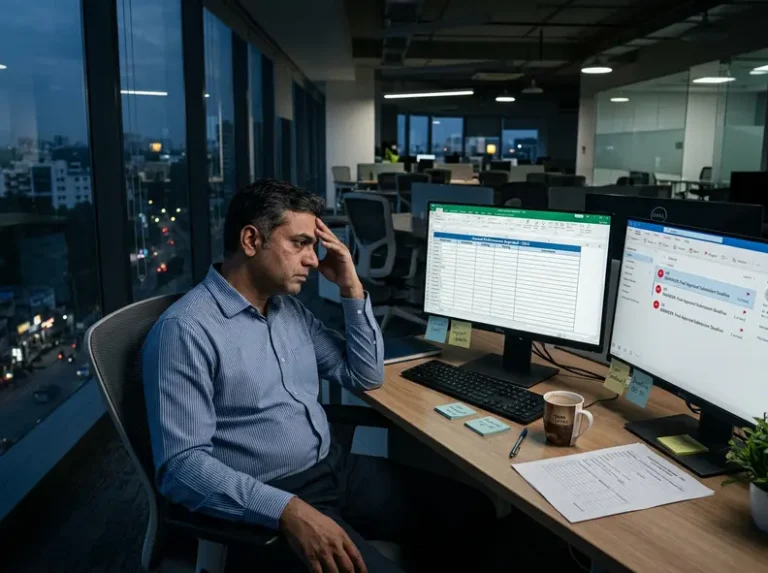
Picture this. Rajan, a team lead at a mid-sized IT firm in Bengaluru, is staring at a spreadsheet of names. It is December. HR has sent the appraisal forms, and three reminder emails after that. The deadline was last week, and Rajan is trying to remember what each person on his team did back in February.
Meanwhile, employees are anxious. They know their rating determines their bonus, their promotion chances, and a fair amount of their self-worth. The best performers are worried they will be underrated because of the bell curve. The average performers are hoping nobody looks too closely. Nobody has spoken to the underperformers about their gaps all year. They are about to find out everything in one uncomfortable hour.
Everyone is unhappy. The system keeps running anyway.
The problem is not the software. It is not the form. It is that managers have never been trained to do this well. They get a rating scale, a deadline, and a template. Then they are supposed to evaluate, calibrate, differentiate, and deliver feedback that motivates people, all without a single hour of formal preparation.
Excellential traces this same execution gap in Performance Improvement Training: Where Execution Fails.
The patterns Excellential sees across every industry
After delivering performance review training for managers across IT, BFSI, manufacturing, pharma, and startups, the same five problems surface with striking consistency.
1. Recency bias rules everything
Managers judge twelve months on eight weeks.
Managers remember the last two months, not the last twelve. Managers forget that stellar Q1 delivery by December. The November mistake? Front and centre. Employees know this, so performance theatre near appraisal season is the predictable result.
2. The bell curve breeds real resentment
The conversation stops being about performance.
Many Indian companies force-fit ratings into a distribution. Managers end up explaining to a strong performer why they got a 3 out of 5 because the curve demanded it. The conversation becomes about the system, not about the person.
3. Goals become fiction
Creative writing disguised as performance planning.
Managers write objectives in January and forget them by March. By December, everyone scrambles to retrofit twelve months of work into goals that stopped being relevant in Q2. The entire exercise becomes an act of narrative construction.
4. Feedback happens once a year
A verdict, not a dialogue.
In the Indian context, where direct feedback already feels culturally risky, the annual review becomes the only moment anyone says anything. By then, issues are stale, emotions are charged, and the conversation feels more like a sentencing than a development discussion.
5. The number overshadows everything
The most important conversation of the year turns into a negotiation over a digit.
The entire process becomes about the rating. Employees obsess over it. Managers agonise over justifying it. Nobody talks about development, growth, or how to get better. When managers are never trained on these conversations, they default to avoidance. This is precisely why performance appraisal training for managers is not optional. It is a core leadership skill.
It’s the same skill gap Excellential explores in Why Your Best Performers Struggle as Managers.
High performers leave because their contributions feel invisible. Average performers coast because the curve protects them. Underperformers go unchecked for months until the situation becomes a crisis that HR has to firefight. Year after year, organisations keep running a system that managers were never trained to operate, and employees bear the cost. They keep running it because nobody has trained the managers who operate it. Enquire Now →
THE PROGRAMME
Performance appraisal and feedback training for managers that goes beyond the form
Eight topics. Each targeting an area where managers consistently struggle. Managers practice every topic during the session with real scenarios, real goals, and real feedback.
Topic 1
Goals that hold up
Writing objectives tied to business outcomes using OKRs and SMART. Excellential helps managers choose the right framework and write goals that still make sense in October, not just in January.
Topic 2
The continuous feedback habit
A practical system: fifteen minutes per team member per month. Eliminates year-end surprises. Excellential teaches the cadence, the conversation structure, and the discipline of giving and receiving feedback regularly.
Topic 3
SBI in practice
Giving feedback that is specific, timely, and usable using the Situation-Behaviour-Impact model. Both praise and constructive input. Your managers practise on real scenarios during the session.
Topic 4
Monthly check-ins that replace December panic
A structured template. Thirty minutes. Covers progress, blockers, development, and relationships. Simple, repeatable, effective. No more scrambling to reconstruct twelve months in a week.
Topic 5
The appraisal conversation, step by step
How to open the conversation, deliver the rating, handle disagreement, and close with the relationship intact. Even when the news is bad. Scripts and structure for every scenario.
Topic 6
Managing the bell curve
When the system forces you to differentiate in ways that feel wrong, how do you have that conversation honestly? Specific strategies for the single most common question Indian managers ask us.
Topic 7
PIPs that work
Building Performance Improvement Plans that give the employee a genuine shot at recovery. Structuring them so they are fair, documented, and developmental, not a paper trail for termination.
Topic 8
When the conversation gets emotional
What do you do when someone cries? Gets angry? Goes completely silent? Challenge the rating? Scripts and strategies for each scenario, practised in a safe environment.
Want a detailed programme outline for your team?
Excellential will customise the topics to your appraisal system and specific challenges.
LEARNING OUTCOMES
What your managers walk away with
After completing this feedback training programme, your managers will be able to:
- Set clear, measurable goals using OKR and SMART frameworks and keep them relevant throughout the year, not just at goal-setting season.
- Give continuous feedback using the SBI (Situation-Behaviour-Impact) model so that year-end reviews contain zero surprises for anyone.
- Run structured monthly check-ins in thirty minutes that replace hours of December stress and year-end scrambling.
- Differentiate performance fairly across their team and explain ratings with confidence, clarity, and genuine empathy.
- Navigate the bell curve conversation without destroying motivation or trust, even when the forced distribution feels unfair.
- Address underperformance early through Performance Improvement Plans focused on development, not on building a paper trail for termination.
- Separate the appraisal conversation from the development conversation, because cramming both into one meeting guarantees neither gets done well.
- Document performance consistently across the year to reduce bias and improve calibration accuracy.
- Handle emotional reactions during rating discussions: tears, anger, silence, defensiveness, and outright challenges to the rating.
- Build a team culture where giving and receiving feedback is expected and welcomed, not feared and avoided. Excellential built exactly this kind of feedback culture in a 360-degree feedback programme for a mid-sized IT company.
OUR APPROACH
How Excellential teaches performance conversations that stick through feedback training
If this training does not change how your managers conduct their next review, it has not worked. Every element of Excellential’s approach is designed for transfer to the workplace.
Practice on your real work
Your managers write goals for their own team members. They role-play appraisal conversations using scripts that mirror Indian workplace scenarios. They give feedback to peers and receive coached feedback on their delivery.
Video playback
Many managers are startled to see the gap between what they intended to communicate and what their body language and tone were actually saying. That single insight often reshapes their entire approach to performance conversations.
Aligned to your system
Excellential tailors the programme to your specific performance management system, whether you use OKRs, balanced scorecards, 9-box grids, or competency-based reviews. This is a performance management system training designed around your reality.
Timed to your appraisal cycle
Follow-up sessions align with your review calendar so managers get coaching exactly when they need it most: right before and during the appraisal season.
Takeaway toolkit
Each person leaves with a Performance Conversations Playbook, a monthly check-in template, goal-writing guides, and a 90-day implementation plan.
See how Excellential’s feedback training programme works for teams like yours.
RESULTS
What changes after this feedback training
For the manager
- Deliver tough ratings and genuine praise with equal confidence.
- Carry far less stress into review season because they build the groundwork all year.
- Build stronger team relationships through regular, honest feedback rather than annual surprises.
- Address underperformance early, before it requires HR intervention.
- Carry a repeatable system into every review cycle with confidence.
For the organisation
- Higher quality of appraisal conversations across the company.
- Lower attrition from perceived rating unfairness.
- Better alignment between individual work and business priorities.
- Fewer managers depend on HR to handle every difficult people conversation.
- Consistent management quality across departments and teams.
Ready to fix appraisal season?
Tell us about your performance management challenges, and Excellential will recommend the right format.
DELIVERY
Format and delivery options
Every organisation has different constraints. Excellential adapts to your reality, not the other way around.
| Format | Duration | Best for |
|---|---|---|
| Intensive workshop | 2 full days (in-person) | Deepest skill-building with role plays, video playback, and real scenarios |
| Virtual programme | 4 half-day sessions over 2–3 weeks | Distributed or hybrid teams, with practice assignments between sessions |
| Blended programme | 1-day workshop + 4 virtual follow-ups | Follow-ups aligned to your appraisal cycle for sustained behaviour change |
| Custom format | Flexible | Tailored to your performance management system and calendar |
Delivered in English, Hindi, and select regional languages across Bengaluru, Mumbai, Delhi NCR, Hyderabad, Chennai, and Pune. Virtual delivery available anywhere. Recommended batch size: 15 to 25 managers.
WHO IS IT FOR
Who should attend this feedback training programme?
This programme suits anyone whose job involves evaluating, developing, or having honest conversations about performance.
First-time reviewers
Managers conducting performance reviews for the first time, or for the first time without winging it. The core audience for performance appraisal training for managers.
Many attend alongside Excellential’s First-Time Manager Training, since the broader delegation and feedback skills usually surface together.
Experienced managers
Those who want to dramatically improve the quality of their feedback and appraisal conversations. Especially those with ingrained habits of avoiding tough ratings or rushing through reviews.
Supervisors and team leads
Conducting reviews for the first time. This works equally well as performance management training for supervisors who manage teams but have never been formally trained.
HR business partners
HR business partners coach managers through the review cycle, calibration process, and rating conversations. They need these same frameworks to guide others effectively.
Startup team leads
Building performance processes from the ground up. No legacy system to work around, but no institutional knowledge to lean on either.
Pairs well with Excellential’s Startup HR Policies programme if the broader people-policy foundation isn’t in place yet either.
Anyone who dreads appraisal season
And wants that to change. Whether the dread comes from the bell curve, tough conversations, or the sheer discomfort of rating people you work with daily.
Testimonials
FOR EMPLOYEES
Performance management and feedback training for employees
Excellential’s primary programme targets managers because they drive the quality of performance conversations. But Excellential also runs shorter sessions for employees, so both sides approach the process with the same language and expectations.
This is performance appraisal training for employees that complements what their managers learn, not a watered-down version of the same programme. If you want the entire performance cycle to improve, training only one side of the conversation is not enough.
- Receiving feedback constructively without defensiveness
- Writing strong, evidence-based self-assessments
- Setting personal goals aligned to business outcomes
- Owning their side of the development conversation
WHY EXCELLENTIAL
Why organisations choose Excellential for feedback and performance training
You have options. Large global platforms, boutique trainers, and online certificate courses. Here is what makes working with us different.
Excellential has sat in those calibration meetings
Bell curves, normalisation debates, forced differentiation. Excellential knows what managers struggle with because it has been in the room hundreds of times over 25+ years. Not theory. Pattern recognition from real Indian organisations.
25+ years across Indian industries and MNCs
IT, BFSI, manufacturing, retail, pharma, startups. 20,000+ professionals trained. Pattern recognition from 85+ organisations. Excellential has seen every type of performance management challenge and knows what actually changes behaviour.
Aligned to your PM system
OKRs, balanced scorecards, 9-box grids, competency-based reviews. Excellential builds around your system, not ours. No generic framework that does not fit your reality.
Built for Indian workplace dynamics
Bell curves, forced distribution, seniority dynamics, and the cultural discomfort with direct feedback. Every scenario reflects how Indian professionals actually work.
Measurable impact
Aligned with the Kirkpatrick Model. Excellential tracks behaviour change and business outcomes, not just satisfaction scores from a post-training survey.
Specialist facilitators
Each session is led by a facilitator with deep expertise in performance management, not a generalist trainer reading from a slide deck.
Your managers deserve better than a spreadsheet and a deadline.
Good performance management is the difference between a company where people grow and one where they stagnate. The skill of the manager sitting across the table is what actually determines whether the conversation lands. Excellential builds that skill.
FAQS
Frequently asked questions
What is a feedback training programme for managers?
It helps managers build the skills to give regular, clear, and actionable feedback and to conduct appraisal conversations that feel fair, even when the rating is tough. The focus is on real workplace scenarios, not theory.
Is this the same as performance review training for managers?
It includes the review conversation, but goes further. Instead of focusing only on annual reviews, it builds continuous feedback habits that improve performance throughout the year.
Do supervisors and team leads benefit from this?
Absolutely. This works equally well for supervisors and team leads who manage people but have never received formal training in handling performance conversations.
Does this include giving and receiving feedback training?
Yes. A core part of the program teaches managers to both give and receive feedback so they can build a team culture where feedback is normal, not an event.
Can this be timed to our appraisal cycle?
Yes, and we strongly recommend it. Our blended format is specifically designed so that managers get the training a few weeks before reviews begin and receive follow-up coaching during the cycle. That way, they apply what they learn when it matters most.
Do you offer performance management training for employees, not just managers?
Our primary program is for managers. We also run shorter sessions for employees on receiving feedback, self-assessment, goal setting, and owning their development conversation. Many clients run both, so that everyone approaches the process with the same language and expectations.
What if our company does not use a bell curve?
The program adapts to your system, whether you use a bell curve, forced ranking, absolute ratings, or a narrative-based approach. The conversation skills we teach work regardless of the rating mechanism.
Will this work for managers who have been doing appraisals for years?
Especially for them. Experienced managers often carry the deepest ingrained habits, avoiding tough conversations, inflating ratings, and rushing through reviews. This program gives them a structured reset with techniques they have never been formally taught.
How many managers can attend in one batch?
Batches of 15 to 25 managers work best for active participation in role-plays and practice exercises. For larger groups, we run multiple cohorts.