
KEY ACCOUNT MANAGEMENT TRAINING
Key account management training that stops churn now
This strategic account management training helps your team grow existing clients, reduce churn, and build long-term, high-value relationships. Built for key account managers and customer success teams in Indian B2B companies.
Your most profitable revenue is already sitting inside your existing accounts. The question is whether you are growing it or quietly losing it.
- Practical frameworks. Account planning, churn prevention, stakeholder mapping, and cross-sell strategies, no theory, straight to application.
- Built for Indian B2B dynamics. Relationship-driven, price-sensitive, multi-stakeholder. Real Indian enterprise scenarios, not imported case studies.
- For KAMs and customer success teams. Works for key account managers, customer success managers, and anyone owning client retention and expansion.
- 25+ years of L&D expertise. 20,000+ professionals trained across 85+ organisations.
- Flexible delivery. In-person, virtual, or hybrid. English, Hindi, and regional languages.
Tell us about your account management challenges and Excellential will design a programme around them.









































KEY TAKEAWAYS
- Built for account managers, customer success managers, and client-facing delivery managers responsible for retaining and growing existing accounts.
- Excellential names six recurring failures: reactive fire-fighting, transactional order-taking, single-threaded relationships, missing account plans, price-only conversations, and renewal assumed rather than earned.
- The programme covers eight areas: strategic account planning, stakeholder mapping, the trusted advisor model, quarterly business reviews, churn prevention, cross-selling, price pushback, and escalation recovery.
- Participants build a strategic account plan for their top five accounts within the first week back at work, using their own real clients.
- The blended programme includes three months of monthly account review calls, so new habits get checked against real accounts, not just workshop enthusiasm.
- Excellential teaches twelve early warning signs of account risk, from declining response times to earlier-than-usual budget conversations, each with its own playbook.
Share which accounts feel most at risk of quiet churn, and Excellential will build the stakeholder maps and playbooks around them.
THE CHALLENGE
Why do companies keep losing clients they should be keeping
Nobody sends a breakup email. That is what makes client churn so dangerous.
The client does not storm out. They do not file a formal complaint. They just stop responding as quickly. They start taking meetings with your competitors. They give the next project to someone else. By the time your account manager or customer success manager senses something is off, the decision has already been made. The relationship you thought was solid was actually on life support for months.
Acquiring a new client costs five to 25 times more than retaining an existing one, depending on the industry. Every business leader knows retention is cheaper. Few build a system around it. Most companies still spend 80% of their sales training budget on winning new business and almost nothing on protecting and growing what they already have.
Excellential explores this same retention-over-acquisition shift in Client Retention Is the New Acquisition.
After delivering key account management training and customer success training programmes across IT services, consulting, BFSI, SaaS, and manufacturing, Excellential sees the same mistakes on repeat.

The patterns that Excellential sees across every organisation
Six account management failures that repeat across every industry, every time. Any of these sound familiar?
1. Reactive mode is the default
Fire-fighting instead of planning.
Account managers wait for clients to raise issues instead of anticipating them. By the time the client says something, they have already lost patience. The conversation you should have initiated three months ago becomes the fire you are fighting today.
2. The relationship stays transactional
Order-taking disguised as account management.
The client asks. The team delivers. Repeat. There is no strategic conversation about the client’s broader challenges, their industry pressures, or where they want to be in two years. Without that context, you are replaceable. Anyone can take an order.
3. Everything hangs on one person
One resignation away from losing the account.
The entire account depends on a single relationship. When that contact changes roles, gets promoted, or leaves, the account is suddenly at risk. Nobody else in your company has a meaningful connection with anyone on the client side.
4. No account plan exists
Growth by accident, not by design.
No documented strategy for growing the account. No stakeholder map. No understanding of the client’s priorities beyond the current project. Without account management skills training, growth happens accidentally or not at all.
Excellential traces a similar execution gap in Performance Improvement Training: Where Execution Fails.
5. Price becomes the only conversation
Competing on cost because you are not adding strategic value.
When you are not adding strategic value, every renewal turns into a cost negotiation. And once you are competing purely on price, someone will always undercut you. This is especially acute in Indian enterprise deals where procurement teams benchmark aggressively.
6. Renewal is assumed, not earned
Confusing silence with satisfaction.
Last year’s renewal does not guarantee this year’s. Account managers confuse silence with satisfaction. Often, the client’s silence means they are too busy evaluating your replacement to give you a heads-up.
Harvard Business Review research found that even a 5% increase in customer retention can lift profits by 25% to 95%. When you lose a large account, you lose more than revenue. You lose the cross-sell potential of the next three years, the referrals that the client would have given, and the morale of the team that worked on that account. And you replace it at five to seven times the cost. Enquire Now →
THE PROGRAMME
Key account management training built for Indian B2B teams
Excellential turns reactive order-takers into proactive strategic partners. Every framework is adapted for Indian realities: the importance of personal trust, multi-stakeholder decision-making, price sensitivity, and the long sales cycles that define most Indian enterprise relationships.
Strategic
Strategic account planning
Hands-on account planning training. Your team builds a working plan during the session using a template for mapping opportunities, risks, competitive threats, and growth potential. They walk out with finished plans for their real accounts.
Relationships
Stakeholder mapping and relationship architecture
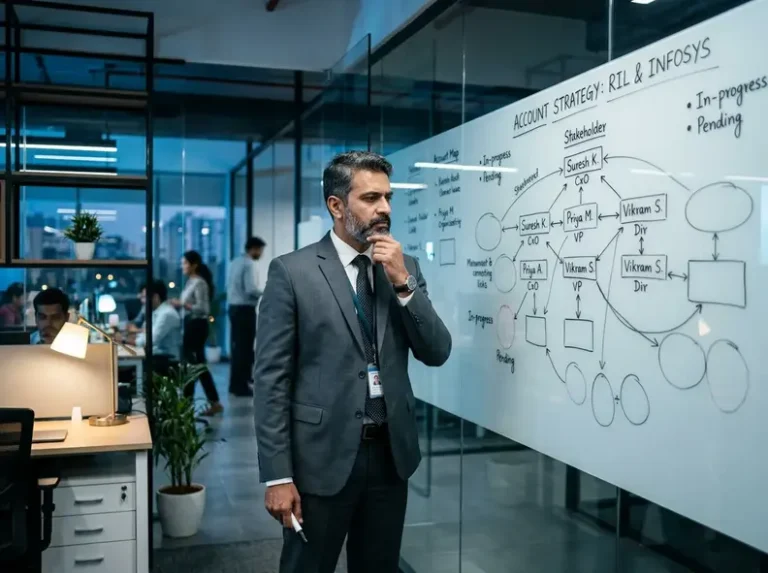
Identifying decision-makers, influencers, blockers, and champions. Building relationships at every level so you are never one resignation away from losing the account. Especially critical for customer success managers who inherit shallow, single-threaded relationships.
Positioning
The trusted advisor model
Moving from vendor to partner. Knowing your client’s industry, competition, and pressures better than they expect you to. This shift is what separates account managers who retain clients from those who lose them to competitors offering the same services at a lower price.
Reviews
QBRs that clients actually value
Structuring quarterly business reviews that demonstrate impact, surface concerns before they escalate, and open doors for expansion. Not slide-heavy status updates everyone endures. For customer success teams, the QBR is the single most important touchpoint in the relationship cycle.
Retention
Churn prevention signals
Twelve early indicators that an account is at risk, with specific playbooks for each one. From declining response times and shrinking meeting attendance to budget conversations that come earlier than usual. Practical detection, not theoretical frameworks.
Growth
Cross-sell and up-sell done right
How to introduce additional services naturally, in a way that feels like genuine help rather than a sales push. Identifying needs the client has not articulated yet and connecting them to solutions you already offer.
Negotiation
Handling price pushback
Reframing conversations around value, ROI, and total cost of switching when the procurement team wants to negotiate every rupee. Specific to Indian enterprise dynamics, where multi-level approval and competitive benchmarking are standard.
Recovery
Escalation recovery
Turning a complaint into a loyalty-building moment. Clients who experience a well-handled escalation often become more loyal than clients who never had a problem. Excellential teaches the frameworks for making that happen.
Want a detailed programme outline for your team?
Excellential will customise the topics to your industry and specific account management challenges.
LEARNING OUTCOMES
What your team walks away with
- Build a strategic account plan for their top five accounts within the first week back at work.
- Map stakeholder relationships and identify dangerous gaps in their client coverage.
- Conduct strategic business reviews that clients look forward to, not status meetings they tolerate.
- Spot the twelve early warning signs of dissatisfaction before they become churn.
- Shift conversations from price to value by connecting your services to the client's business outcomes.
- Cross-sell and up-sell by identifying needs the client has not articulated yet.
- Build multi-threaded relationships so the account survives contact changes on either side.
- Turn client escalations and complaints into moments that deepen trust rather than destroy it.
- Start renewal conversations months before the contract is due, not weeks.
- Develop a professional identity as a trusted advisor, not a vendor representative.
OUR APPROACH
How does Excellential teach Key Account Management
If key account management training does not change how your team manages their accounts on Monday morning, it has not worked. Excellential designs every element for immediate transfer to real client relationships.
Real accounts, not case studies
Your people work on their actual client accounts during the session. Real clients. Real challenges. Real stakeholder maps. By the time the workshop ends, they have a finished, usable account plan for their most important relationships.
Live role plays for hard conversations.
The renewal pushback. The escalation call. The expansion pitch to a sceptical CFO. The cross-sell conversation needs to feel like help, not a sales push. Your team practises these with expert facilitator feedback.
Customer success lifecycle integration
For customer success manager training programmes, Excellential adds specific focus on onboarding-to-renewal lifecycle management, health scoring, and proactive engagement rhythms. Excellential adapts the programme to whether your team sits in a traditional KAM structure or a modern CS function.
Three months of accountability
Excellential’s blended programme includes monthly account review calls. Skills translate into results when someone checks in. This sustained reinforcement separates a training event from a genuine capability shift.
Deliverables, not theory. Results, not certificates.
See how our account management training approach works for teams like yours.
RESULTS
What changes after this key account management training
For the individual
- A clear, repeatable system for managing and growing key accounts.
- Confidence in strategic conversations with senior client stakeholders.
- Ability to spot churn risks early and act before the client mentally checks out.
- Relationships that survive personnel changes on both sides.
- A professional identity as a strategic revenue grower, not just a relationship maintainer.
For the organisation
- Higher retention rates and lower churn across the account portfolio.
- Increased revenue from existing accounts through organic expansion.
- Lower acquisition costs as satisfied clients refer new business.
- More predictable revenue forecasting based on healthy account pipelines.
- A scalable account management practice across the entire team.
Ready to turn existing accounts into your best growth channel?
Tell us about your team, and Excellential will recommend the right format.
Testimonials
DELIVERY
Format and delivery options
Every organisation has different constraints. Excellential adapts to your reality, not the other way around.
| Format | Duration | Best for |
|---|---|---|
| Intensive workshop | 2 full days (in-person) | Deepest skill-building and practice |
| Virtual programme | 4 half-day sessions over 2 to 3 weeks | Distributed or hybrid teams |
| Blended programme | 1-day workshop + guided account reviews for 3 months | Sustained behaviour change |
| Custom format | Flexible | Designed around your client base, industry, and revenue model |
Delivered in English and Hindi across India: Bengaluru, Mumbai, Delhi, Hyderabad, Chennai, Pune, Gurgaon, and Kolkata. Virtual delivery available anywhere. Regional languages on request. Recommended batch size: 12 to 20 participants for meaningful, focused account work.
WHO IS IT FOR
Who should attend this training
Built for professionals responsible for protecting and growing your most valuable client relationships.
Account managers and key account managers
Responsible for client retention and revenue growth in B2B organisations. The core audience for this key account management sales training.
Customer success managers
Who owns the post-sale relationship, health scoring, and renewal decisions? This programme serves as focused customer success manager training for teams moving beyond reactive support.
Client-facing delivery managers
In IT services, consulting, and professional services who influence client satisfaction but have never received formal account management skills training.
Sales professionals transitioning to farming
Moving from new business acquisition to growing existing accounts requires a fundamentally different skillset. This sales and account management training bridges that gap.
Teams still building their new-business muscle alongside this may also want Excellential’s B2B Sales Training.
Founders and BD heads in startups
Who manage key client relationships personally and need a repeatable system rather than instinct.
Customer success leaders building a CS function
Those who need their team trained on a consistent methodology. Works as a customer success manager bootcamp for teams being assembled or restructured.
Not sure if this fits your team?
Excellential will help you assess the need and recommend the right approach. No hard sell.
WHY EXCELLENTIAL
Why organisations choose Excellential for account management training
You have options. Large global firms, boutique trainers, and online certification courses. Here is what makes working with us different.
Indian B2B market expertise
Relationship-driven sales, multi-stakeholder procurement, personal trust, price sensitivity. Excellential has trained account teams across IT services, BFSI, manufacturing, and SaaS. The scenarios come from Indian boardrooms, not American case studies.
Working output, not workshop handouts
Your people leave with completed account plans for their real clients. Deliverables that go into use on Monday, not theories they forget by Friday.
Three months of accountability
Monthly account review calls ensure skills translate into real account results, not just workshop enthusiasm.
Cross-industry perspective
Having trained account teams across very different industries, Excellential brings best practices your people would never encounter within their own sector. A retention strategy from SaaS might transform how your manufacturing team thinks about client value.
Measurable impact
Aligned to the Kirkpatrick Model. Excellential tracks behaviour change and business outcomes, not just participant satisfaction scores. If the training does not change how your team manages accounts, it has not worked.
25+ years in Indian and MNC organisations
IT, BFSI, manufacturing, retail, SaaS, startups. 20,000+ professionals trained. 85+ organisations. Excellential has seen every type of account management challenge and knows what actually moves the needle.
THE GAP
The most expensive gap in your business is the one nobody trains for
An account manager watches a key client slowly disengage over six months. They notice the signs but have no framework for what to do. By the time they escalate internally, the client has already signed with a competitor. The account that contributed 15% of the division’s revenue is gone.
Without structured strategic account management training, account managers default to one of two modes: passive relationship maintenance or reactive firefighting. Neither grows the account. Neither prevents churn. Both leave revenue on the table.
The gap is not in intention. Most companies know their existing clients matter. The gap is in capability. The people responsible for your most valuable relationships have never been given a structured system for managing and growing them.
Your strongest growth engine is your existing client list
Every account that churns is revenue you replace at five to seven times the cost. Every account that stays flat is growth you leave on the table. Whether you need key account management training, customer success manager training, or a combined programme covering both, Excellential would like to understand your situation and design around it.
FAQS
Frequently asked questions
What is key account management training?
A structured program that helps professionals manage and grow existing client relationships. It covers account planning, stakeholder mapping, cross-selling, churn prevention, and retention strategies for your most valuable accounts.
Who should attend this programme?
Account managers, key account managers, customer success managers, client-facing delivery managers, and sales professionals transitioning from new business to account growth.
Is this also a customer success manager training programme?
Yes. We include specific modules covering the onboarding-to-renewal lifecycle, health scoring, and proactive engagement. Many clients use this as their core customer success management training.
Can this be customised for our industry?
Yes. We tailor role plays, case studies, and scenarios for IT services, BFSI, consulting, SaaS, and manufacturing based on your client dynamics and sales cycle.
How soon can we see results?
Teams typically see early improvements within four to eight weeks, particularly in proactive client engagement, stakeholder coverage, and renewal conversations. The blended program with three months of guided reviews produces the most sustained results.
Can this work alongside our existing sales training?
Yes. Many clients run both in sequence. We can design a combined sales and account management training journey covering acquisition and retention, tailored to your team’s responsibilities.
Do you offer key account management training across India?
Yes. We deliver in-person training in Bengaluru, Mumbai, Delhi, Hyderabad, Chennai, Pune, Gurgaon, and Kolkata. Virtual and hybrid formats available for distributed teams. English, Hindi, and regional languages.
Is this the same as a key account management certification?
No. Certifications like SAMA or KAM certifications focus on individual professional development. Our program is built around your actual client portfolio. Your people leave with completed account plans for real clients, not a certificate for their wall.
Can this work for IT services and consulting companies?
This is one of our strongest areas. IT services and consulting companies face unique challenges: long delivery cycles, multi-stakeholder procurement, and the constant risk of being commoditised. Every scenario is tailored to these realities.
What if our account managers also handle new business development?
Many of our clients have hybrid roles. We can design a combined journey covering both acquisition and retention, or focus specifically on the account growth and retention skills that are typically undertrained.
What is the ideal group size?
12 to 20 participants for the best experience. This size allows for meaningful role plays, peer reviews of real account plans, and individual facilitator attention.
Do you offer training in Hindi or regional languages?
Yes. All formats are available in English and Hindi as standard. Regional language delivery is available on request, depending on the location and facilitator availability.