
CULTURE CHANGE TRAINING
Workplace culture change training that drives results
Your culture is not what the poster says. It is what happens when the CEO leaves the room. Excellential’s diagnostic-driven culture change training helps organisations identify what is actually broken, align leadership, and build systems that make the new culture stick.
- Diagnostic-first approach. Excellential assesses your actual culture before designing any intervention. No generic frameworks forced onto your reality.
- Built for Indian organisations, where hierarchy, seniority, deference, and indirect communication shape everyday work.
- 25+ years of L&D expertise. 20,000+ professionals trained across 85+ organisations.
- Flexible delivery. In-person, virtual, or hybrid. English, Hindi, and regional languages.
Tell us about your team and Excellential will customise a programme.


























KEY TAKEAWAYS
- Excellential’s workplace culture change training helps organisations change shared behaviours, working norms, and leadership patterns.
- Every engagement begins with an assessment of current behaviours, working norms and leadership patterns.
- Senior leaders participate at the start to align expectations and identify the behaviours required from the leadership team.
- Delivery can take the form of a two- or three-day intensive, a virtual programme, an 8- to 12-week blended journey, or a customised transformation engagement.
- Excellential develops a culture charter with defined behaviours, commitments, accountability measures, and a quarterly review process.
- Progress measures are agreed before the intervention and reviewed through culture health checks, charter reviews, and relevant organisational indicators.
Define the culture shift your organisation needs
Share the organisation’s current challenges, leadership context and desired behaviours. Excellential will recommend the appropriate diagnostic and sustainment plan.
THE PROBLEM
Why most culture change efforts fail within six months
A new CEO announces a culture transformation. Town halls happen. A consulting firm produces a 60-page deck. Posters go up. Six months later, nothing has changed. The same people avoid the same conversations. The same dysfunction plays out in the same meetings.
Culture initiatives lose momentum when organisations overlook the behaviours, incentives and leadership patterns supporting the current culture. After two decades of delivering culture change training across Indian organisations, Excellential sees six patterns that repeat in almost every engagement.
Culture problems do not show up as a single line item. They show up everywhere: in attrition among your best people, in projects that take twice as long, and in leaders who spend 40% of their time managing politics instead of driving results. Every quarter without a deliberate, structured approach to culture change compounds the cost. Enquire Now →
The patterns that Excellential sees across every organisation
1. The values-behaviour gap
The poster says one thing. The experience says another.
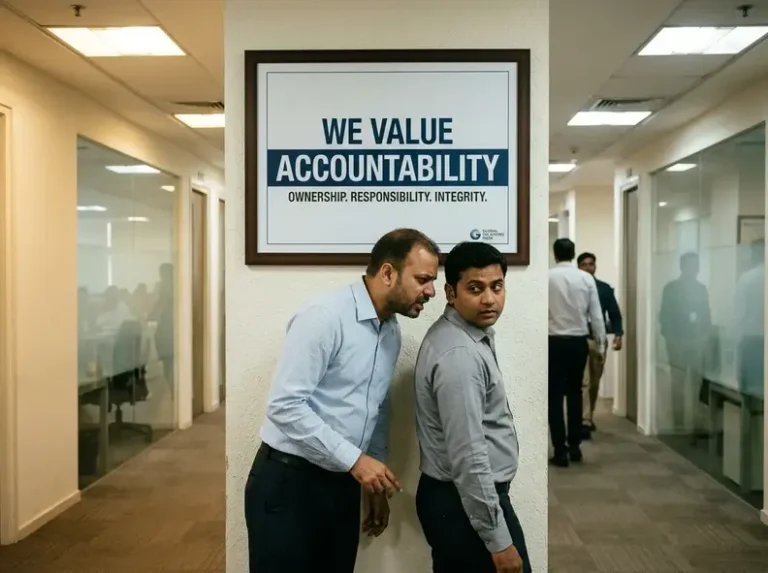
The organisation has clearly stated values. Collaboration. Innovation. Accountability. But the experience of working there tells a different story. Collaboration means cc’ing people on emails. Innovation often ends up meaning the founder’s ideas get implemented. Accountability means someone gets blamed. The gap between stated culture and lived culture is where cynicism breeds.
2. Leadership models the opposite
Actions override every value statement – every time.
A senior leader talks about open communication but shuts down dissent in meetings. A VP champions work-life balance but sends emails at midnight. A department head asks for innovation but punishes every failed experiment. When leadership behaviour contradicts stated values, the behaviour wins – every time.
3. Silos have become identities
Departments operate as separate cultures.
Marketing thinks the product does not listen. Product thinks engineering over-promises. Engineering thinks everyone else changes scope without consequence. These silos are not just structural. They are cultural. They shape how information flows, how decisions get made, and who trusts whom.
4. Feedback does not flow upward
Leadership operates on filtered, optimistic data.
In many Indian organisations, hierarchy is not just a reporting structure. It is a cultural force. Junior employees learn quickly that questioning a senior’s decision is career risk. Middle managers filter information before it reaches leadership. Problems are visible at the ground level months before they appear in a boardroom.
5. The "that is just how things are" resignation
This is the most dangerous pattern of all.
When employees stop expecting things to change, they stop trying. Talented people leave quietly. The ones who stay disengage quietly. Managers who once pushed for better ways of working give up. This is not apathy. It is learned helplessness, the result of watching previous attempts at cultural change fail.
6. Post-merger cultural collision
Two cultures are forced into one org chart.
Two companies merge. People with different working styles, communication norms, and unspoken rules are expected to function as one organisation. Nobody talks about it explicitly. What follows are months of friction disguised as “alignment issues.” In reality, it is a culture clash that nobody has the language or framework to address.
Excellential has written more on why culture decks alone don’t build leaders capable of naming and resolving that clash.
WHAT IT COVERS
What this culture change training programme covers
Six areas address the behaviours, norms, and systems that shape workplace culture. The intervention combines culture diagnosis, leadership alignment, behavioural practice, and sustainment planning.
Module 1
Culture diagnostic and assessment
What is the actual culture, not the aspirational one? Where are the gaps between stated values and daily behaviour? Excellential uses structured assessments, interviews, and behavioural observation to build an honest picture. This diagnosis becomes the foundation for the entire culture change process.
It’s the same diagnostic-first approach behind how Excellential helped a tractor manufacturer replace isolation with collaboration.
Module 2
Leadership alignment
Culture change not led from the top remains a training programme. Culture change led from the top is a transformation. This module brings senior leaders into alignment on what the desired culture looks like and where their own behaviour may be reinforcing patterns they want to eliminate.
For employee adoption during a defined rollout or restructuring, see Excellential’s Organisational Change Management Training instead.
Module 3
Trust and psychological safety
The foundation on which every other cultural improvement depends. Without it, feedback does not flow, accountability feels punitive, and people protect themselves instead of contributing fully. For Indian teams, building trust requires techniques adapted to hierarchy and deference.
Teams whose primary gap is trust and accountability specifically, rather than culture broadly, may want our dedicated Team Effectiveness Training.
Module 4
Accountability and ownership systems
Most organisations confuse accountability with blame. Real accountability means clear ownership, transparent tracking, and a culture where people hold each other to standards without it becoming personal or political battles. This module builds structures that work in the Indian workplace dynamics.
Module 5
Communication norms and feedback loops
How people communicate defines culture more than any value statement. This module establishes new norms for meetings, decision-making, cross-functional communication, and feedback. It addresses deference, information hoarding, and the gap between what people say in meetings and in the corridor afterward.
Module 6
Culture charter and sustainment plan
A working document that defines the specific behaviours, norms, and commitments the organisation is adopting. Not a values poster. A practical document with measurable standards, accountability mechanisms, and a quarterly review process. This is where culture change becomes sustainable.
Want a detailed programme outline for your organisation?
Excellential will tailor the modules to your industry, size, and specific cultural challenges.
OUR APPROACH
How Excellential delivers workplace culture change training that lasts
If company culture training does not change behaviour, it is a seminar with a nicer name. Every element of Excellential’s approach is designed to produce visible, measurable shifts in how people work together.
Culture diagnostic before any intervention
Every engagement starts with an assessment. Excellential uses structured tools, conversations, and observation to build an accurate picture, then designs the intervention around the findings.
Leadership-first design
Senior leaders participate before anyone else. They align with the desired culture, confront where their own behaviour may contradict it, and commit to specific changes.
Real workplace scenarios
Every exercise, role-play, and discussion is built around situations your people will recognise. These scenarios are derived from 25 years of experience working in Indian organisations, not from a textbook.
Facilitated honest conversations
The most valuable moments happen when teams have the conversations they have been avoiding. Excellential’s facilitators make these conversations productive instead of destructive.
Culture charter creation
Every programme produces a working culture charter. Specific behaviours. Clear norms. Measurable commitments. Quarterly review cadence.
Post-programme sustainment
Monthly culture health checks. Quarterly charter reviews. Leadership coaching touchpoints. Culture does not change in a workshop. It changes over months and quarters.
Behaviour change, not posters.
See how our approach works for organisations like yours.
RESULTS
What changes after workplace culture change training
For the team
- Meetings where people say what they actually think, not what they think leadership wants to hear.
- Accountability that is shared and structural, not dependent on one manager chasing everyone.
- Cross-functional collaboration that works because the norms and trust are in place.
- Feedback that flows in every direction, including upward.
- A culture charter that the team holds itself to, reviewed quarterly.
For the organisation
- A clear, honest picture of the current culture and a structured plan to shift it.
- Senior leaders align on the desired culture and the behaviours expected from the leadership team.
- Reduced attrition driven by culture frustration.
- Clearer working norms reduce delays caused by silos and internal politics.
- A replicable model for positive workplace culture training across departments.
Ready to start a culture change process that actually works?
Tell us about your organisation, and Excellential will recommend the right approach.
Testimonials
DELIVERY
Format and delivery options
Every organisation has different constraints. Excellential adapts to your reality, not the other way around.
| Format | Duration | Best for |
|---|---|---|
| Intensive culture workshop | 2-3 full days (in-person) | Deepest diagnostic work, leadership alignment, and charter creation |
| Virtual programme | 4-6 half-day sessions over 3-4 weeks | Remote or distributed teams with practice between sessions |
| Blended journey | 1-day workshop + follow-ups over 8-12 weeks | Sustained behaviour change with ongoing reinforcement |
| Custom engagement | Flexible | Post-merger integration, large-scale transformation, or multi-location rollouts |
Excellential offers all formats in English and Hindi as standard, with regional language delivery on request. Excellential delivers on-site at your office, at an off-site venue, or through its virtual platform. Recommended batch size: 15-25 participants, though Excellential has run effective sessions for groups of 8 to 40.
WHO IS IT FOR
Who should attend this workplace culture change training
This programme is designed for organisations and leaders at inflection points where culture can either be a competitive advantage waiting to be built or a liability that is quietly costing them.
HR leaders and CHROs
HR leaders who are responsible for diagnosing culture concerns and presenting a structured response to the leadership team.
Senior leadership teams
Those who recognise the need to shift the culture and are willing to start with their own behaviour. Culture change requires visible participation from the senior leadership team.
Department heads and BU leaders
Dealing with the symptoms of culture dysfunction: attrition, disengagement, silos, and politics. Want to address the root cause within their sphere of influence.
Organisations post-merger or post-restructuring
Where two or more cultures are colliding, and the “integration” is not happening organically. Where friction is being politely ignored, but is slowing everything down.
Organisations in rapid growth
Where the culture that worked with 50 people is breaking at 500. Where the founders can no longer personally set the tone for every team.
Leaders preparing for succession or transition
Where a change in leadership is an opportunity to deliberately shape the culture rather than let it drift.
Not sure if this fits your situation?
Excellential will help you assess the need and recommend the right approach. No hard sell.
WHY EXCELLENTIAL
Why organisations choose Excellential for workplace culture change training
You have options. Large consulting firms, global training platforms, and individual coaches. Here is what makes working with us different.
Diagnostic-first, not framework-first
Most culture change programmes start with a framework and force your organisation into it. Excellential starts with your reality. Excellential’s diagnostic identifies the behaviours and working norms requiring attention. The findings guide the intervention design.
25+ years in Indian and MNC organisations
Hierarchy, seniority, deference, indirect communication, and family-run dynamics. These are not theoretical concepts for us. Excellential has navigated them across 85+ organisations, from IT companies in Bengaluru to manufacturing plants in Pune.
Contextualised for Indian workplaces
Every scenario, role play, and case study reflects how Indian professionals actually work. No imported Western frameworks applied without adaptation. Excellential’s cultural transformation training is built on lived experience.
The charter makes it stick
The culture charter is not symbolic. It is a practical tool with specific behaviours, measurable commitments, and a quarterly review process. This gives the organisation defined behaviours, commitments, and a regular review process.
Measurable impact
Excellential aligns the measurement plan with the Kirkpatrick Model and tracks agreed behavioural and organisational indicators.
Startup-friendly, enterprise-ready
Whether you have 30 employees or 30,000, the experience scales without losing quality or relevance.
IN PRACTICE
What culture change looks like in practice
Culture change is not abstract. Here are patterns Excellential sees repeatedly across Indian organisations, and the kinds of shifts its programmes produce.
The post-merger identity crisis
Two mid-sized IT services companies merged. On paper, the integration was complete. New org chart. Shared offices. Combined client list. In practice, the two groups operated as separate tribes. Different communication styles. Different expectations about hierarchy. Different definitions of accountability. Eighteen months in, the attrition rate among high performers was 30% higher than the industry average. Excellential’s diagnosis revealed the issue was not structural. It was cultural. Two fundamentally different ways of working had never been reconciled. The culture charter process gave both groups a shared language and shared commitments. Within two quarters, cross-team collaboration metrics improved measurably, and voluntary exits slowed.
The founder-dependent culture
A 200-person company had grown from a 20-person startup in four years. The culture still ran on the founders’ personal presence. They set the tone in every room. When they were involved, things moved fast and decisions were clear. When they were not, teams stalled, avoided decisions, and waited. The company culture training engagement started with the founders themselves, helping them recognise that their strength had become the organisation’s bottleneck. The programme built decision-making norms, accountability structures, and a culture charter that distributed cultural ownership across the leadership team.
The feedback desert
A large BFSI organisation scored well on engagement surveys. Attrition was manageable. But internal promotions kept failing. Leaders promoted from within consistently struggled in their new roles. The diagnostic revealed why: feedback had effectively stopped flowing. Managers avoided honest performance conversations. Senior leaders received only filtered, optimistic updates. Problems were invisible until they became crises. The positive workplace culture training programme rebuilt feedback norms from leadership downward, with specific techniques adapted for the organisation’s hierarchical dynamics. Within six months, 360-degree feedback participation doubled, and promotion success rates improved.
THE GAP
Why culture problems persist without structured intervention
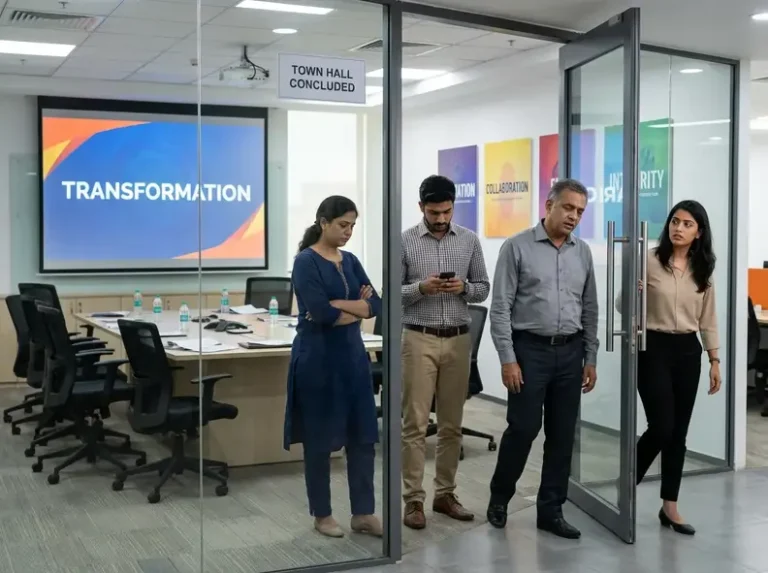
An organisation launches a new set of values. Runs a town hall. Sends a company-wide email. Prints posters. And then expects the culture to change.
It does not.
Culture is not what you declare. It is what you tolerate, what you reward, and what your leaders demonstrate every day. Without structured culture change training that starts with diagnosis, involves leadership, builds skills, and creates accountability mechanisms, culture remains what it has always been, regardless of what the posters say.
As Excellential put it in Culture Eats Strategy for Breakfast – But Only If Leaders Know How to Serve It, the plan on paper is never the constraint; the daily behaviour of leaders is.
Start a culture change that is built to last.
Whether you need organisational culture change management for a post-merger team, a culture change workshop for your leadership group, or a comprehensive cultural transformation training programme across your organisation, Excellential would like to understand your situation and design around it.
FAQS
Frequently asked questions
What is workplace culture change training?
A structured programme that helps organisations diagnose their actual culture, identify what needs to change, align leadership, build new skills and norms, and sustain the change through a culture charter and ongoing reinforcement. The goal is not to inspire culture change. It is to engineer it through deliberate shifts in how people work together daily.
What is the process of changing organisational culture?
The process of changing organisational culture follows four stages: diagnostic (what do people actually experience, not what leadership assumes), leadership alignment (because culture flows from the top), skill-building (practical tools for communication, feedback, and accountability), and sustainment (culture charter, quarterly reviews, ongoing reinforcement). Without the sustainment layer, old patterns reassert themselves within months.
Can you share examples of change in organisational culture?
A post-merger IT services company used our culture charter process to unify two distinct working cultures, reducing high-performer attrition within two quarters. A rapidly growing startup transitioned from founder-dependent decision-making to distributed leadership through structured accountability norms. A BFSI firm restored honest feedback flow across its hierarchy, improving promotion success rates within six months.
How is this different from a team-building workshop?
Team-building workshops create temporary bonding through activities. Culture change training addresses the underlying behaviours, norms, and systems that determine how people work together every day. The culture charter alone produces more lasting impact than any offsite because it creates documented, reviewable commitments that the team holds itself to.
How long does the corporate culture change process take?
The workshop runs two to three days in-person, or four to six half-day sessions virtually. Culture change itself is sustained over months: our blended format includes monthly health checks and quarterly charter reviews. Most organizations see behavioural shifts within four to six weeks and measurable results within two to three quarters.
Is this relevant for organisations going through a merger or restructuring?
Yes. Post-merger culture collisions are one of the most common reasons organizations engage us. Our diagnostic identifies the specific cultural differences explicitly, and the charter process gives both groups a shared framework. Addressing this deliberately saves months of productivity loss and prevents the attrition spike that follows most mergers.
Who should lead culture change in an organisation?
The senior leadership team. HR can facilitate it and external consultants can guide it, but if the top team is not actively involved and willing to change their own behaviour first, the initiative will not succeed. Our program starts with leadership alignment for exactly this reason.
Do you deliver culture change workshops across India?
Yes. We deliver across Bengaluru, Mumbai, Chennai, Hyderabad, Gurugram, Delhi, Noida, Pune, Indore, and Coimbatore. Virtual and hybrid formats available anywhere. English and Hindi as standard, regional languages on request.
Can this training be customised for our industry?
Yes. We customise the diagnostic tools, scenarios, role plays, and charter frameworks to reflect your industry, organisation size, and specific challenges.
What makes Excellential's approach to corporate culture consulting different?
We are diagnostic-first, not framework-first. Our programs are built for Indian organizations where hierarchy and indirect communication shape culture in ways Western models do not account for. And we build accountability into the process through the culture charter and sustained post-program engagement.
How does Excellential measure whether the culture change programme is working?
Excellential agrees relevant measures with the organisation before the intervention. Culture health checks, charter reviews and behavioural indicators track adoption. Business measures can include decision speed, collaboration, feedback flow, accountability and culture-related attrition.