
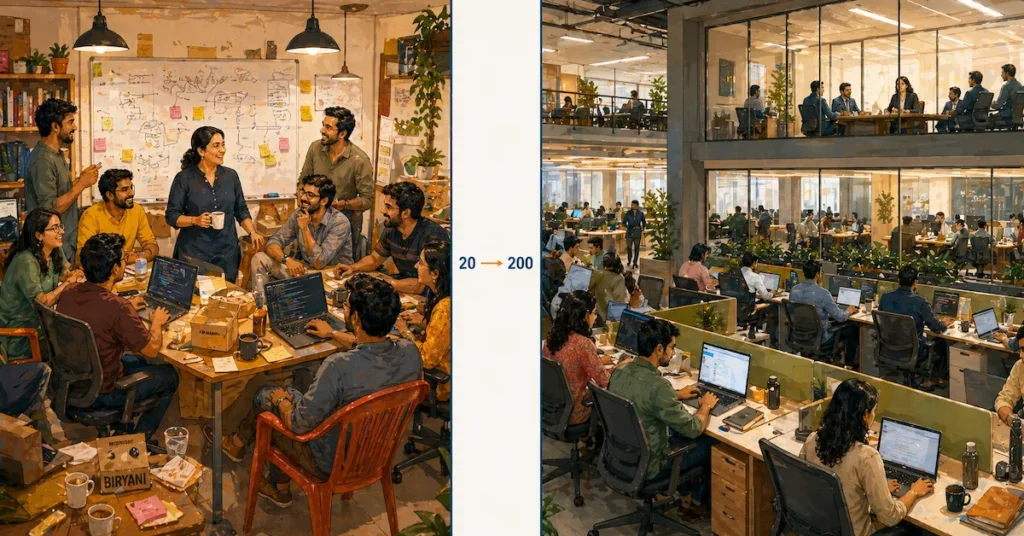
Bharati founded a Bengaluru-based SaaS startup in 2017. Three years in, she had twenty-two people, two shared desks, and a team that celebrated every product milestone with biryani ordered at midnight. She called it a family. It was.
By 2023, Bharati had 190 employees, four floors, and an office in Hyderabad.
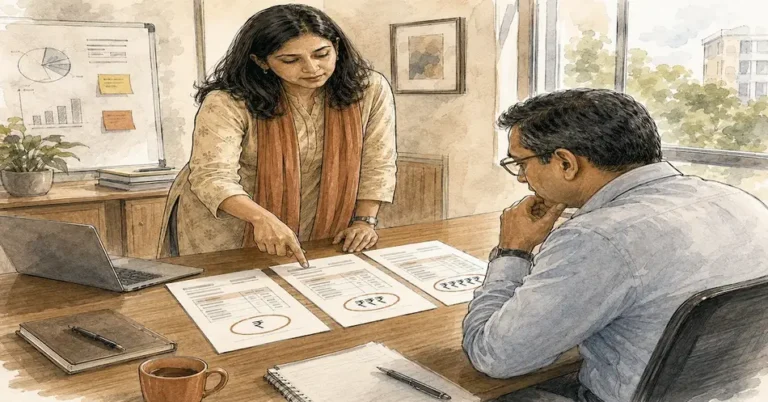
- She walked into a Monday morning standup, scanned the room, and realized she did not know the name of the person presenting.
- She was the founder.
- She had hired every one of these people, directly or indirectly. And she did not know their name.
That was the moment she understood something had broken.
Every startup founder I have met remembers the early days like a first love. If you are building a startup culture in India right now, this story is probably yours too.
Not the romantic kind. The joint-family kind.
That stretch of time may have been six months, maybe two years, when the team was small, everyone ate lunch together, and culture wasn’t something you managed. It was something you lived. You didn’t need a values document because everyone had been in the room when the values were formed, over chai and cold samosas at midnight while debugging the MVP.
Then you grew. And somewhere between employee 50 and employee 150, something shifted. The warmth didn’t disappear overnight. It leaked. Slowly. Quietly. Until one morning you walked into your own office and thought, “This doesn’t feel like us anymore.”
If you’re a founder navigating startup culture in India, whether you’re in Bengaluru, Mumbai, Gurugram, or Hyderabad, this blog is the story you’re probably living right now. It happens in three phases. And the third phase, the rebuild, is the one that determines whether your company survives its own success.
Startup culture in India is the shared set of behaviours, rituals, and unwritten rules that holds a young company together and the thing that quietly breaks somewhere between 50 and 200 employees unless founders rebuild it on purpose.
Key Takeaways
|
Phase I: The Family Room (5–20 People)
Building company culture for startups is one of those things that feels effortless at the start and impossible later. In the beginning, a startup doesn’t have a culture. It has a family.
And like every Indian family, it runs on unwritten rules, shared meals, loud arguments that resolve by evening, and an unspoken understanding that everyone has each other’s back. The founder is the eldest not by title, but by weight. Their energy sets the tone. Their habits become everyone’s habits. If the founder works Sundays, everyone works Sundays. If the founder values blunt feedback, blunt feedback flows freely.
Hiring is intuitive. The founder meets every candidate. The question isn’t “Do they have the right skills?” It’s “Will they fit at our table?” And it works. Because at 15 people, cultural fit is something you can feel in your gut. You can read the room because it is small enough to read.
Onboarding is sitting next to someone for a week. Training is osmosis. Feedback is instant and unfiltered. When someone makes a mistake, you hear about it over chai, sort it out face-to-face, and move on. No HR ticket. No skip-level meeting. Just two people solving a problem because that’s what families do.
Communication is effortless. You say something once, and everyone hears it, because everyone is within earshot. Decisions happen fast because the decision-maker and the people affected are the same five individuals sitting around the same table.
This phase is magic. And it’s the phase founders try to preserve long after it’s gone.
What works at this stage: Speed. Informality. Gut instinct. The founder is the heart of the household.
Why it can’t last: Every single thing that works here depends on proximity to being able to see everyone, hear everything, and course-correct in the moment. The instant you outgrow one room, one floor, one city, the system starts to crack.
Phase II: The Growing Pains (50–150 People)
This is the phase nobody warns you about.
You’ve raised your Series A. Or maybe your B. You’re hiring fast. Five people a month. Maybe ten. The office or the Slack workspace is suddenly full of faces you don’t recognize. You walk past someone in the corridor and feel a flicker of something unfamiliar – the company has outgrown your ability to hold it in your head.
You’re the founder of this company, and you don’t know their name.
Here’s what starts happening, and most founders only recognize it in retrospect:
The founder’s signal weakens
At 20 people, the founder’s behaviour was the culture. If the founder was transparent, everyone was transparent. If the founder cared about customer experience, everyone cared. The signal was strong because the source was close.
At 80 people, the founder is in investor meetings, strategy sessions, and board calls. They’re no longer the loudest voice in the daily experience. Middle managers are. And those managers were hired for their functional skills, not for their ability to carry culture. They bring their own habits, their own management styles, their own versions of “how things are done.”
Suddenly, the engineering team has one culture, the sales team has another, and operations has a third. Nobody planned this. It happened because culture abhors a vacuum, and when the founder’s signal weakens, subcultures fill the gap.
Hiring breaks first
The founder can’t interview every candidate anymore. So, hiring managers take over. With no shared framework for what “good” looks like, each manager hires in their own image. The scrappy generalist who thrived in the family room gets replaced by the polished specialist who looks great on paper but doesn’t understand why the team celebrates small wins with samosas. Nobody can pinpoint what changed, but the table feels different.
The “We Used To” syndrome
Old-timers start sentences with “We used to…” We used to ship fast. We used to make decisions without twelve people on a call. We used to know everyone’s name. This isn’t just nostalgia. It’s a symptom of cultural drift. The things that made the early team feel bonded, shared struggle, shared context, shared meals, shared purpose, haven’t been replaced with anything. The new people never sat in the family room. They have an employee handbook and an orientation deck.
The process backlash
Someone suggests introducing a performance review framework. Or an approval process for expenses. Or a formal onboarding program. The early employees revolt. “That’s not who we are. We’re not some MNC.” And they’re right, that’s not who you were. But who you were was a team of 15. You’re now a company of 90, and the alternative to thoughtful process isn’t freedom. It’s chaos that only the loudest voices navigate successfully.
What breaks at this stage: Hiring quality. Communication clarity. Decision speed. Trust between teams. The feeling of “being in it together.”
Why it breaks: Because everything that worked in Phase I was a function of being small, and you’re no longer small. You’re trying to run a 100-person company with a 15-person operating system.
Phase III: The Rebuild (150–200+ People)
This is the phase that separates startups that become lasting companies from startups that become cautionary tales.
If you’re searching for how to maintain culture while scaling, here’s the uncomfortable truth: you can’t maintain it. You have to rebuild it. The rebuild isn’t about going back to Phase I. You can’t recreate the family room for 200 people, and you shouldn’t try. The rebuild is about doing intentionally what used to happen accidentally. It’s about designing a culture system that works without the founder in every room.
What the rebuild requires: Intention. Systems. The courage to let go of what used to work and build what the company now needs.
Name what was invisible.
In the family room, culture was felt but never written down. At 200 people, it needs to be articulated. Not on a poster. In behaviour. What does “transparency” actually look like when you have 200 people and five departments?
- It means monthly town halls with unfiltered Q&A.
- It means publishing decision rationale, not just decisions.
- It means managers sharing context, not just assigning tasks.
Take your top three cultural values and translate each one into three specific, observable behaviours. Not “We value innovation.” Instead: “Every team presents one failed experiment per quarter and what they learned.” That’s a values-driven culture with teeth, not a poster, but a practice that people can point to and say, “This is how we actually work here”.
Build the hiring filter you’ve carried in your gut.
The founder’s instinct needs to become a shared framework. Specifically, if “cultural fit” at 20 people meant “will they fit at our table,” at 200, it needs to mean something concrete that any interviewer can assess. Define three to five non-negotiable cultural markers. Not skills. Markers. How does this person handle ambiguity? How do they respond to feedback? Do they default to ownership or to blame? Then build these into your interview process so that every hiring manager is screening for the same DNA.
Importantly, in Indian startups, especially where many candidates come from MNC backgrounds built on deference and hierarchy, “defaults to ownership” is not obvious. Test it in the interview. Give them a scenario where the answer is not clear, and the decision is theirs to make. Watch what they do with the discomfort.
Invest in the middle layer.
Here’s the unsexy truth: at 200 people, your culture is not your founders. It’s your managers. They’re the ones conducting one-on-ones, giving feedback, making promotion decisions, and modelling behaviour every single day. Because if your managers aren’t equipped to carry culture, no amount of founder charisma will compensate.
Train them. Not in process and compliance. In the skills that made the early team special: direct communication, fast feedback, shared context, and the ability to say “I don’t know yet” without losing credibility.
Create new rituals that scale.
The midnight samosas don’t scale. But the feeling they created, shared struggle, shared triumph, shared identity, can be recreated intentionally. Monthly demo days where any team showcases what they’re building. Quarterly “failure forums” where leaders share what went wrong and what they learned. For example, Onboarding buddies from different teams so cross-functional connections form from day one. Small rituals. But small rituals repeated consistently become culture. These rituals are the backbone of startup employee engagement at scale. Ultimately, when people feel connected to a shared experience, not just a shared Slack channel, engagement stops being an HR metric and starts being a lived reality.
Crucially, in Indian workplaces, where admitting failure in front of a group feels like a career risk, the failure forum only works if the founder goes first. Always. Every quarter.
Let go of “We used to”
This is the hardest part. Founders and early employees need to accept that the culture of Phase I has served its purpose. It was real. It was powerful. And it’s done. Not because someone ruined it. Because you succeeded. Growth is what happened to it.
The question isn’t “How do we get the old feeling back?” It’s “What do we want the new culture to feel like, and what systems are we willing to build to make it real?”
The Founder’s Real Job at 200 People
At 20 people, your job was to be the culture.
With 200 people, your job is to build the system that carries the culture without you in the room.
That’s a harder job. Less glamorous. More process, more patience, more letting go. But it’s the job that determines whether your company’s best days are behind it or ahead of it.
This is exactly why organizational culture training matters at the growth stage, not as a corporate formality, but as survival equipment for a company outgrowing its own operating system.
The startups that scale culture aren’t the ones that tried to freeze what they had at 20. They’re the ones who dared to rebuild it for 200.
Frequently Asked Questions
Why does startup culture in India break as the company grows?
Startup culture in India breaks because early culture depends on proximity everyone close enough to see, hear, and fix things in the moment. Between 50 and 150 people, the founder’s daily signal weakens, managers set their own norms, and subcultures fill the gap. The warmth does not vanish; it leaks quietly until the company stops feeling like itself.
At what stage does startup culture usually start to break?
Culture usually starts to crack between employee 50 and employee 150. Hiring breaks first, as founders stop interviewing everyone and each manager hires in their own image. Communication clarity, decision speed, and trust between teams follow. The core problem is running a 100-person company on a 15-person operating system.
How do you maintain company culture while scaling a startup?
You cannot maintain it; you rebuild it. Do intentionally what once happened by accident: translate values into observable behaviours, turn your gut hiring instinct into a shared filter every interviewer uses, train the manager layer that now carries culture daily, and create new rituals that scale, such as monthly demo days and quarterly failure forums.
What is the founder’s role in startup culture at scale?
At 20 people, the founder is the culture; their habits set the tone. At 200, the founder’s job changes to building the system that carries culture without them in every room. That means articulating values, equipping managers, and going first in rituals like the failure forum, where admitting mistakes feels risky in Indian workplaces.
Why does culture matter for startup employee engagement?
Culture turns engagement from an HR metric into a lived reality. The shared struggle and shared triumph of the early days bonded the first team; at scale, repeated small rituals recreate that feeling intentionally. When people feel connected to a shared experience rather than just a shared Slack channel, engagement and retention follow naturally.
Scaling your startup past 50 people? Book a Free Consultation with Excellential – we build culture systems before they break, not after. Contact Us.