WOMEN’S LEADERSHIP AND DEVELOPMENT PROGRAMME
Women's leadership and development programme for growth
Your company has talented women at every level. The pipeline narrows sharply between mid-management and the leadership table.
That is not a talent problem. It is a system problem. Excellential’s women’s leadership and development programme builds the skills women need to advance and helps your organisation remove the barriers that prevent them from reaching senior roles.
- Practical leadership skills, not motivational sessions. Executive presence, strategic communication, stakeholder influence, negotiation, and career navigation.
- Designed for Indian women professionals. The double bind of being assertive and likeable, family transitions, the confidence gap shaped by culture, and the "she is not ready yet" bias in promotion discussions.
- Individual development plus organisational change. Most women's leadership programmes develop women. Excellential also helps you examine the system around them and where it leaks talent.
- Men are part of the conversation. Specific modules engage male leaders as sponsors, allies, and decision-makers in promotion discussions.
- 25+ years of L&D experience. 20,000+ professionals trained across 85+ organisations. Including organisations actively building their women's leadership pipeline.
- Flexible delivery across India. In-person, virtual, or hybrid. English, Hindi, and regional languages.
Tell us about your organisation and Excellential will design a programme around your women’s leadership goals.



















KEY TAKEAWAYS
Excellential’s women’s leadership programme develops leadership capability while helping organisations address barriers affecting women’s advancement into senior roles.
- The programme supports mid-level women, first-time managers, functional specialists, returning professionals and women identified for senior leadership.
- Participants address visibility gaps, double-bind expectations, difficult promotion discussions, career transitions and limited access to sponsorship.
- Four modules cover leadership identity, executive presence, stakeholder influence, negotiation, career strategy, sponsorship and professional networks.
- Women practise high-stakes communication, self-advocacy and negotiation through exercises grounded in Indian workplace situations.
- Each participant creates a 12-month career strategy, sponsorship map, visibility plan and return-to-work plan where relevant.
- Excellential compares promotion-shortlist representation, stretch-assignment access, sponsorship activity and retention against agreed organisational baselines.
Build a stronger pipeline of women prepared and supported for senior leadership.
Excellential can align the programme with leadership competencies, succession plans, promotion practices and gender-diversity priorities.
THE PROBLEM
Why women in your organisation are not reaching the top
The women in your organisation, the ones who chose to build a career and navigated every cultural and structural obstacle to get here, are some of the most capable professionals you have. And yet at the senior leadership level, they are dramatically underrepresented.
This is not a question of ambition. It is not a question of capability. It is a question of how the system around them distributes opportunity, defines leadership, and makes promotion decisions.
Most women’s leadership programmes treat the gap as something to fix in women. They focus on building confidence, polishing communication, and encouraging self-belief. These things matter, but they do not address the structural reasons why capable women plateau.
After two decades of working with Indian organisations across IT, BFSI, manufacturing, pharma, and startups, the same six patterns surface in almost every engagement.

The patterns Excellential sees across every organisation
The reasons women plateau in Indian organisations are structural, cultural, and systemic. Not individual.
1. The confidence gap is an opportunity gap
Confidence comes from experience. Experience comes from opportunity.
Women in Indian companies receive fewer stretch assignments, fewer high-visibility projects, and less informal mentoring from senior leaders. When they appear less confident in leadership discussions, it is not because they lack ability, but because they have had fewer opportunities to build the muscle.
2. Sponsorship, not mentorship, is missing
A mentor advises. A sponsor advocates.
Many companies have women’s mentoring programmes. Few have sponsorship. A sponsor puts their reputation on the line in rooms where promotion decisions are made. Most women professionals in India have mentors. Very few have sponsors. Sponsorship is what moves careers.
3. The "ideal leader" image is male by default
The double bind that penalizes both ways.
When organisations describe their ideal leader as assertive, decisive, and commanding, they are describing one narrow image of leadership. Women who display the same traits often pick up the “aggressive” label. Women who lead more collaboratively often pick up the “not leadership material” label. This double bind is well-documented across decades of research and rarely discussed openly inside Indian companies.
4. Family transitions become career cliffs
The system treats life events as exit ramps.
Marriage, relocation, maternity, and childcare. Each transition is a moment where capable women step back, slow down, or leave entirely. Not because they want to, but because the organisation offers no flexibility, no phased return, and no career continuity planning. As a result, women who return often find their peers have been promoted past them.
5. Promotion criteria reward visibility, not capability
The 9 PM-in-office model of leadership.
Visibility, late-evening availability, frequent travel, and attendance at every offsite signal commitment in many Indian organisations. In a culture where women still carry the larger share of family responsibilities, this version of visibility quietly filters out talented people the organisation cannot afford to lose. It is rarely the intended outcome, but it is consistently the actual one.
6. The "she is not ready yet" bias
Men get promoted on potential. Women get promoted on proof.
In practice, men are often promoted on demonstrated potential, while women are more often asked to prove readiness first, one more project, one more year, one more stretch assignment completed. The asymmetry is rarely deliberate; most leaders making these calls would be surprised to see the pattern in their own decisions. But the gap compounds across a career, and capable women plateau as a result.
Every woman who leaves your organisation because she could not see a path to the top takes with her institutional knowledge, client relationships, and a signal to every other woman watching that growth here has a ceiling. McKinsey and Deloitte research have consistently linked gender diversity in leadership to stronger profitability and innovation outcomes. In other words, you do not have a diversity problem. You have a retention-of-talent problem. Enquire Now →
THE PROGRAMME
What this women's leadership and development programme covers
Four modules. Each addresses a specific capability gap. Realistic exercises drawn from the barriers women in Indian workplaces actually face, not generic leadership content with a gender label attached.
Module 1
Leadership identity and confidence
- Building a leadership identity beyond being good at your job
- Navigating the double bind of assertive versus likeable
- Self-advocacy: making your work visible without feeling like self-promotion
- Overcoming the “she is not ready yet” barrier in promotion discussions
Module 2
Executive presence and stakeholder influence
- Projecting confidence without losing authenticity
- Influencing without formal authority: getting ideas adopted in rooms with no titles
- Strategic communication with senior leaders, boards, and external stakeholders
- Handling interruptions, credit-taking, and being talked over in meetings
Module 3
Career strategy and negotiation
- Building a career plan that survives life transitions
- Salary and role negotiation: specific scripts and frameworks for the Indian workplace dynamics
- Managing the return from maternity or a career break without losing momentum
- Saying no without guilt: protecting time and energy for strategic work
Module 4
Sponsorship, networks, and sustained growth
- The difference between mentorship and sponsorship, and how to earn both
- Building strategic professional networks that open doors
- Engaging male sponsors and allies effectively
- Sustaining leadership growth beyond the programme
Want a detailed programme outline for your organisation?
Excellential tailors the modules to your industry, your talent strategy, and your specific pipeline goals.
OUR APPROACH
How Excellential delivers women's leadership development that lasts
This is not a panel discussion about gender equity. It is a working session where women build real skills and real strategies, and where the organisation examines the system around them.
Pre-programme discovery
Excellential spends time with your HR and leadership team understanding where women in your pipeline get stuck, what your promotion criteria actually reward, and where sponsorship gaps exist. Excellential team also speaks with a sample of participants. By the time the programme starts, the content reflects your reality, not a generic syllabus.
Practical skill-building, not motivation alone
Participants practice executive presence through live exercises with peer and facilitator feedback. They also role-play salary negotiations using scripts designed for Indian workplace dynamics, then build a 12-month career strategy that accounts for the realities of their lives.
Indian cultural dynamics are central.
The double bind, the discomfort with self-promotion, the “good girl” conditioning, and family expectations during career-defining moments. Excellential addresses what is real for women in Indian workplaces, not what is comfortable to discuss in a Western framework.
Male leaders are part of the programme.
Specific modules invite male sponsors, managers, and senior leaders into the programme as partners. Sustainable change in any leadership pipeline needs the people making promotion decisions in the room. They get a clearer view of what their women colleagues navigate, what they themselves can do differently, and where the organisation is losing strong talent it spent years developing.
Action planning tied to your organisation
Every participant leaves with a 12-month career strategy, a sponsorship map, a self-advocacy plan, and a return-to-work plan if relevant. The organisation leaves with a view of where the system is leaking talent.
Your next woman CEO is in your organisation right now
This is what Excellential means when it says, “behaviour change,” not “better intentions.” The Monday after the workshop looks different from the Monday before it, and so do the eight Mondays that follow.
Excellential built exactly this kind of accelerator in a Women in Leadership Program that fuelled innovation and strengthened the succession pipeline.
See how Excellential’s approach works for teams like yours.
RESULTS
What changes after this training
For the individual
- A clear leadership identity and 12-month career strategy
- Confidence in high-stakes conversations, negotiations, and stakeholder interactions
- Specific scripts and frameworks for self-advocacy, negotiation, and saying no
- A professional network and active sponsorship relationships
- Strategies for managing career transitions without losing trajectory
For the organisation
- A stronger, more diverse leadership pipeline
- Higher retention of high-potential women professionals
- More women are ready for promotion to senior roles within 12 to 24 months
- Male leaders equipped to sponsor and advocate for women's advancement
- Progress on gender diversity metrics backed by real development, not just hiring targets
Ready to build a women's leadership pipeline that produces results?
Tell us about your organisation, and Excellential will recommend the right approach.
Testimonials
WHO IS IT FOR
Who should attend this women's leadership programme?
Designed for women professionals identified for senior leadership and the male leaders who shape promotion decisions and hold the keys to opportunity.
Mid-level women identified for senior roles
High-potential women who have been flagged for senior leadership within the next 12 to 24 months, and need the skills and strategies to make the transition.
Women in technical and functional roles
High performers transitioning from deep functional expertise into general management or cross-functional leadership, where the rules of advancement change.
Women returning from maternity or career breaks
Professionals who need to rebuild momentum, visibility, and trajectory after a transition, and reposition themselves on the leadership track.
First-time women managers
Women are navigating the added complexity of gender dynamics in leadership for the first time and building the foundation for the trajectory ahead.
High-potential women in startups
Women who have grown into leadership roles faster than their formal preparation, and need to build the structure underneath the title.
Male sponsors and senior leaders
For specific modules, the leaders who shape promotion decisions, allocate stretch assignments, and hold the keys to sponsorship for women across the organisation.
Not sure if this fits your situation?
Excellential will help you assess the need and recommend the right approach. No hard sell.
DELIVERY
Format and delivery options
Every organisation has different constraints. Excellential adapts to your reality, not the other way around.
| Format | Duration | Best for |
|---|---|---|
| Intensive workshop | 2 full days (in-person) | Deep skill-building with peer networking and live practice |
| Development journey | 4 modules over 3 months | Sustained development with coaching between modules |
| Blended programme | 1-day workshop + monthly virtual sessions over 6 months | Long-term leadership development with accountability and reinforcement |
| Custom format | Flexible | Aligned to your DEI strategy and women's leadership goals |
Excellential delivers across Bengaluru, Mumbai, Delhi, Hyderabad, Chennai, Pune, Gurgaon, Noida, Kolkata, Ahmedabad, Indore, and Coimbatore. Virtual delivery available anywhere in India. All formats in English and Hindi as standard, with regional language delivery on request. Recommended cohort size: 15-25 participants, though Excellential has run effective programmes for groups of 8 to 40.
WHY EXCELLENTIAL
Why organisations choose Excellential for women's leadership development
You have options. Global business schools, boutique trainers, and inspiration-led programmes. Here is what makes working with us different.
Skills, not just inspiration
Most women’s leadership programmes in India lead with motivational content. Inspiration matters, but it does not get women into rooms where decisions happen. Excellential leads with executive presence, negotiation, stakeholder influence, and career strategy.
Indian women's reality, not imported frameworks
Family expectations during career-defining moments. The double bind. The cultural conditioning around self-promotion. Excellential designs for what your women employees actually face, not what a Harvard Business Review article describes.
System change alongside individual development
Developing women without examining the system promoting them produces frustration. Excellential helps you look at promotion criteria, sponsorship structures, and flexibility policies. This is what makes the development stick.
Men are in the conversation
Sustainable change in a leadership pipeline involves the people who shape promotion decisions, not just those affected by them. Excellential engages male sponsors, managers, and senior leaders as partners in the programme, not as an afterthought.
Built for the long arc
A two-day workshop on Women’s Day does not change a leadership pipeline. Excellential designs programmes that run across months, with reinforcement, coaching, and accountability built in.
25+ years of cross-industry experience
85+ organisations across IT, BFSI, manufacturing, pharma, and startups. 20,000+ professionals trained. Excellential has seen what works and what does not in Indian organisations.
THE GAP
Why women's leadership programmes fail without organisational change
A high-potential woman attends a leadership programme. She comes back energised, with new skills and a clearer career strategy.
Six months later, nothing has changed.
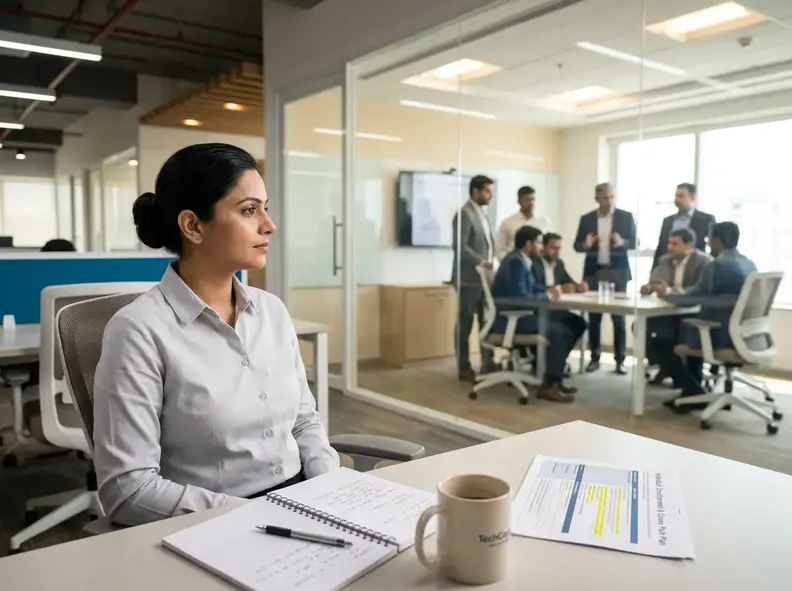
The same promotion discussions happen without her in the room. The stretch assignments still go to the same familiar names. The visibility model still rewards being seen at 9 PM in the office. Her sponsor list is empty because the structure for senior leaders to advocate for her never got built.
This is not a development failure. Instead, it is an organisational design failure, and without parallel work on the system itself, individual development creates frustration. The women you invested in either accept the ceiling or leave for an organisation that has done the harder work.
Build a women's leadership pipeline that produces results, not reports.
Whether you need an intensive workshop for high-potential women, a sustained development journey aligned to your DEI strategy, or a custom engagement that combines individual development with organisational change, Excellential would like to understand your situation and design around it.
FAQS
Frequently asked questions
What is a women's leadership and development programme?
A structured initiative that builds the leadership skills women need to advance into senior roles while also addressing the systemic barriers slowing that advancement. The strongest programs combine individual development with organisational work on sponsorship, promotion criteria, and bias in opportunity distribution.
How is this different from a general leadership programme?
General leadership programs teach universal skills. A women’s leadership program addresses the additional barriers women face: the double bind, the sponsorship gap, the visibility challenge, and systemic biases in promotion discussions. Both matter. We focus on what general programs miss.
Is this only for women participants?
The core program is designed for women professionals. Specific modules engage male leaders as sponsors, managers, and decision-makers in promotion conversations. Sustainable change requires everyone at the table.
What makes Excellential's women's leadership programme different from other providers in India?
We lead with skills, not inspiration. We design for Indian workplace dynamics rather than imported global frameworks. And we engage the organisation, not just the participants, because pipeline change needs both individual development and structural support.
Can this be part of our DEI or gender diversity strategy?
Yes. We align program outcomes to your gender diversity metrics, work with your DEI team to customize content, and provide impact data for leadership and board reviews. It can be embedded in your broader talent strategy as a structured development journey, not a standalone workshop.
Does this cover women returning from maternity or career breaks?
Yes. Module 3 addresses the return from maternity or a career break specifically, covering how to rebuild visibility, renegotiate scope, and create a re-entry plan that puts women back on the leadership track. For organizations supporting individual returners, we also offer one-on-one coaching alongside the program.
Is this a women's empowerment training or a leadership skills program?
Both, but we lead with skills. Empowerment that comes from real capabilities, executive presence, negotiation, and sponsorship strategy lasts. Empowerment that comes from motivational talks does not.
Can this be combined with mentoring, coaching, or sponsorship matching?
Yes. Many clients combine the workshop modules with individual coaching for participants and structured sponsorship matching with senior leaders. The combination of group learning, individual coaching, and organizational sponsorship produces meaningfully stronger outcomes than the workshop alone.
How do you measure the impact of this program?
We align measurement with the Kirkpatrick model. Behavior change is tracked at 30, 60, and 90 days through self-assessment, peer feedback, and manager observation. Business outcomes such as women’s representation in promotion shortlists and retention of high-potential women are tracked against a baseline.
Do you customise the programme to our industry and context?
Yes. We customise scenarios, exercises, and case material to reflect your industry, organisational dynamics, and cohort seniority. The programme for a manufacturing client looks meaningfully different from one for a BFSI or technology client.
What is the ideal cohort size and programme length?
We recommend 15 to 25 participants for the best learning experience, though we run effective programmes from 8 to 40. The intensive workshop runs across two full days, the development journey across four modules over three months, and the blended programme combines a one-day workshop with monthly virtual sessions over six months.
Is this available across India?
Yes. We deliver women’s leadership programs across Bengaluru, Mumbai, Delhi, Hyderabad, Chennai, Pune, Gurgaon, Noida, Kolkata, Ahmedabad, Indore, and Coimbatore. Virtual and hybrid formats are available anywhere in India, in English, Hindi, and regional languages.
Do you offer ongoing consulting beyond the programme?
Yes. We work with HR and DEI teams on the systemic side: promotion criteria audits, sponsorship matching design, return-to-work frameworks, and leadership pipeline tracking. If you need strategic support beyond the programme, we do both.