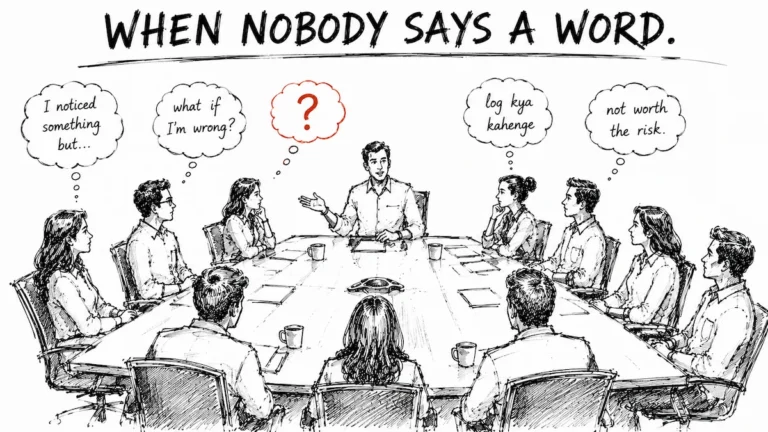
This is where psychological safety India loses its biggest battle: the Log Kya Kahenge effect.
Psychological safety India describes whether people in Indian workplaces feel safe to ask questions, admit mistakes, and challenge ideas without fear of being punished, judged, or sidelined.
Key Takeaways
|
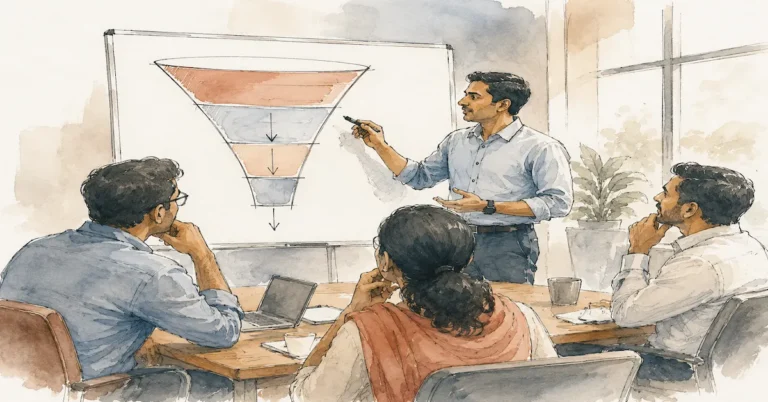
Tuesday, 11:15 AM. Conference Room B. A product review meeting at a 400-person software company in Bengaluru.
Arjun, the Engineering Director, is presenting the Q3 roadmap. Twelve people are in the room. He asks, “Any questions? Any concerns?”
Silence.
He waits three seconds. “Great, let’s move forward then.”
Here’s what Arjun doesn’t know:
Deepa, the QA lead, noticed a dependency conflict that will delay the release by two weeks. She didn’t say anything because the last time she raised a flag in a meeting, Arjun said, “Let’s not be negative, let’s focus on solutions.” She decided it wasn’t worth the risk.
Farhan, a senior developer, has a fundamentally different approach to the architecture that would save three sprints. He didn’t mention it because Arjun had already committed to the current approach in front of the VP. Contradicting him would feel like insubordination.
Sneha, a new hire with four weeks on the job, had a question about the user research data. She didn’t ask because nobody else was asking questions, and she assumed she was the only one who didn’t understand.
The meeting ended in 25 minutes. Arjun thought it went well. Three months later, the release was delayed by six weeks, the architecture had to be reworked, and the user research gap caused two major bugs in production.
Every one of these problems was preventable. Everyone was visible to someone in that room. And nobody said a word.
This is what happens when the psychological safety Indian workplaces desperately need goes missing from a team.
What Psychological Safety Actually Means (And What It Doesn’t)
Harvard professor Amy Edmondson coined the term psychological safety. It means a shared belief that the team is safe for interpersonal risk-taking, that you can ask a question, admit a mistake, challenge an idea, or disagree with your boss without being punished, humiliated, or sidelined.
- It does not mean being nice.
- It does not mean avoiding conflict.
- It does not mean lowering performance standards or coddling underperformers.
In fact, the most psychologically safe teams are often the most demanding. They hold each other to high standards precisely because people feel safe enough to give honest feedback, point out problems early, and push back on bad ideas regardless of who proposed them.
Google’s Project Aristotle, which studied hundreds of teams to understand what made some effective and others not, found that psychological safety was the single most important factor in team performance.
- Not talent.
- Not resources.
- Not a strategy.
But Safety.
You can read more about Amy Edmondson’s foundational research on psychological safety on Harvard Business Review.
Why Indian Teams Struggle to Build Psychological Safety
Every workplace has barriers to psychological safety. But Indian workplaces have some that are culturally specific and deeply embedded.
Barrier 1: The Hierarchy Tax
Research on psychological safety in India consistently points to one dominant barrier: hierarchy. Respect for seniority is ingrained from childhood in our families, in our schools, and in our workplaces. Questioning a senior person feels like disrespect. Disagreeing with your manager feels like career sabotage.
In many Indian companies, the most senior person in the room speaks first and speaks most. Everyone else adjusts their opinion to match. The result: meetings produce agreement, not insight. And the organisation loses the benefit of the 11 other brains in the room.
Barrier 2: The Punishment Pattern
In too many Indian organisations, speaking up brings consequences, not rewards. The employee who flags a problem is labelled “negative.” The manager who admits uncertainty is seen as “weak.” The new hire who asks too many questions is told, “Just follow the process for now.”
Over time, people learn. They learn that silence is safer than honesty. They learn that nodding is easier than questioning. And the organisation wonders why nobody raises red flags until it’s too late.
Barrier 3: The “Log Kya Kahenge” Effect
This is where psychological safety in India loses its biggest battle, the Log Kya Kahenge effect. In Indian workplaces, there’s a constant awareness of how you’re being perceived by others.
- Will I look stupid if I ask this?
- Will my manager think I’m not ready for promotion if I admit I don’t know something?
- Will my peers judge me if I disagree?
This social surveillance is exhausting. It turns every meeting into a performance, every email into a calculated move, and every interaction into a risk assessment. The mental energy goes into managing impressions rather than solving problems.
Barrier 4: The Remote and Hybrid Amplifier
All of the above gets worse in remote and hybrid settings. On a video call, you can’t read the room. You can’t gauge whether it’s safe to speak. The mute button becomes a shield. And the chat box, which should be a participation channel, becomes a place where people type “+1” instead of their actual opinion.
For Indian teams operating across cities and time zones, Bengaluru, Pune, Hyderabad, Gurugram, Chennai, the combination of cultural hierarchy and digital distance creates a perfect storm of silence.
Five Shifts That Build Psychological Safety in Indian Teams
You can’t build the psychological safety Indian teams need with a policy or a poster. Managers and leaders build it through consistent, visible behaviour. Here are five practical shifts that work in Indian contexts.
Shift 1: Make the Leader Speak Last
This single change transforms meetings. When the most senior person speaks first, everyone anchors to their view. When the leader speaks last, the team is forced to think independently.
Start your next meeting by saying: “I want to hear from everyone before I share my view.” Then actually do it. Call on people by name. Give junior members the floor first. And when someone shares an idea you disagree with, resist the urge to correct immediately, and ask a follow-up question instead.
This isn’t about being democratic for the sake of it. It’s about getting access to information that the hierarchy normally suppresses.
Shift 2: Normalise Admitting Mistakes – Starting with Yourself
If you want your team to admit mistakes, you have to go first.
In your next team meeting, share a mistake you made recently. Not a humble brag (“I worked too hard and forgot to take a break”). A real mistake. “I underestimated the timeline on the client project, and it caused a scramble. Here’s what I’m doing differently.”
When a leader admits a mistake, and the sky doesn’t fall, it sends a message louder than any values statement: it’s safe to be human here.
One General Manager I coached at a manufacturing company in Chennai started every Monday review by sharing his “learning of the week,” a polite way of saying “here’s what I got wrong.” Within two months, his team started doing the same. Within six months, their error-reporting rate tripled, not because more errors were happening, but because the team was surfacing errors earlier.
Shift 3: Separate the Idea from the Person
In Indian workplaces, ideas and identities are often fused. Criticizing an idea feels like criticizing the person who proposed it. This makes an honest evaluation of proposals almost impossible.
Build a practice of idea evaluation that explicitly separates the two. One technique that works well: before debating a proposal, have the team list the three strongest arguments in favour and the three biggest risks, regardless of who proposed it. This makes critique feel analytical, not personal.
Another approach: rotate the “devil’s advocate” role in meetings. When one person is explicitly tasked with poking holes in an idea, disagreement stops feeling like betrayal and starts feeling like rigour.
Shift 4: Respond to Bad News Like It’s a Gift
The way a leader responds to the first piece of bad news determines whether they’ll ever hear the second one.
If your first reaction to a problem is frustration, blame, or a sharp “How did this happen?” you’ve just taught your team to filter bad news before it reaches you. They’ll start softening problems, hiding delays, and presenting only the version of reality they think you can handle.
Instead, when someone brings you a problem, start with: “Thank you for telling me. What do you need from me to fix it?” This isn’t a weakness. It’s strategic. You’re building an early-warning system that runs on trust instead of fear.
A VP at a financial services company in Mumbai told me, “I used to wonder why surprises always came at the worst possible moment. Then I realized the surprises weren’t sudden. My team had known about them for weeks. They just didn’t feel safe telling me.”
Shift 5: Build Safety into the System, Not Just the Culture
Don’t rely on individual managers to create psychological safety through sheer personality. Build it into your systems and rituals.
Run anonymous “pre-mortems” before major projects: “Imagine this project has failed. What went wrong?” This permits people to voice concerns without directly opposing the plan.
Add a standing agenda item to your weekly team meetings: “What’s one thing that’s not working that we haven’t talked about yet?” Make it normal. Make it expected. Make it boring because boring is safe.
Institute skip-level meetings where team members talk to their manager’s manager once a quarter. Not to complain, to share perspective. When people know there’s a channel beyond their direct reporting line, the power dynamic shifts just enough to enable honesty.
The Cost of Silence Is Always Higher Than the Cost of Speaking Up
Every organisation has people who see problems others don’t see. Who has ideas others haven’t considered? Who could prevent failures before they happen?
The question is whether those people feel safe enough to open their mouths.
Psychological safety isn’t a soft, feel-good initiative. It’s the difference between a team that catches a bug before it reaches the customer and a team that watches it ship because nobody wanted to be the one who raised the alarm. It’s the difference between a culture that learns from failure and a culture that repeats it.
And in Indian workplaces where hierarchy, reputation management, and the instinct to avoid conflict are deeply wired, building psychological safety isn’t optional. It’s the most important work a leader can do.
Start with one shift. Try it for 30 days. Watch what changes.
Your team already has the answers. They’re just waiting for permission to share them.
At Excellential, we specialise in psychological safety. India’s leadership teams can actually build not through motivational slogans, but through structured behavioural interventions that change how teams communicate, decide, and learn. With 24 years of experience across sectors, we know what works in Indian workplaces because we’ve seen what doesn’t.
Frequently Asked Questions
What is psychological safety?
Psychological safety is a shared belief that a team is safe for interpersonal risk-taking. People can ask questions, admit mistakes, challenge ideas, and disagree with a manager without being punished or humiliated. Harvard professor Amy Edmondson coined the term. It raises performance rather than lowering standards.
Why is psychological safety harder to build in Indian workplaces?
Indian workplaces carry culturally specific barriers. Respect for hierarchy makes questioning seniors feel like disrespect. Speaking up often brings the label “negative.” The Log Kya Kahenge effect adds constant worry about how others judge you. Remote and hybrid work then deepens the silence across cities and time zones.
What is the Log Kya Kahenge effect at work?
Log Kya Kahenge means “what will people say.” At work, it shows up as constant impression management. People stay quiet because they fear looking foolish, seeming unready for promotion, or being judged for disagreeing. The energy that could solve problems goes into protecting reputation instead.
How can leaders build psychological safety in their teams?
Leaders build it through visible behaviour, not posters. Speak last so the team thinks independently. Admit your own mistakes first. Separate ideas from identities when critiquing. Respond to bad news with thanks, not blame. And build safety into systems through pre-mortems, standing agenda items, and skip-level meetings.
Does psychological safety mean lower performance standards?
No. The most psychologically safe teams are often the most demanding. People feel safe enough to give honest feedback, flag problems early, and push back on weak ideas, whoever proposed them. Safety removes the fear that hides problems, so standards rise rather than fall.
Has your team gone silent in meetings? I’d love to hear what’s worked (or hasn’t) in building a speak-up culture at your organisation.
We help Indian leadership teams build psychological safety that holds, not through motivational slogans but through structured behavioural interventions that change how teams communicate, decide, and learn.