
This is the “last mile” problem of change management India repeatedly trips over.
Why most change management India initiatives fail before they even reach Month 6: a post-mortem of one transformation, five autopsy findings, and what the 30% who succeed do differently.
The following is a composite case, drawn from multiple real transformations I’ve been part of. Names and industries are changed. The patterns are exact.
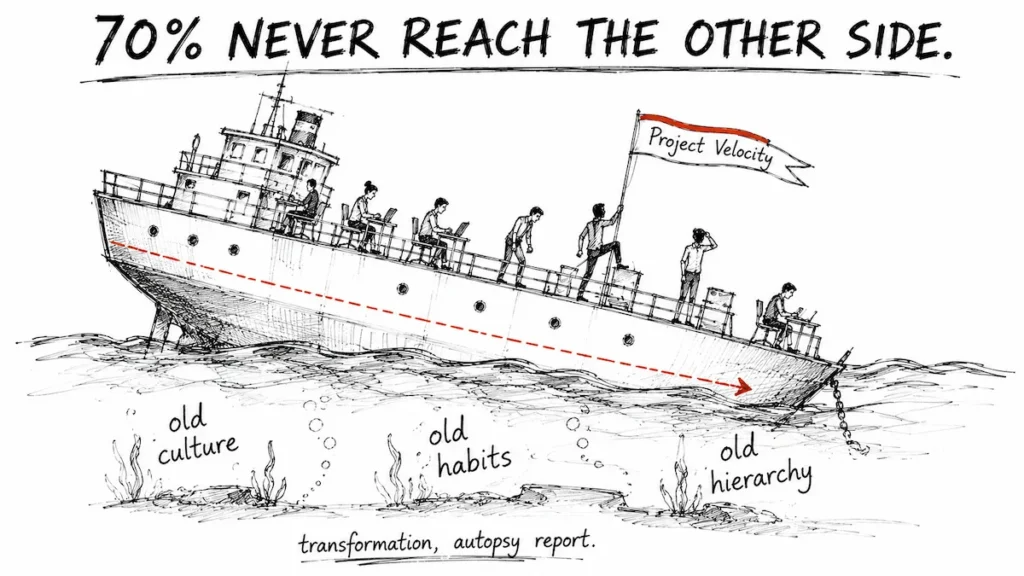
In January 2023, the CEO of a 1,200-person FMCG company headquartered in Mumbai announced a company-wide transformation. The initiative had a name (Project Velocity), a consulting partner, a 48-slide deck, and a ₹2.5 crore budget.
The goals were ambitious: restructure the sales organisation, implement a new CRM, shift from product-led to customer-led operations, and “build a culture of accountability.”
By December 2023, here’s where Project Velocity stood: The CRM was live, but only 40% of the sales team was using it. The restructured organisation had been announced but not operationalized. People had new titles but old jobs. The “culture of accountability” had become a running joke on the floor. And the consulting partner had moved on to the next client.
Project Velocity wasn’t cancelled. It just quietly faded. No one declared it dead. It simply stopped mattering.
This is how most transformations fail in India. Not with a dramatic collapse, but with a slow, silent retreat to the way things were.
McKinsey has long reported that roughly 70% of change initiatives don’t achieve their stated goals. The pattern holds and arguably intensifies in change management India practitioners see across sectors.
The question isn’t whether change fails. The question is why it keeps failing in the same ways.
Change management India is the practice of leading organisational change within Indian workplaces, where hierarchy, tenure, and face-saving norms decide whether a transformation takes root or quietly fades.
Key Takeaways
|
Here are the five causes of death.
Cause of Death #1: The Change Was Announced, Not Explained
Project Velocity kicked off with a town hall. The CEO gave a 30-minute speech. There were slides. There was applause. And then everyone went back to their desks with the same question: “What does this actually mean for me?”
This is what we keep seeing in Indian change management India practitioners deliver every quarter. Leaders communicate the what but not the why. They announce the destination without explaining the reason for the journey. And in hierarchical cultures where asking “why” can feel like questioning authority, employees don’t push back. They just wait and hope it blows over like the last initiative.
The antidote isn’t more communication. It’s better communication, and it works in layers:
Layer 1-The strategic why: Why is this change necessary? What will happen if we don’t change? This comes from the CEO, and it needs to be honest, not corporate. “We’re losing market share because our competitors are closer to the customer than we are” is better than “We’re embarking on a transformation to become a customer-centric organisation.”
Layer 2-The personal why: What does this mean for my role, my team, my daily work? This comes from the direct manager, not from a slide deck. Every employee should be able to answer: “What will change about my Tuesday?”
Layer 3-The ongoing why: Repeat the message. Then repeat it. Research consistently shows that people need to hear a message 5-7 times through different channels before they internalize it. One town hall does not change communication. It’s a starting pistol and most companies treat it as the finish line.
Cause of Death #2: Middle Management Was Left Out of the Room
In Project Velocity, the strategy was designed by the CEO and the consulting team. The senior leadership signed off. And then senior leadership handed the plan to middle managers with instructions to “cascade.”
- Nobody asked them what they thought.
- Nobody trained them for the new expectations.
- Nobody acknowledged that they were being asked to drive a change they didn’t help design, in teams that didn’t want it, with no additional time or support.
Middle managers in India are the most overloaded, under-supported layer in any organisation. They’re managing delivery upward and managing people downward, and most of them are doing both on instinct because nobody invested in their development. When a transformation lands on their desk, they don’t resist because they’re not against change. They resist because they’re exhausted and unsupported.
The antidote: Bring middle managers into the design phase not to get their permission, but to get their intelligence.
- They know where the real bottlenecks are.
- They know which processes will break.
- They know which team members will struggle.
Use that knowledge. And then equip them with three things: clear talking points (so they can explain the change to their teams without guessing), permission to adapt (so they can fit the change to local realities), and visible support from above (so they’re not standing alone when their team pushes back).
Cause of Death #3: The Change Had No Behavioural Anchor
Project Velocity talked a lot about “accountability.” But nobody defined what accountability looked like on a Tuesday morning.
- Was it logging activity in the CRM?
- Was it owning a problem without passing it up the chain?
- Was it having honest conversations about underperformance?
When a change initiative uses abstract words without linking them to observable behaviours, everyone nods in agreement, and nothing changes. Because everyone defines the word differently in their head.
- To the CEO, “accountability” meant ownership.
- To a sales manager in Ahmedabad, it meant “more reporting.”
- To a frontline executive, it meant “more scrutiny.”
Same word. Three different interpretations. Zero alignment.
The antidote: Translate every change objective into 2-3 specific, observable behaviours. Not “become customer-centric” but “Every client interaction ends with the question: What else can we help you with?” Not “build accountability” but “Every project has one named owner, and that person gives a weekly status update in the Monday standup.” Behaviour matters more than philosophy. Always.
Cause of Death #4: The Change Fought the Culture and Culture Won
There’s a famous business adage often attributed to Peter Drucker: “Culture eats strategy for breakfast.” In Indian organisations, culture eats strategy, digests it, and asks for seconds.
Project Velocity wanted to flatten decision-making. But the company had 20 years of hierarchical culture baked into every process, every meeting, every promotion decision. You can’t install flat decision-making in an organisation where people still stand up when the MD enters the room.
The change wasn’t wrong. It just ignored the cultural gravity it was fighting against. And in India, this resistance is heavy. Tenure matters. Status matters. Seniority determines who speaks, who decides, and who gets credit. The existing culture will swallow any change that threatens these norms without explicitly addressing them.
The antidote: Map the cultural norms that will resist your change before you launch it. Ask yourself: What current behaviour does this change threaten? Who loses status, power, or comfort? What informal rules will this break? Then design the change to work with the culture where possible and deliberately rewire the specific norms that must shift. You can’t change an entire culture overnight. But you can change three or four critical behaviours, and that’s where transformation actually lives.
Cause of Death #5: Nobody Owned the Change After the Launch
Project Velocity had a launch team. It had a Gantt chart. It had a war room for the first 60 days. And then the consulting partner left, the launch team went back to their regular jobs, and the initiative became an orphan.
This is the “last mile” problem of change management India repeatedly trips over. The energy goes into the announcement, the kickoff, the first phase. But nobody plans for months 4 through 12 the long, unglamorous slog where the real change either takes root or dies.
Transformation doesn’t happen at the town hall. It happens six months later, when a manager in Kolkata is still following the new process even though nobody is watching. It happens when the CRM adoption rate keeps climbing because someone is tracking it weekly, removing friction, and celebrating small wins.
The antidote: Appoint a Change Owner, not a committee, a person. Someone with the authority and bandwidth to drive adoption after the consultants leave. Give them three non-negotiables: a weekly adoption dashboard (are people actually changing behaviour?), a monthly leadership check-in (is this still a priority from the top?), and a quarterly course-correction (what needs to be adjusted based on ground reality?). Most transformations do not die because they were bad ideas, but because nobody tended the garden after planting the seeds.
Change Management India: What the 30% That Succeed Do Differently
The transformations that work in India share a pattern. Not a formula, a pattern.
- They start with brutal honesty about why the change is needed.
- They bring middle managers into the room early.
- They translate abstract goals into concrete, daily behaviours.
- They respect the existing culture while deliberately shifting the three or four norms that must change.
- And they assign ownership that lasts well beyond the launch.
None of this is complicated. But all of it is hard. It requires patience, consistency, and the willingness to manage the people side of change with the same rigour you manage the process side.
The 70% that fail don’t fail because change is impossible. They fail because organisations treat change as a project with a start date and an end date. Change isn’t a project. It’s a shift in how people work, think, and interact every day, long after the slide deck has been forgotten.
If your organisation is about to start a transformation or recover from one that stalled, start with one question: “Who is going to own this change on Day 180, when nobody is excited about it anymore?”
If you don’t have a name, you don’t have a plan.
Frequently Asked Questions
Why do most change management initiatives in India fail?
Most change management India initiatives fail because organisations treat change as a project with a start and end date, not a daily shift in how people work. Leaders announce rather than explain, leave middle managers out, skip observable behaviours, fight the culture, and assign no owner after launch.
What percentage of change management initiatives fail?
McKinsey has long reported that roughly 70% of change initiatives do not achieve their stated goals. In India, the pattern holds and often intensifies, because hierarchy, tenure, and face-saving norms add resistance that generic transformation plans rarely account for. The failure is usually quiet, fading by Month 6 rather than collapsing outright.
How can Indian organisations make change management succeed?
The 30% that succeed start with brutal honesty about why the change matters, bring middle managers into the design early, translate goals into daily behaviours, respect cultural norms while shifting three or four critical ones, and assign a single Change Owner who drives adoption long after the launch excitement fades.
What is the role of middle managers in change management?
Middle managers carry transformations on the ground, yet most organisations hand them a finished plan to cascade without design input, training, or support. Bring them in early for their intelligence about real bottlenecks, then equip them with clear talking points, permission to adapt locally, and visible backing from senior leaders.
Why does culture affect change management in India?
In Indian organisations, culture often outweighs strategy. Twenty years of hierarchy, tenure, and status sit inside every process and meeting, so the existing culture quietly swallows any change that threatens these norms. Map the cultural gravity your change fights before launch, then rewire the three or four behaviours that must shift.
At Excellential, we partner with Indian organisations on change management India needs but rarely gets managing the human side of transformation, the side that consulting decks don’t cover. From cultural diagnostics to behavioural change programs to leadership alignment, we help you build the muscle that makes change stick. With 25+ years of hands-on experience, we’ve seen what kills transformations and what saves them.
Book a Free Consultation
Has your organisation survived or stalled a transformation? I’d love to hear what happened and what you learned. Drop a comment or reach out.