
DESIGN THINKING WORKSHOP
Design thinking workshop in India that changes what your teams build
Fall in love with the problem, not your first solution.
Design thinking is a five-stage method: empathise, define, ideate, prototype, and test for solving the right problem by starting with the user rather than the solution.
Most teams in Indian organisations reach for a solution before they have understood the problem. The engineer’s reflex, the manager’s confidence, and the pressure to look decisive in front of a senior, all of it pushes teams to build before they understand. This design thinking workshop trains your product, business, and functional teams to slow down at the moment that matters: understand the real user, frame the right problem, and test cheap prototypes before committing budget to the wrong build.
- Built for Indian workplaces. Hierarchy, face-saving, jugaad, and the polite signal that hides an honest no, named directly and worked into every sprint, not abstracted into a global creativity module.
- A real credential, not a printout. Participants earn the Excellential Certified Design Thinker (ECDT) credential after a 30-day audit on a design sprint they actually ran at work; Excellential does not hand it out at the closing session.
- 25+ years of HR, L&D, and business advisory experience. 20,000+ professionals trained across 85+ organisations in IT, BFSI, manufacturing, retail, pharma, and startups.
- Flexible delivery. In-person, virtual, or hybrid. English and Hindi are standard regional languages on request.
Tell us about your team and the challenge you are facing, and Excellential will design the workshop around it.









































KEY TAKEAWAYS
- Built for people who decide what gets built: product managers, founders, business unit heads and technical leads, not a craft course for designers.
- Excellential names five recurring failure patterns: solving before meeting the user, designing for the senior reviewer instead of the customer, jugaad mistaken for design, hidden unfinished prototypes, and ideation where hierarchy silences the best idea.
- The workshop runs seven modules across the empathise, define, ideate, prototype and test stages, ending with running a live design sprint.
- Organisations report fewer products built for needs nobody validated, and faster, cheaper learning through tested prototypes rather than finished launches.
- Before the workshop, Excellential spends two to three hours with product or L&D leadership to build the session around a live challenge from the organisation, not a textbook case.
- Learning gain is measured by re-running each participant's diagnostic five days after the workshop and calculating the change, not by a feedback form.
Share the real product or process decision your team is facing, and Excellential will build the design sprint around it.
THE PROBLEM
Why most "innovation" workshops produce sticky notes and nothing else
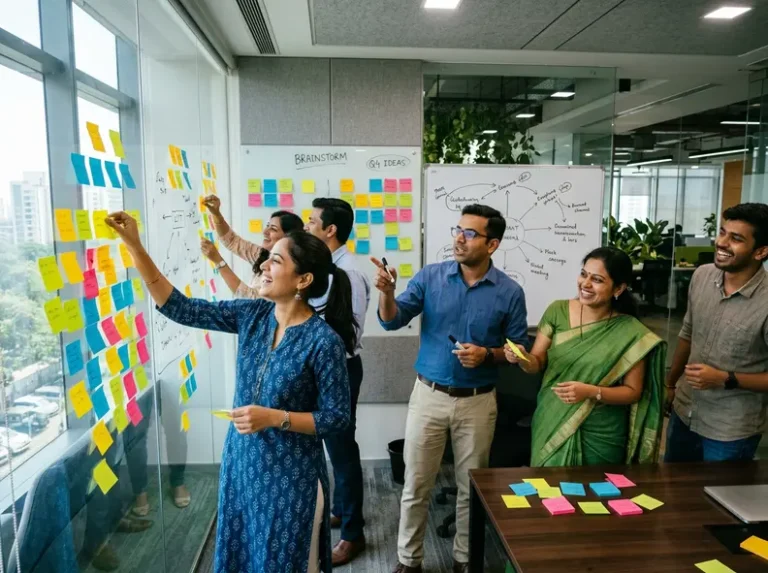
Most Indian organisations have run a design thinking session at some point. A facilitator arrived, the room filled with coloured sticky notes, everyone enjoyed the day, and within a fortnight, the team was back to building exactly what the most senior person wanted in the first place. The method was performed. The behaviour did not change.
The reason is rarely the method. Design thinking works. The reason is that the workshop treated it as a creativity event rather than a working discipline, then taught it to people who returned to a hierarchy and a deadline that punish the very behaviours design thinking depends on: admitting you do not yet understand the problem, showing an unfinished prototype, letting a junior’s idea beat a director’s.
McKinsey’s study, The Business Value of Design, tracked companies over five years and found the top performers on its design index grew revenue 32 percentage points faster and delivered total shareholder returns 56 points higher than their industry peers.
Design is not decoration on the product. It is a measurable factor in which products succeed and which quietly fail.
The patterns that Excellential sees across every organisation
After delivering design thinking workshop training across IT services, BFSI, manufacturing, pharma, retail, and startups, the same five patterns surface with striking regularity.
1. Solution-first, user-never
The team knows the answer before it has met the user.
The product is scoped around what engineering can build, what the founder already believes, or what a competitor just launched. The end user is consulted late, if at all, and usually to confirm a decision already made rather than to shape it. Build ships. The adoption never comes.
2. Building for the boss, not the customer
The safest design decision is the one the senior person prefers.
Teams quietly optimise the product for the reviewer in the room rather than the user outside the building. The feature that impresses the steering committee gets built. The feature the customer needed loses the argument because the customer was not in the room to make it.
3. Jugaad mistaken for design
Improvisation patches the symptom. Design redesigns the cause.
Indian teams are skilled at the quick fix and the make-do under constraint, and that instinct is a real strength. But jugaad solves the immediate symptom with whatever is at hand. Design thinking asks whether the right problem is being solved at all. Teams that rely only on improvisation patch the same problem repeatedly and never redesign the thing that keeps breaking.
Excellential has written more on capability versus improvisation in The Balloon Lesson: Why Capability Beats Hustle Every Time.
4. The fear of the unfinished prototype
Polish signals competence, so rough work stays hidden.
Showing rough work is culturally expensive in Indian workplaces, where a half-finished draft can read as carelessness. So teams hide their thinking until it is “ready,” skip the cheap prototype, and present the expensive finished build, at which point the flaws are slow and costly to fix. The fear of looking unpolished is exactly what makes the final product so expensive to correct.
5. Ideation under hierarchy
The most senior voice judges before the quietest voice has spoken.
The brainstorm where the director speaks first, and everyone else calibrates to that view. The junior who had the better idea reads the room and stays quiet. Divergent thinking needs psychological safety and a structure that separates generating ideas from judging them. Most Indian ideation sessions collapse the two, and the most senior voice does the judging before the quietest voice has spoken.
What design thinking done badly, or not at all, costs an Indian organisation
The feature that took two quarters to build and that nobody uses. The app redesign that tested beautifully with the internal team and confused every actual customer. The new service line the team launched on a senior leader’s conviction, which the market never confirmed. The process redesign that fixed the problem the team could see and missed the one the user had.
None of these read as design failures in the post-mortem. They read as market timing, adoption, or execution problems. The cost landed much earlier, the day the team committed to a solution, it had never been tested against a real user.
Take an illustrative Indian product organisation spending ₹50 crore a year on product and engineering (put your own number through it). If even a conservative one-fifth of that effort aims at needs no one validated, that is ₹10 crore of build pointed at the wrong target every year, which project budgets absorb quietly, and almost no one traces back to the design decision that caused it. The rupee figure is illustrative; the cost category is real.
The good news: design thinking is teachable. Run as a working method rather than an away-day, the discipline is learnable, and it pays for itself the first time it stops a team from building the wrong thing.
THE PROGRAMME
What this design thinking workshop covers
Seven modules, each built around the situations Indian product, business, and functional teams face every quarter. Pre-read assignments come before the workshop, live design sprint work during it, and Excellential awards the ECDT credential only after the 30-day application audit clears.
Module 1
The mindset shift from solving to understanding
Why the instinct to solve fast is the most expensive habit on the team. The difference between a creative event and a working discipline. The five stages, and the exact point where Indian teams skip straight to the build. Setting the workshop up around a real challenge that the team brings from work.
Module 2
Empathise: understanding the user you build for
User research that fits a working week, not an academic study. An interview technique that surfaces what people do rather than what they say. Observation, journey mapping, and separating the user’s problem from your assumption about it. Why building for the boss is the most costly research error.
Module 3
Define: framing the right problem first
Turning research into a sharp problem statement that the whole team can agree on. Point-of-view statements and “How Might We” framing. The reframe that turns an unsolvable problem into a solvable one. Why a well-defined problem is most of the solution, and why most teams never write it down.
Module 4
Ideate: real options under a real hierarchy
Structured ideation that separates generating ideas from judging them. Techniques that get the quietest person’s idea onto the wall before the most senior person speaks. Working with the Indian hierarchy and face-saving rather than pretending they are not in the room. Moving past the first obvious idea and past jugaad.
Module 5
Prototype: making ideas cheap enough to be wrong
Low-fidelity prototyping with paper, wireframes, storyboards, and role-play. Making the unfinished prototype safe to show in a culture that prizes polish. The principle that a prototype is built to be killed, not defended. Spending hours to test an idea before spending months to build it.
Module 6
Test: validating and reading honest signals
Running a test that produces a decision, not just applause. Telling a real signal apart from the polite agreement that Indian users often offer to be courteous. Iterating on what you learn rather than defending what you built. Knowing when to advance an idea, when to change it, and when to let it go.
Module 7
Running a design sprint and embedding the method
The compressed five-day sprint format and how to facilitate one. Building the method into how the team works after the workshop, so it survives contact with the next deadline. Linking design decisions to the outcomes leadership tracks: adoption, cycle time, and revenue, not satisfaction scores.
Want a design sprint built around your team's real challenge?
Excellential will tailor the modules and challenge library to your industry, team, and the decision you are facing.
OUR APPROACH
The Predict-Probe-Validate (PPV) Framework
The test of this workshop is simple: does the team’s next real product decision look different from its last one? If not, we failed. PPV is built around that test. It is not a method Excellential invented last year. It is how team Excellential has run knowledge and skills workshops for 25+ years, now codified into three stages, so you know exactly what you are buying and how Excellential proves it worked.
Predict: the week before
Two to three hours with your product, innovation, or L&D leadership to learn the real design challenges and where the team jumps from problem to build. Every participant completes a 30-minute diagnostic, rating their own practice across the five stages. Each gets an individual baseline; you get a cohort capability map. The workshop is then built around a live challenge from your organisation, not a textbook case about a Western start-up.
Probe: the workshop, one to two days
Seven modules, drawn from industry-specific challenge libraries built over 25+ years across IT services, BFSI, manufacturing, pharma, retail, and startups. Every participant runs a compressed design sprint under facilitator observation, builds and tests real prototypes in the room, and Excellential scores the work against a published rubric. They learn the method by running it, not by hearing it described.
Validate: proving the practice changed
Within five days, Excellential re-runs the diagnostic and calculates each participant’s pre-to-post delta, Kirkpatrick Level 2 evidence of learning, rather than a feedback form, alongside supervisor-validated feedback. At 30 days, each participant submits a real design sprint they ran at work, and Excellential audits it for research quality, problem framing, prototype-and-test rigour, and honest iteration. Clear the audit, and the participant earns the ECDT credential. Fall short, and they receive coaching and a re-audit at 60 days.
CERTIFICATION
Design thinking training certification: the Excellential Certified Design Thinker (ECDT) credential
Most design thinking workshop training in India hands out a participation certificate. Anyone who attends walks away certified, regardless of whether they can run a real design sprint the next morning.
Attendance alone tells you nothing about whether the person can run a real sprint.
Participants earn the Excellential Certified Design Thinker credential across the three PPV stages, and Excellential awards it only after they clear the second beat of Validate, the 30-day audit.
The standard
- Pre-work diagnostic and pre-read completed in full.
- Workshop attendance with a live design sprint scored against the published rubric.
- Post-assessment showing a measurable learning gain.
- Supervisor-validated feedback completed.
- A 30-day audit of a real design sprint the participant ran, demonstrating research quality, problem-framing discipline, prototype-and-test rigour, and honest iteration.
The outcomes
- Participants who meet the standard receive the ECDT credential, valid for three years.
- Participants who do not meet the standard on the 30-day audit receive coaching feedback and a re-audit option at 60 days, holding "Provisional ECDT" status until the re-audit clears.
The signal. An ECDT badge means the person has run a real design sprint on a real problem from their own work, to a published standard. Because Excellential publishes the standard and audits it against real output, the credential is a verifiable claim, not a printout. Your product and innovation leaders can see exactly what is required and judge the work against it. A real standard means a real signal in your team.
LEARNING OUTCOMES
What your teams will do differently after this design thinking workshop
By the end of the workshop and the 30-day application audit, every certified participant will be able to:
- Run user research that fits a working week and surfaces what people actually do, not what they say they do.
- Write a sharp problem statement and a "How Might We" framing that the whole team can agree on before any building starts.
- Reframe a stuck problem into one the team can solve.
- Facilitate a structured ideation session that surfaces the quietest person's idea before the most senior person judges it.
- Build a low-fidelity prototype cheaply enough to be wrong, and show it without waiting for polish.
- Run a user test that produces a decision, and read honest signal past the polite agreement Indian users often offer.
- Decide, on evidence, when to advance an idea, when to change it, and when to let it go.
- Run a compressed design sprint end-to-end on a real business or product challenge.
- Tell disciplined design thinking apart from improvisation, and know when each is the right tool.
- Link design decisions to the adoption, cycle-time, and revenue outcomes that leadership actually tracks.
RESULTS
What changes after this design thinking workshop
For the participant
- The confidence to show unfinished work early, when it is still cheap to change.
- A verifiable signal of applied design capability in the ECDT credential.
- Better product and process decisions, measurable through adoption and cycle-time data over 6 and 12 months.
For the organisation
- Fewer features and products were built for needs that were never validated.
- Faster, cheaper learning before commitment, because ideas are tested as prototypes rather than as launches.
- A shared design language across product, business, and functional teams.
- Decisions shaped by the user in the field rather than the senior voice in the room.
- A standing internal capability that does not depend on hiring an external design agency for every problem. It's the same build-internal-capability principle behind Excellential's AI-Enabled Learning Ecosystem case study.
- A clear line between design practice and the adoption, cycle-time, and revenue metrics leadership already tracks.
Testimonials
DELIVERY
Format and delivery options
| Format | Duration | Best for |
|---|---|---|
| Intensive workshop | 2 full days, in-person | A full design sprint run end-to-end with the team together |
| Virtual programme | 4 half-day sessions over 2 weeks | Distributed teams apply each stage between sessions |
| Blended journey | 1-day workshop + 3 virtual follow-ups over 6 weeks | Sustained application with live coaching on a real sprint |
| Intact product-team format | Custom design | A real product or process team running its current challenge as the workshop sprint |
Excellential delivers across India, including Bengaluru, Mumbai, Delhi NCR, Hyderabad, Chennai, Pune, Gurugram, Noida, Kolkata, and Coimbatore. Virtual delivery reaches teams anywhere in India and abroad. English and Hindi are standard, with regional languages on request. Recommended cohort size: 12 to 20 participants per workshop, working in sprint teams of four to six.
WHO IS IT FOR
Built for the people who decide what gets built
This is a decision-making discipline for the people who own what gets built, not a craft course for design professionals.
Product managers and owners
Who owns what gets built and needs the discipline to validate a need before committing to a roadmap for it.
Founders and senior leadership
Where every product and service bet carries real money, and the founding team’s first conviction needs testing against a real user before it becomes the company’s direction.
Innovation, CX, and service-design teams
Whose remit is to find and frame the right problems, but who often never learned the method formally.
Business unit and functional heads
In operations, marketing, HR, and customer service, where redesigning a process or an internal service benefits from the same user-first discipline as a product.
R&D, engineering, and technical leads
Whose solution-first instinct is a strength in delivery and a liability in discovery, and who gains the most from learning where each belongs.
Teams that need the diagnostic layer before the ideation layer may also want Excellential’s Critical Thinking and Problem-Solving Training.
L&D and HR leaders
Who wants a shared problem-solving and design capability across teams, built on a method that survives past the away-day.
Teams whose underlying gap is trust or accountability rather than method may be better served starting with Team Effectiveness Training.
WHY EXCELLENTIAL
Why product and L&D leaders choose Excellential for design thinking workshop
You have options. Global training platforms, boutique design studios, and online courses. Here is what makes working with us different.
A method for decision-makers, not a theory class
Excellential teaches design thinking to the people who decide what gets built, as a discipline they apply on Monday, not a vocabulary they recite. The target is behaviour change on a real project.
The PPV Framework
Pre-work diagnostic, a live design sprint, supervisor-validated feedback, a post-assessment, and a 30-day audit on a real sprint the participant ran. In Excellential’s experience, few Indian providers run a post-workshop application audit or let a participant fall short of certification.
Indian workplace context, not a Western template
The hierarchy makes the unfinished prototype expensive to show. The face-saving that suppresses the junior’s better idea. The polite agreement that hides an honest signal. Named directly and worked into every sprint.
25+ years of cross-industry work
The challenges, the user-research methods, and the facilitation under a hierarchy were all built and refined over 25+ years within Indian organisations and MNCs. 20,000+ professionals were trained across 85+ organisations.
Method-neutral, not tool-locked
Excellential does not sell a proprietary design platform or a certification you must renew with us. Your team learns the method and owns it permanently, using whatever tools it already has.
A certification with a real standard
The ECDT credential is awarded after a 30-day audit on a real design sprint, not at the end of the workshop. Pass rates are tracked and shared cohort-over-cohort.
COMPARISON
Generic design-thinking training vs Excellential
How a generic design thinking workshop compares with the Excellential PPV Framework.
| Comparison Factor | Generic design thinking workshop | Excellential PPV Framework |
|---|---|---|
| Pre-work | Optional reading list | Mandatory diagnostic + five-stage pre-read |
| Workshop duration | Half-day to one day | One to two days with a live design sprint |
| Audience | Designers, or a general "creativity" mix | Decision-makers: product, founders, function heads |
| Application | Hypothetical case (a coffee shop, a Western start-up) | A real challenge from the participant's own work |
| Indian context | Abstracted or absent | Hierarchy, face-saving, jugaad, and polite-signal patterns are named directly |
| Prototyping | Discussed | Built and tested in the room |
| Post-assessment | Feedback form | Diagnostic re-administered, pre-to-post delta measured |
| Depth of measurement | Feedback form | Supervisor-validated as standard; multi-source or 360 scoped on request |
| 30-day audit | None | Mandatory, on a real design sprint, the participant ran |
| Certification standard | Attendance-based | Application-based on a real sprint, with re-audit option |
| Methodology ownership | Vendor's proprietary tool or platform | Method-neutral, fully owned by your team |
Ready to build teams that solve the right problem?
Your teams are talented, fast, and confident, which is exactly why they reach for a solution before they have understood the problem. Whether it is one product team or the whole organisation, Excellential will understand your context first and build the workshop around your real challenges, not a generic curriculum.
FAQS
Frequently asked questions
Is this workshop for designers?
No. It is built for the people who decide what gets built: product managers, founders, function heads, and their teams. Designers are welcome and gain from it, but the method here is taught as a decision-making discipline for the people who decide what gets built.
How is the PPV Framework different from a standard design thinking workshop?
A standard workshop ends on the last day. The PPV Framework runs across three stages: pre-work diagnostic and pre-read, a workshop with a live design sprint, post-assessment with a measurable learning gain, and a 30-day application audit on a real sprint the participant ran. Certification is awarded only after the audit is cleared. The challenges are Indian-context, and supervisor-validated feedback is built in as standard.
What does the ECDT design thinking training certification involve?
The Excellential Certified Design Thinker credential requires five things: a completed pre-work diagnostic and pre-read, workshop attendance with a live design sprint scored against the published rubric, a measurable learning gain on the post-assessment, supervisor-validated feedback completed, and a passed 30-day audit on a real design sprint the participant ran. Validity is three years, with annual refresher options.
Do all participants get certified?
No. Participants who fall short on the 30-day audit receive coaching feedback and a re-audit option at 60 days. The credential is designed to be earned, not handed out. Cohort pass rates are tracked and shared cohort-over-cohort.
What is the supervisor-validated feedback component?
We agree on the measurement mechanism with you on a short expectation-setting call because every programme’s objective differs. The standard is supervisor-validated feedback: the participant and their supervisor independently rate practice before and after, giving a calibrated read that is more reliable than self-assessment and lighter than a full 360. If you want deeper measurement, we can scope a multi-source review or 360.
Can you run this as a workshop on design thinking for an intact product team working on a live challenge?
Yes, and it is one of our most-requested formats. The workshop is built around the team’s actual challenge, a product, service, or process decision the team is currently facing, and the sprint the team runs during the workshop becomes part of the real work. The 30-day audit then assesses the sprint the team produced. Best for intact teams of 8 to 12.
Do we need designers or special tools to take part?
No. The method runs on paper, whiteboards, and conversations with real users. Low-fidelity prototyping is deliberate; it keeps ideas cheap enough to be wrong. Teams that already use design or prototyping tools are welcome to, but nothing in the programme depends on them.
Where do you run design thinking workshops in India?
We deliver in-person across India, including Bengaluru, Mumbai, Delhi NCR, Hyderabad, Chennai, Pune, Gurugram, Noida, Kolkata, and Coimbatore. Virtual delivery is available for teams anywhere in India and abroad, in English and Hindi as standard, with regional languages on request.
How do you measure impact?
We measure across all four Kirkpatrick levels. Reaction at workshop close (Level 1). Pre-to-post diagnostic delta as learning evidence (Level 2). Supervisor-validated feedback and the 30-day audit as behaviour change (Level 3). And where you want to track them, adoption, cycle-time, and revenue outcomes on the cohort’s projects over 6 and 12 months (Level 4).
What makes Excellential different from other design-thinking providers in India?
Three things. A 30-day audit on a real design sprint, which, in our experience, few Indian providers run. An ECDT credential is awarded only after the audit clears, which means a real standard and a real signal in your team. And a method built specifically for Indian workplace dynamics rather than adapted from a Western template. Your people leave with a capability, not a certificate.