
TEAM EFFECTIVENESS TRAINING
Team effectiveness training and trust-building workshops
Excellential’s team effectiveness training helps teams examine trust, communication, conflict, and shared accountability through structured experiential activities. Activities are selected for the team behaviour they help participants observe and practise. Excellential designs each exercise around a defined team behaviour. A structured debrief connects the activity with everyday work.
- Built on the Predict-Probe-Validate (PPV) Framework. Pre-work team assessment, an experiential workshop, a post-assessment, and a 30-day behavioural check-in. Grounded in Lencioni's five team behaviours, Amy Edmondson's psychological safety research, and Google's Project Aristotle findings. Not in icebreakers and trust falls.
- A credential the team leader earns, not one we hand out. The Excellential Certified Team Leader (ECTL) credential is awarded only after a real 30-day check-in on the operating rhythm the leader actually implemented.
- 25+ years of facilitating difficult team conversations. 20,000+ professionals trained. 85+ organisations across IT, BFSI, manufacturing, retail, pharma, and startups. The depth to hold a senior team through real conflict, not just run an activity and leave it.
- Flexible delivery. Indoor, outdoor, outbound, or virtual, whichever learning calls for. English, Hindi, and regional languages on request.
Tell us about your team and the situation it is facing, and Excellential will design the work around it.







































KEY TAKEAWAYS
- Excellential’s team effectiveness training is designed for one intact team whose members work together in their regular roles.
- The recommended team size is 15 to 25 members.
- One-day, two-day, residential, outbound, indoor, and customised leadership-team formats are available.
- Excellential selects each experiential activity to examine a defined team behaviour and follows it with a structured debrief.
- A confidential team assessment and leader discussion guide the design of the workshop.
- Pre-to-post assessment and a 30-day check-in review changes in the team’s working behaviour.
Share the team structure, current relationships, and situations affecting performance. Excellential will recommend the right assessment and experiential format.
THE PROBLEM
Why team-building activities do not always change workplace behaviour
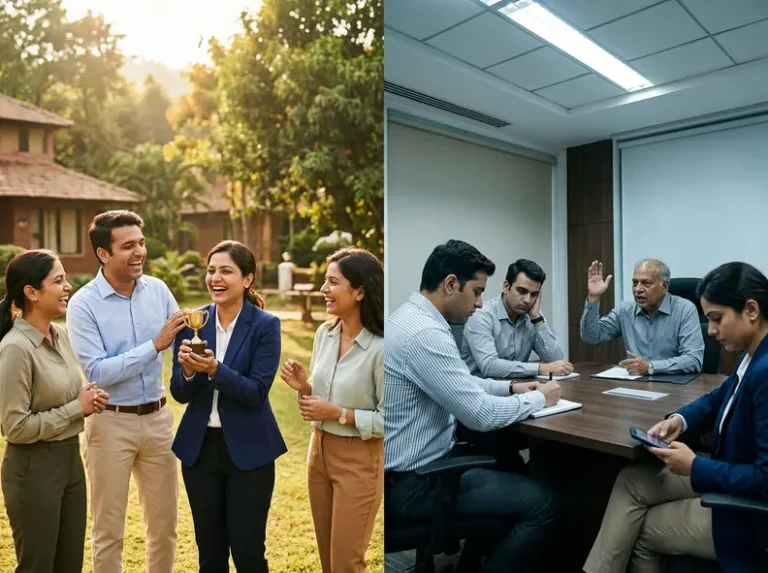
There is a particular kind of corporate disappointment that follows a team-building day. The team went to a resort for a bonding day. They did the activities. People laughed, a few competitive moments got heated in a good way, and the photos went up on the internal channel. Everyone agreed it was a nice break.
Then, by the following Monday, the same senior person dominated the same meeting, the same two functions avoided the same hard conversation, and the same quiet team member stayed quiet. Nothing changed, because nobody designed anything to change.
The activity was the product. Team-building activities have limited workplace value when they are not connected with specific behaviours and working situations. The rope course, the escape room, the cooking challenge, and the treasure hunt are genuinely good experiences. But an experience is not a behaviour change. An activity contributes to team development when participants connect it with how they communicate and work together. It becomes high-performing because it learns to do specific things differently in its actual work: trust each other enough to be vulnerable, engage in productive conflict instead of artificial harmony, commit after genuine debate, hold each other accountable as peers, and put collective results ahead of individual wins.
These are not abstractions. They are the five behaviours Patrick Lencioni identified in The Five Dysfunctions of a Team; the conditions Amy Edmondson’s research on psychological safety shows separate teams from teams that stagnate; and the patterns Google’s Project Aristotle study found in its highest-performing teams. The research on what makes teams effective is mature, replicated, and clear. Almost none of it is built into how Indian organisations run team building and training.
After 25+ years of facilitating teamwork across Indian organisations, Excellential sees the same five patterns in almost every team that calls us.
The patterns that Excellential sees across every team
1. Team building reduced to a day of activities
The activity happens. The diagnosis never does.
A half-day or full day of outdoor games, with no diagnosis of what the team needs and no structured debrief connecting the experience to workplace behaviour. The team has a good time. The dysfunctions survive the offsite intact. The budget is spent, and the L&D team quietly wonders why nothing shifted.
2. Trust is assumed to be a feeling, not a behaviour
“We trust each other” is a sentiment, not evidence.
What specific behaviours signal trust on this team?
Trust as a behaviour rather than a feeling is the theme of The Bridge: Why Trust Means Holding On.
Can a member admit a mistake without consequence? Ask for help without losing status? Disagree with the senior person without political cost? If you cannot describe trust as observable behaviour, you cannot build it, measure it, or rely on it when the stakes rise.
3. Conflict avoidance mistaken for harmony
A team that “never fights” is rarely a healthy one.
Indian workplace culture often rewards silence over dissent and surface harmony over honest debate. A team that cannot engage in productive conflict makes comfortable decisions and pays for them later. Excellential has written more on this exact pattern in Building Psychological Safety: Why Your Team Won’t Speak Up.
Artificial harmony is one of the most expensive conditions a team can have, precisely because it looks like health.
4. New and restructured teams left to find their own way
Forming on purpose, not by accident.
Post-merger teams, post-restructure teams, and cross-functional project teams. Organisations routinely expect them to settle in on their own. Tuckman’s forming-storming-norming sequence does not happen by accident. Without deliberate team-formation work, new teams spend months in unproductive storming, or skip to a false norming that papers over unresolved tension.
5. Senior team dysfunction left untouched
The most consequential team is the least likely to do the work.
Organisations almost always spend the team-building budget on the layer below the senior team: the frontline teams, the middle managers, and the project squads. The senior leadership team, whose dysfunction sets the operating temperature for the entire organisation and whose unresolved conflicts cascade downward as misaligned priorities, is the team least likely to do this work, because doing it requires the senior team to admit it has dysfunctions in the first place.
THE REAL COST
What a dysfunctional team actually costs an Indian organisation
The senior leadership team, whose unspoken conflict between two function heads quietly set two departments against each other for a year. Excellential worked through exactly this kind of cross-functional breakdown in how a tractor manufacturer broke down its silos.
The project team delivered late because nobody felt safe flagging the slippage early. The post-merger leadership team never genuinely formed, so every decision took three times as long, and half of them got quietly relitigated afterwards. The high-performing individual left because the team around them was exhausting to work with. None of these shows up in a team-building feedback form. They show up in missed deadlines, duplicated effort, slow decisions, and the resignation of people the organisation could not afford to lose.
The cost of team dysfunction is hard to reduce to a single number, but its components are concrete:
- Decision latency. The weeks are lost when a team cannot reach genuine commitment and keeps revisiting settled questions.
- Duplicated and misaligned effort. The cost of two functions working at cross-purposes because the senior team never resolved its own conflict.
- Regrettable attrition. The people who leave not for money but because the team was a difficult place to be.
The numbers behind that last point are stark. India’s overall attrition rate sat at around 17% in 2024, with sectors such as BFSI running above 25% (TeamLease Services, 2024). The team a person works inside is one of the strongest predictors of whether they stay, and the direct cost of replacing them runs at 50% to 200% of annual salary, rising towards the top of that range for managers and senior specialists (Gallup).
At the same time, India’s workforce engagement fell to 19% in 2025 from 24% the year before, the steepest decline of any major economy (ADP Research, People at Work 2025). Disengaged people do not leave dramatically. They leave quietly, or they stay and stop contributing, and the team they sit inside is usually the reason.
There is a second cost that compounds quietly. Team dysfunction at the top sets the operating culture for everyone below. A senior team that cannot have honest conversations teaches the whole organisation that honest conversations are unsafe. A senior team that avoids conflict produces a thousand smaller teams that avoid conflict. The cost of senior team dysfunction is never contained to the senior team. It is the multiplier on everything else.
This cost is reducible. The behaviours that produce team effectiveness are well-researched, teachable, and observable. Excellential designs the workshop around observable behaviours and reinforces agreed commitments after delivery.
Want a detailed module outline for your team?
Excellential will tailor the modules to your team’s situation, the behaviours it needs to build, and your industry.
WHAT IT COVERS
What this team effectiveness training programme covers
Seven modules. Excellential builds each around the behaviours that research shows predict team performance, and around the specific patterns Indian teams bring into the room. Pre-work team assessment before the workshop, experiential exercises with structured debriefs during it, and the Excellential Certified Team Leader (ECTL) credential awarded to the team leader after the 30-day check-in clears.
Module 1
What the team performance research actually says
Lencioni’s five behaviours: trust, conflict, commitment, accountability, and results. Edmondson’s research on psychological safety as the condition for team learning. Project Aristotle’s findings on what distinguished Google’s best teams. The difference between a team that feels good and a team that performs.
Module 2
Trust as observable behaviour
Vulnerability-based trust versus predictive trust. The specific behaviours that build Trust: admitting mistakes, asking for help, and acknowledging weaknesses. An experiential exercise that surfaces the team’s current trust level, followed by a structured debrief that names what the team saw.
Module 3
Productive conflict in the Indian workplace culture
Why conflict avoidance is the most common pattern on Indian teams. The cultural roots, hierarchy, deference, and face-saving are named directly rather than abstracted. Building the capacity for honest disagreement about ideas without damaging relationships.
Module 4
Commitment after debate, not to avoid debate
How a dysfunctional team makes decisions… then quietly relitigates them. The discipline of genuine debate followed by genuine commitment, including from those who disagreed. Disagree-and-commit as a team practice.
Module 5
Peer accountability
The hardest behaviour for Indian teams because hierarchy says accountability flows down, not sideways. Why high-performing teams hold each other accountable laterally, and how to build the mechanisms that make peer-to-peer challenge normal rather than insubordinate.
Module 6
Collective results over individual wins
The behaviours that put the team’s shared outcome ahead of individual and functional goals. Why incentives, recognition, and status games pull teams towards individual results, and what the team leader can change about how results are defined and celebrated.
Module 7
Forming new teams and doing senior teamwork
Tuckman’s forming-storming-norming-performing model is applied deliberately to restructured, post-merger, and new leadership teams. And the more demanding work of intact senior leadership teams, where the dysfunction is most consequential and hardest to examine.
OUR APPROACH
How Excellential runs team effectiveness training: the PPV Framework
The 30-day check-in examines how agreed behaviours are being applied in workplace meetings. Every part of the Predict-Probe-Validate framework is designed for measurable change in team behaviour, not for a memorable day out.
Pre-programme discovery and team assessment
A confidential pre-work assessment, completed by every team member, measures the team against the five behaviours and against psychological safety. Excellential adds a discovery conversation with the leader. The result is a team profile that tells us what the team actually needs, so Excellential engineers the workshop around that, not a standard agenda.
Experiential learning is engineered backwards from behaviour
Excellential uses indoor, outdoor, outbound, or off-site formats, whichever the learning calls for. But it chooses every activity because it surfaces a specific team behaviour that needs to be worked upon. Each activity is linked with a behaviour identified during discovery.
Structured debriefs that convert experience into commitment
Every activity ends in a structured, facilitated debrief, the part most activity providers skip. The team names the behaviour the activity revealed, connects it to how it operates at work, and commits to a specific change. The debrief is what turns the fun into Monday-morning behaviour.
The depth to hold real conflict
Senior team work surfaces tension that has sometimes been unspoken for years. A facilitator who runs from difficult moments leaves the team exactly where it started. Excellential is equipped to hold a team through the uncomfortable conversation, not to defuse it with another game.
Post-assessment and behaviour-change measurement
Excellential re-administers the pre-work assessment after the workshop. The pre-to-post delta gives you Kirkpatrick Level 2 evidence of the shift in the team’s self-assessed behaviour, a genuine measurement, not a satisfaction form.
30-day behavioural check-in
Thirty days on, the team leader submits evidence of the new operating rhythm in practice. Excellential reviews the evidence against the published rubric and provides coaching where required. It then awards the ECTL credential or holds it for a re-check at 60 days.
THE METHODOLOGY
The four stages of the PPV Framework, applied to team effectiveness
PPV is not a methodology Excellential invented last year. It is how Excellential has delivered knowledge and skills workshops for two decades, now codified, so clients know exactly what they are buying.
Stage 1: Predict
The week before the workshop. Confidential pre-work assessment completed by every member, measured against the five behaviours and psychological safety. Team leader discovery conversation. The result is a team profile that tells us what this specific team needs.
Stage 2: Probe
One to two days, the workshop.
Excellential selects indoor, outdoor, or outbound activities based on the target behaviour. Each activity is followed by a structured debrief and workplace commitment.
Stage 3: Validate
Within five days of the workshop.
Team assessment re-administered. Pre-to-post delta calculated. Team-level capability report to the team leader and to HR. For leadership teams, Excellential administers the multi-rater 360.
Stage 4: 30-Day Check-In
30 days after the workshop.
The team leader submits evidence of the new operating rhythm in practice. Excellential reviews it against the rubric. The ECTL credential is awarded to the team leader or held for a 60-day re-check.
PREMIUM ADD-ON
Pre- and post-multi-rater 360 feedback
Team effectiveness, by its nature, is observed by the people around the team: direct reports, peers in adjacent functions, and the leaders the team reports to. For leadership team engagements where the client wants Kirkpatrick Level 3 evidence of behaviour change, Excellential runs pre- and post-multi-rater 360 feedback as a premium add-on.
Excellential administers the same instrument before the workshop and again 90 to 120 days after. Direct reports, peers, and the team’s own leadership rate the team’s observable behaviours: psychological safety, productive conflict, follow-through on commitments, and peer accountability. The delta between the two rounds is the evidence. The analysis report typically surfaces which behaviours genuinely shifted and which still need attention.
This is operationally heavy and appropriate for intact leadership teams, not for every engagement. Available for leadership teams of 6 to 12 members, with a 90-day post-workshop measurement window.
LEARNING OUTCOMES
What your team will do differently after this team effectiveness training
The programme gives the team opportunities to practise and apply the following behaviours:
- Describe trust on the team as a set of specific, observable behaviours rather than a vague feeling
- Admit mistakes, ask for help, and acknowledge weaknesses without political cost
- Engage in productive conflict about ideas without it becoming personal or relationship-damaging
- Distinguish artificial harmony from genuine alignment, and recognise when the team is settling for the former
- Reach genuine commitment after real debate, including commitment from members who initially disagreed
- Hold each other accountable as peers, laterally, rather than relying solely on the leader
- Put the team's collective results ahead of individual and functional wins
- Recognise where the team sits in Tuckman's stages and what it needs to progress
- Run their own structured team debriefs going forward, so the team-collaboration training continues without an external facilitator
- For senior teams: name and work through the specific dysfunctions that have been setting the operating temperature for the wider organisation
CERTIFICATION
The Excellential Certified Team Leader (ECTL) credential
Most team building in India ends with photographs. Nobody is certified, nothing is measured, and the only evidence that the day happened is the group photo and the catering invoice.
The team leader earns the ECTL credential, and Excellential awards it only after the 30-day behavioural check-in clears.
The standard
- Pre-work team assessment completed, and the team leader's discovery conversation held.
- Workshop participation with active facilitation of the team's debriefs.
- Post-assessment showing a measurable shift in the team's self-assessed behaviour.
- A 30-day check-in demonstrating that a new operating rhythm, productive conflict, a commitment mechanism, or a peer-accountability practice is genuinely in use.
The outcomes
- A leader who meets the standard receives the ECTL credential, valid for three years.
- A leader who does not yet meet it at 30 days receives coaching and a re-check at 60 days.
- "Provisional ECTL" status applies until the re-check clears.
- The standard is published, and the credential is verifiable, so your CHRO knows what an ECTL-led team operates like, and so does everyone on that team.
Behaviour change, not photographs.
See how the PPV Framework would apply to your team and your situation.
Testimonials
RESULTS
What changes after this workshop
For the team leader
- A team whose trust, conflict, and accountability behaviours are visible and improving, not assumed
- The facilitation skill to run the team's own structured debriefs going forward
- A measured pre-to-post shift in the team's behaviour, not a satisfaction score
- The ECTL credential is a verifiable signal of team-leadership capability
- An operating rhythm that the leader can sustain without an external facilitator on retainer
For the organisation
- Faster team decisions, because the team commits the first time genuinely and relitigates less
- Reduced duplicated and misaligned effort, particularly across functions that previously worked at cross-purposes
- Lower regrettable attrition on teams that have become better places to work
- Senior team dysfunction is addressed at the source, reducing the downstream cost it imposes on the whole organisation
- A research-grounded, repeatable approach to team effectiveness that does not depend on the next offsite
- A clear linkage between team-effectiveness work and the retention and performance metrics leadership already tracks
Not sure if this fits your team?
Excellential will help you assess the need and recommend the right approach. No hard sell.
DELIVERY
Format and delivery options
The format follows the learning need, never the other way around.
| Format | Duration | Best for |
|---|---|---|
| Intensive workshop | 2 full days, indoor or outbound | Intact teams doing deep behavioural work with full debrief depth |
| Single-day intensive | 1 full day | Teams with a focused need on one or two of the five behaviours |
| Outbound experiential journey | 2-day residential | Teams where the experiential format and shared time away accelerate the behavioural work, with full structured debriefs throughout |
| Leadership team engagement with 360 | Custom design | Intact senior teams wanting pre/post multi-rater 360 evidence of behaviour change |
Excellential delivers off-site team building and indoor team building workshops for employees across India, including Bengaluru, Mumbai, Delhi NCR, Hyderabad, Chennai, Pune, Gurugram, Noida, Kolkata, and Coimbatore, and at outbound venues nationwide. Virtual delivery is available for distributed teams. English and Hindi are standard, with regional languages on request. Recommended team size: a single intact team of 6 to 15 members, because this is teamwork, not a training cohort of strangers.
WHO IS IT FOR
Built for intact teams, not cohorts of strangers
This is teamwork on the actual relationships of a real team, not a training cohort assembled from across the organisation.
Senior leadership teams
Intact leadership teams whose effectiveness sets the operating culture for the entire organisation, and whose dysfunction is the most consequential and most often left untouched.
New leadership teams after restructure or M&A
Teams that need to form deliberately rather than spend months in unproductive storming or false harmony.
Cross-functional teams on high-stakes deliverables
Teams assembled across functions for a critical project, where the team has to build trust and productive conflict fast and cannot leave them to develop on their own.
Startup founding teams
Where cofounder and early-leadership dynamics will either compound into a strong team or fracture under scaling pressure, and where getting the behaviours right early is existentially valuable.
Business unit and regional leadership teams
Whose internal effectiveness determines the performance of everyone reporting to them.
Intact functional teams with a specific dysfunction
Teams that know they have a trust, conflict, or accountability problem and want research-grounded team effectiveness training, not another off-site.
WHY EXCELLENTIAL
Why CHROs choose Excellential for team effectiveness training
You have options: activity providers, global training platforms, and proprietary-assessment licensees. Here is what makes working with us different.
Experiential team building with a spine
Excellential reverse-engineers every activity backwards from a specific team behaviour and ends in a structured debrief that converts the experience into a workplace change. With most providers, the activity is the product. That is why Exellential’s work shows up in Monday meetings, not just off-site photos.
Research-grounded, not improvised
Lencioni’s five behaviours, Edmondson’s psychological safety research, Google’s Project Aristotle, and Tuckman’s stages. Built on the mature, replicated research on what makes teams effective, not a personal collection of games.
A follow-through nobody else runs
Pre-work assessment, an experiential workshop with structured debriefs, a post-assessment, and a 30-day behavioural check-in. No other Indian team-building provider runs the behavioural check-in, and no other lets the credential be held back until the behaviour is real.
The depth to hold real conflict
Senior teamwork surfaces tension unspoken for years. Excellential’s 25+ years of L&D and HR experience nurturing human assets are the difference between a facilitator who holds the team through the difficult conversation and one who defuses it with another activity.
Indian workplace context, not Western templates
A hierarchy that makes peer accountability feel like insubordination. Deference that suppresses productive conflict. Face-saving that mistakes silence for agreement. Excellential names these patterns directly and works them into every exercise.
Methodology-neutral, not tool-locked
Excellential is not a licensed reseller of a single proprietary assessment. It draws on established research, selects the right approach for your team, and leaves the capability with your team. No tool licence to renew, no per-head fee in perpetuity.
Activity-based team building vs the PPV Framework
What you actually get for what you pay.
| Comparison Factor | Typical activity provider | Excellential PPV Framework |
|---|---|---|
| Starting point | A menu of activities | A diagnosis of what your team actually needs |
| Role of activities | The activity is the product | The activity is the vehicle; behaviour change is the product |
| Research grounding | Rarely | Lencioni, Edmondson, Project Aristotle, Tuckman |
| Debrief | Brief or skipped | Structured debrief after every activity, converting experience to commitment |
| Indian context | Generic | Hierarchy, deference, face-saving, and peer-accountability barriers are named directly |
| Senior teamwork | Rarely attempted | Core strength, with the facilitation depth to hold real conflict |
| Measurement | Feedback form | Pre/post team assessment delta, with multi-rater 360 available as a premium |
| 30-day follow-through | None | Behavioural check-in against a published rubric |
| Certification | None, or attendance-based | ECTL credential earned through the 30-day check-in |
| What you own afterwards | A good memory | A repeatable operating rhythm and a team leader who can sustain it |
Ready to build a team that performs, not just one that bonds?
A pleasant team and a high-performing team are not the same thing. Plenty of teams get along, avoid conflict, take nice photos at the offsite, and still make slow decisions, work at cross-purposes, and lose good people. The team behaviours that predict performance, trust, productive conflict, genuine commitment, peer accountability, and collective results. Excellential builds them deliberately, grounds them in research, and reinforces them beyond the workshop room. Whether you need to work with one intact senior team or build team-effectiveness capability across the organisation, Excellential will diagnose what your team needs first and design around it.
If your team already has strong day-to-day habits and the gap is specifically in how the team designs its own operating system (accountability structures, meeting cadence, decision rights), Excellential’s Building High-Performing Teams Training goes deeper on that system-design layer. This programme focuses on the underlying behaviours: trust, conflict, and commitment, that make any system work in the first place
FAQS
Frequently asked questions
Do you run outdoor and outbound team building activities, or only classroom workshops?
Excellential runs both and everything in between: indoor, outdoor, outbound, residential, and virtual. The difference between a typical activity provider and us is not whether we use activities. We do. It is that Excellential engineers every activity backwards from a specific team behaviour, and then follows every activity with a structured debrief that converts the experience into a workplace change. The format follows the learning need, never the other way around.
How is this different from a typical corporate team-building day?
A typical team-building day starts with a menu of activities. We start with a diagnosis of what your team actually needs, measured against the research on team effectiveness. The activity is then selected to surface the specific behaviour we are working on, and the structured debrief afterwards is where the actual learning happens, the part most providers skip. You leave with a measured behaviour shift and a 30-day check-in, not just photographs.
Is this based on the Five Dysfunctions or Five Behaviours model?
We draw on Patrick Lencioni’s The Five Dysfunctions of a Team as one of several research foundations, alongside Amy Edmondson’s psychological safety research, Google’s Project Aristotle findings, and Bruce Tuckman’s stages of team development. We are not a licensed reseller of the proprietary Five Behaviours assessment. Our exercises, debriefs, and team assessments are our own, designed for Indian team contexts, and your team owns the capability afterwards with no licence to renew.
What does the ECTL certification actually involve?
The Excellential Certified Team Leader credential is earned by the team leader across the full cycle: pre-work team assessment completed, workshop participation with active debrief facilitation, a post-assessment showing a measurable shift in the team’s behaviour, and a 30-day check-in demonstrating that a new operating rhythm is genuinely in use. Validity is three years.
Can the senior leadership team itself do this, or is it only for the layers below?
The senior leadership team is precisely where this work is most valuable, and it is our core strength. Senior team dysfunction sets the operating culture for the whole organisation, and addressing it requires a facilitator with the depth to hold the team through real, sometimes long-unspoken conflict. This is the work most providers cannot do and the work most organisations most need.
What is the multi-rater 360 add-on?
For intact leadership teams that want evidence of behaviour change observed by the people around the team, we run pre- and post-multi-rater 360 feedback as a premium add-on. Direct reports, peers, and the team’s own leadership rate the team’s observable behaviours before the workshop and again 90 to 120 days after. The delta is the evidence. Available for leadership teams of 6 to 12 members.
How big should the team be?
This is teamwork, not a training cohort, so the ideal is a single intact team of 6 to 15 members. We do not combine unrelated teams into one room, because the entire point is to work on the actual relationships and behaviours of a real team. For larger populations, we run sequential engagements team by team.
We have a new team after a restructure. Is this the right time?
Yes. New and restructured teams benefit most from deliberate team-formation work because it prevents months of unproductive storming or a false harmony that hides unresolved tension. Module 7 specifically addresses forming new teams using Tuckman’s framework.
How is this different from Five Behaviours or other proprietary assessment providers in India?
Five Behaviours licensees deliver a credible, scientifically validated proprietary assessment and tie their programme to it. We are methodology-neutral. We draw on the broader team-effectiveness research, select the right approach for your specific team, and leave the capability with your team rather than a tool licence you keep paying for. We also run the experiential and outbound formats that assessment-led providers typically do not.
Where do you deliver team building training in India?
In-person delivery across Bengaluru, Mumbai, Delhi NCR, Hyderabad, Chennai, Pune, Gurugram, Noida, Kolkata, and Coimbatore, plus outbound venues nationwide. Virtual delivery is available for distributed teams.
How do you measure impact?
We measure across all four Kirkpatrick levels. Reaction at workshop close (Level 1). Pre-to-post team assessment delta as learning evidence (Level 2). The 30-day behavioural check-in is a behaviour change (Level 3, basic), with the multi-rater 360 as comprehensive Level 3 evidence for leadership teams. And, where you want to track them, team decision speed, retention, and performance outcomes over 6 and 12 months (Level 4).
What makes Excellential different from other team building providers in India?
Three things. First, we use activities as the vehicle, never the point. Every exercise is chosen for the behaviour it surfaces and ends in a structured debrief, which is why our work shows up in real meetings rather than only in off-site photos. Second, the PPV Framework includes a 30-day behavioural check-in, which no other Indian team-building provider runs. Third, we have the 24-year facilitation depth to do the hardest and most valuable work: intact senior teams, held through real conflict. Your team leaves with a capability and a credential, not a memory and a group photo.