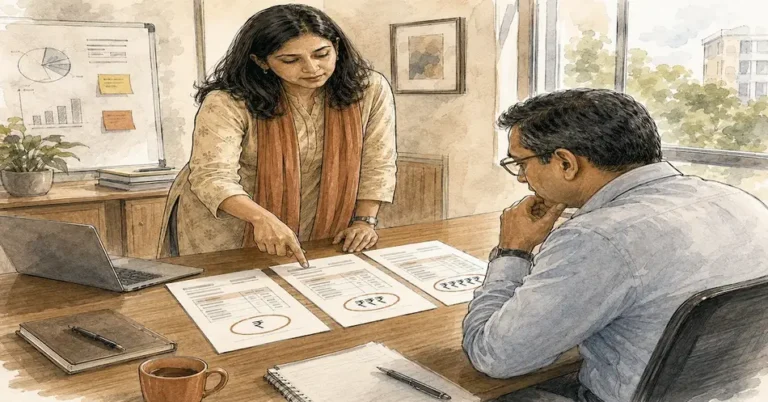


Kishor Sinha, HR head at a 400-person logistics company in Pune, sat through his third vendor pitch of the week. Every presentation promised better leaders, stronger teams, and measurable impact: transformation, engagement, customised. He closed his laptop. At the top of a blank page, he wrote one line: what should I ask these people?
Every HR team eventually compares two or three vendors who promise similar outcomes. The questions below make that comparison much easier.
Before choosing a leadership training company or development partner, ask these five questions first. Ask them before you compare proposals or negotiate pricing.
- How do you diagnose our specific leadership gaps before proposing content?
- What happens once the workshop ends?
- How will you measure changed behaviour rather than attendance?
- Can you show results from a company of similar size and sector to ours?
- What does the contract include if the first cohort produces no visible change?
A partner who answers with detail and named examples deserves a second meeting. That kind of detail always tells you more than a polished presentation. Strong partners explain their thinking before they show their slides.
Key Takeaways
|
Leadership Training Buyers Often Compare
- Facilitation quality
- Industry experience
- Measurement approach
- Reinforcement plan
- References
- Commercial terms
This is the second post in our series on building leadership capability inside Indian organisations. It picks up where our Leadership Development Buyer’s Guide (India) leaves off. That guide covers how to think about the decision. This post gives you the actual questions to put to a vendor sitting across the table. It also gives you the answers that separate a genuine partner from a polished pitch.
Learn: Questions About Diagnosis and Design 
Vendor conversations start with content, not diagnosis. Ask about diagnosis first. A partner worth hiring can describe exactly how they will find your organisation’s real gaps. That description should come before they propose a single module.
Start here: how do you diagnose leadership gaps before designing content? Weak vendors answer with a generic needs-assessment template lifted from another client. Strong vendors describe interviews, surveys, 360-degree feedback or direct observation, tied to your context. SHRM India’s guidance on designing leadership programmes for managers makes the same point. Effective programmes assess leadership needs through evidence: surveys, performance data and direct conversations. They do not assume the gaps from a job title.
Next, ask whether the curriculum changes by seniority level. A first-time manager in Coimbatore may have never given feedback to anyone. Meanwhile, a functional head in Gurugram, managing other managers, needs something entirely different. If a vendor proposes the same workshop for both, that is a warning sign worth taking seriously. Our research on first-time manager training companies in India found something clear. The strongest providers build separate tracks by level, rather than adjusting a single deck.
Ask, too, who writes the content. Some firms build every module in-house. Others license a global framework and lightly adapt it for India. Neither approach is automatically wrong. But you should know which one you are buying. A licensed framework often costs less to customise, and more to certify.
Also ask how often the content is updated. Leadership expectations change quickly, especially around AI, hybrid work and people management.
SHRM’s 2024 research found that 92 percent of HR executives consider people managers critical to organisational success. Few vendors, in our experience, can explain how their diagnosis step tests for that criticality before they start designing slides.
Apply: Questions About Delivery and Facilitation
A strong diagnosis means little without strong delivery. The real test comes on a Tuesday afternoon, when someone acts on what they learned, or does not. This is where most programmes quietly fail, and where your questions need to get more specific.
Ask who facilitates the sessions. A named senior consultant, with real people-management or coaching experience, delivers a different outcome. That is not the same as a rotating pool of junior trainers reading from a fixed script. Ask for the facilitator’s background directly, not a generic bio page.
Find out what proportion of the programme involves practice rather than lecture. Role plays should mirror conversations managers have. Giving difficult feedback, handling poor performance, managing conflict, coaching a high performer- these stay with participants much longer. We built our situational leadership training programme entirely around this kind of realistic role play. Participants remember what they practised far longer than what they were told.
Ask whether a participant’s own manager gets briefed on what to reinforce afterwards. A programme that ends the moment the workshop does leaves no handoff to the participant’s own manager. New behaviour fades fast without one.
Kavita Rao leads learning and development at a mid-sized insurance company in Chennai. She once commissioned a programme that left managers energised. Within a month, the group had reverted to old habits. Nobody had briefed their own bosses on what good looked like.
Measure: Questions About Proof and Measurement
Ask how the vendor proves the programme worked. Push past the first answer, because most vendors start with satisfaction scores.
Press for specifics: what will you measure besides attendance and feedback ratings? A credible answer names specific behaviours, such as delegation frequency, feedback conversations held, or decisions no longer escalated upward. It should also name a timeframe. Early behaviour shifts typically become visible within eight to twelve weeks, when practice and coaching are built in. 
Ask for a reference from an organisation your size, in your sector, ideally one that faced a similar problem. A vendor with genuine results will connect you directly rather than offering a written testimonial. Our case study on building a future-proof leadership pipeline shows the level of detail worth expecting. It names specific metrics, a timeframe, and a quote from the actual client, not marketing copy dressed up as one.
Ask how they would measure your specific situation before you sign anything. If the vendor cannot describe what success looks like for your organisation, take note. That means the diagnostic work has not happened yet, and it should come before the proposal.
Good partners agree on success before the programme starts. That keeps conversations focused on business outcomes instead of opinions after the workshop.
Sustain: Questions About What Happens After the Contract Ends
Every leadership programme faces its real test in week twelve. The initial energy has faded by then, and the organisation’s usual pressures return. Your final set of questions should focus entirely on this period.
Ask what happens on day one after the last session. If the answer is that reinforcement is entirely your responsibility, budget separately for it, because you will need it. Strong partners build in coaching calls, manager check-ins, and a 30-60-90-day follow-up rhythm. It sits in the contract as a deliverable, not a hopeful afterthought.
Ask how they structure pricing. A flat per-head fee, regardless of seniority or complexity, often signals a template being resold. Phased pricing tied to organisational size, seniority mix and the depth of reinforcement signals something different. It usually means the partner has thought through what your engagement needs.
Finally, ask what happens if behaviour has not shifted by the agreed checkpoint. Some partners will redesign the follow-up at no extra cost. Others treat the contract as complete the moment the last workshop slide is shown. Know which one you are signing before you sign it, not after the invoice arrives.
Vetting Questions: Strong Answer vs Weak Answer
| Question to Ask | Strong Answer | Weak Answer |
| How do you diagnose our leadership gaps? | Describes interviews, surveys or 360 feedback tied to your organisation | Sends a standard deck and workshop agenda within a day |
| Does the curriculum change by seniority level? | Separate tracks for first-time managers, mid-level and senior leaders | One generic leadership framework applied to everyone |
| Who facilitates the sessions? | Names a senior facilitator with real coaching or management experience | Describes a rotating pool of junior trainers |
| What happens after the workshop ends? | Coaching calls, manager briefings and a 30-60-90 day follow-up plan | Engagement ends the day the workshop finishes |
| How do you measure success? | Tracks measurable behaviour change and business metrics such as retention or delegation frequency | Reports attendance numbers and average feedback scores |
| What if the first cohort shows no change? | Names a specific remedy: redesign, extended coaching or partial refund | Vague reassurance with no contractual commitment |
| Can you show business impact? | Shows behavioural metrics tied to business KPIs | Shares participant feedback only |
Good leadership programmes get remembered for a specific reason. A manager recalls the framework months later, in an actual difficult conversation with a direct report.
Frequently Asked Questions
What questions should I ask a leadership development vendor before signing a contract?
Ask how they diagnose leadership gaps, and whether the curriculum differs by seniority level. Also find out who facilitates sessions, what reinforcement happens after the workshop, and how success gets measured. Check what remedy exists if the first cohort shows no behaviour change.
Should I choose a leadership training partner based on price or on outcomes?
Price alone is a weak filter. The cheapest proposal often skips diagnosis and reinforcement, the two elements most responsible for lasting behaviour change. Compare proposals on what each vendor measures and how they sustain change over time, then weigh price against that difference in outcomes.
What is the difference between a leadership training company and a leadership development partner in India?
A training company typically delivers a fixed workshop and considers the engagement complete once it ends. In contrast, a development partner works differently. It diagnoses gaps first, delivers contextualised content, and stays involved through coaching after the session. The workshop becomes one stage, not the whole engagement.
How long should a leadership development programme last?
A single one-day workshop rarely changes behaviour on the job. A programme lasting eight to twelve weeks, with practice, feedback and manager reinforcement built in between sessions, gives new habits time to stick. Shorter formats can raise awareness, but sustained change needs that longer runway.
How do you measure leadership training ROI?
Track behaviour change on the job, not attendance at the workshop. Useful indicators include manager observations, productivity, retention, engagement scores and relevant business metrics tied to the programme’s goals. Excellential applies the Kirkpatrick model across all four levels, from reaction and learning through to behaviour and business results.
What to Do Next
Before you compare proposals, send us your shortlist. We will review it with you and point out strengths, gaps and questions worth asking. There is no obligation to work with us afterwards.
Prefer a quicker, informal chat? Message us on WhatsApp, and we will respond directly.
Want more posts like this one as we publish them? Subscribe to our newsletter for HR and L&D insights from Excellential, delivered roughly once a month.
Curious what a genuine leadership partnership looks like in practice? See our case study on building a future-proof leadership pipeline. Or explore our situational leadership training programme, built around real Indian workplace scenarios.