
EMPLOYEE ENGAGEMENT PROGRAMME
Employee engagement training programme for managers who keep their best people
An employee engagement training programme built around the one factor that decides whether your people stay: the direct manager.
This is employee engagement and retention training for managers, not another survey, app, or recognition platform. Excellential teaches the manager-level conversations that turn the people you hire well into the people who stay long-term, and then Excellential audits those conversations on the job before it certifies anyone.
- Manager-led, not HR-led. Managers build engagement in 1:1s, career conversations, and stay interviews, not in the annual survey. Excellential trains the people who hold those conversations.
- Built on the Predict-Probe-Validate (PPV) Framework. Pre-work diagnostic, case-led workshop, post-assessment, and a 30-day application audit on real manager conversations. You know exactly what you are buying.
- Earned certification, not a printout. Excellential awards the Excellential Certified People Manager (ECPM) credential only after the 30-day audit clears, with a re-audit at 60 days for managers who fall short.
- 25+ years of experience across talent acquisition and development. 20,000+ professionals trained and 85+ organisations served across IT, BFSI, manufacturing, retail, pharma, and startups.
- Flexible delivery. In-person, virtual, or hybrid. English, Hindi, and regional languages on request. Industry-specific retention playbooks for six sectors.
Tell us about your organization, and Excellential will design the programme around your retention story.
























KEY TAKEAWAYS
- Built for CHROs, HR business partners, and first- and second-time people managers who hold the relationships with the people most likely to leave.
- Excellential names six patterns: the annual survey as the only intervention, scores chased instead of behaviour, a manager-specific problem met with an org-wide fix, counteroffers used as a delay tactic, tools built for HR rather than managers, and Indian-context drivers a global survey misses.
- The programme runs seven modules: what engagement predicts, reading retention data honestly, the manager as the engagement system, career conversations, stay interviews and recognition, the resignation conversation, and linking engagement to metrics the CEO tracks.
- Organisations measure lower regrettable attrition in the first 12 to 24 months after rollout, tracked against their own pre-rollout baseline.
- For larger rollouts, Excellential offers a pre- and post-360-degree feedback add-on measuring actual behaviour change 90 to 120 days after the workshop, rated by direct reports and peers.
- Excellential is tool-agnostic: managers learn to interpret and act on whatever engagement survey the organisation already uses, Culture Amp, Gallup Q12, or Glint, rather than requiring a new platform.
Share your regrettable attrition data and where career conversations aren’t happening, and Excellential will build the role-plays around your teams.
THE PROBLEM
Why your engagement survey scores keep moving while your best people keep leaving
Most Indian organisations run an annual employee engagement survey. HR presents the results and writes action plans, and by Q2, the action plans are forgotten. Q3 brings the next round of attrition, treated as a fresh surprise each time. The score is not the engagement. The survey is not the system.
Excellential examines this same gap in Why Employee Engagement Initiatives Don’t Work (And What Employees Actually Respond To).
The single biggest driver of engagement is the direct manager. Gallup found that managers account for at least 70% of the variance in employee engagement scores across business units (State of the American Manager, 2015), drawn from data on millions of employees and replicated across industries since. Google’s Project Aristotle reached a structurally similar conclusion: psychological safety, dependability, and role clarity all rest on what the manager does on Monday morning, not on what HR rolls out at the all-hands.
And Indian managers are now disengaging faster than anyone. Gallup’s State of the Global Workplace 2026 found that global manager engagement fell five points in a single year, from 27% to 22% between 2024 and 2025, the steepest single-year drop it has recorded. South Asia, primarily India, posted the largest regional decline of any region, an eight-point fall. If the manager is the engagement system, an engagement programme that bypasses the manager fixes nothing.
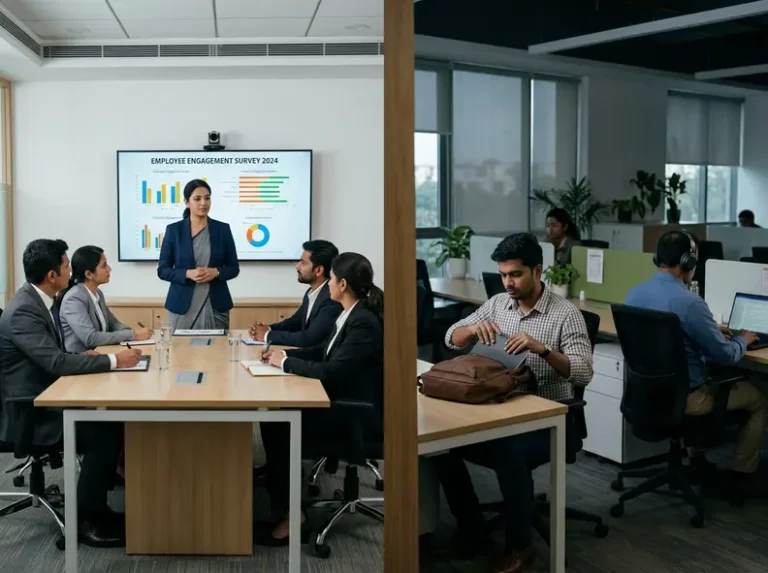
The patterns that Excellential sees across every organisation
After delivering engagement and retention training across IT, BFSI, manufacturing, pharma, retail, and startups, the same six problems surface with striking regularity.
1. The survey is the only intervention
Run once, discussed once, abandoned by Q2.
The annual survey is the only thing that happens. The team discusses results once, abandons the action plans by Q2, and the next survey shows the same problems, often slightly worse. The survey itself loses credibility with employees who notice that nothing changes.
2. Scores treated as the outcome, not the diagnostic
Chasing the number instead of the behaviour.
The score went up two points, and nobody can explain why. It dropped three points, and nobody knows what to fix. Score-watching replaces understanding, and HR teams chase the number instead of the underlying manager behaviours that produced it.
3. A capability gap disguised as an engagement problem
A specific problem met with a generic fix.
The team with the disengaged manager has low scores. HR rolls out an org-wide intervention. Six months later, that same team still has low scores. The intervention was generic. The problem was specific to one manager.
4. Compensation substituting for culture
A counteroffer is a delay, not a strategy.
The high performer threatens to leave, the counteroffer goes out, they stay six months, and then they leave anyway for the same reason they were going to leave the first time. The raise was a delay tactic, not a retention strategy.
5. Programmes designed for HR, not for managers
Tools for everyone except the relationship holder.
Newsletters, intranet portals, recognition apps, town halls, and wellness apps are all run by HR and consumed with varying indifference. The manager who holds the relationship gets no new tools, no training, and no time to do the work that moves the needle.
Excellential tells a similar story about purpose over process in How a NASA Janitor Taught Us the Secret to Employee Engagement.
6. Indian context ignored
Real drivers, a global survey never captures.
A hierarchy that makes upward feedback unsafe. Family obligations that drive geographic exits. Two-career household pressure since the pandemic. The discomfort of senior employees reporting to younger managers. None of this shows up in a global instrument. All of it drives real Indian attrition.
What does disengagement and regrettable attrition cost an Indian organisation
The downstream pattern surfaces in almost every exit interview. The high performer who quietly disengaged for six months before resigning. The middle-manager layer stopped having career conversations because nobody developed them. The senior individual contributor who left for a 15% raise, the organisation could have matched if anyone had asked the right question early enough. The team whose score was “fine” right up until two of the top three performers resigned in the same quarter.
The numbers match what most CHROs already feel. India’s corporate sector recorded a 17% attrition rate in 2024, with BFSI climbing above 25% (TeamLease Services, 2025). Replacement runs higher than most leaders assume. Gallup puts it at one-half to two times annual salary and calls that conservative, with its own breakdown running to roughly 40% of salary for frontline roles, around 80% for technical and professional roles, and up to 200% for leaders and managers. SHRM frames the same reality as six to nine months of salary per departure. Either way, every regrettable exit is a five-to-seven-figure rupee event.
Take a 500-person organisation, average compensation of ₹12 lakh, and 17% attrition. That is roughly 85 people walking out every year. Even at a conservative blended replacement cost of one year’s salary per leaver, that is over ₹10 crore a year, before a rupee of lost productivity or team disruption. Push those leavers up the seniority ladder, where replacement runs 150 to 200% of salary, and the number climbs fast. For a 2,000-person organisation, the same arithmetic crosses ₹40 crore on conservative assumptions alone.
The rupee figure is illustrative. Put your own headcount and salary bands through it. The cost category is not illustrative. It is a real line item, buried in the P&L as “talent costs” or absorbed into business-unit operating expenses, and it rarely surfaces as the integrated attrition cost the CEO sees.
Most of this cost is preventable. Not all of it. Some attrition is healthy, some is unavoidable, and some people leave for reasons no manager could touch. But regrettable attrition, the high performers and critical-role holders who left because of their manager or their experience rather than the next opportunity, is where the avoidable money sits. And that share is driven by manager-level practices that can be trained, audited, and improved.
THE PROGRAMME
What this employee engagement and retention training covers
Seven modules, each built around situations Indian managers face every week. Pre-read assignments come before the workshop, live case studies and role plays during it, and Excellential awards the ECPM credential only after the 30-day application audit clears.
Module 1
What engagement predicts, and what it does not
What the research actually shows is that engagement drives across productivity, retention, customer experience, and profitability, and the correlation is weaker than HR usually claims. Why the engagement-as-survey-score model produces theatre, and what a manager-led system looks like instead.
Module 2
Reading engagement and retention data honestly
Survey design pitfalls. Selection bias in who responds. Why eNPS can mislead in the Indian context. Reading exit interview data for what it says rather than what is comfortable, and linking it to outcomes the CEO already tracks.
Module 3
The manager-employee relationship is the engagement system
Why does direct manager quality predict retention better than any HR programme? The five to ten daily and weekly behaviours that compound into a team people do not want to leave. The “boss tax” and how to spot it in your own data.
Managers whose primary gap is handing over work rather than having career conversations may also benefit from our Delegation Training for Managers
Module 4
Career conversations that retain
The discipline of quarterly career conversations, the structure that makes them useful, and the difference between a career conversation and a career promise. Why fusing it with the performance review is the wrong combination. Role plays from real Indian workplace situations.
Module 5
Stay interviews, recognition, and daily practices that compound
Stay interviews before the exit interview become necessary. Recognition that lands in the Indian context, public versus private, individual versus team. The practices that separate the manager people from the manager people tolerated.
Module 6
The retention conversation when someone is leaving
Counteroffers and when not to make them. The 90-day window after a resignation is when an employee can sometimes be retained for the right reasons. The structured exit interview that produces real insight, and the stay interview that should have happened six months earlier.
Module 7
Linking engagement to metrics that the CEO already tracks
Regrettable attrition rate. First-year attrition. High-performer retention. Manager Effectiveness Index. How to build a one-page engagement and retention dashboard that the CHRO can take to the board.
OUR APPROACH
The Predict-Probe-Validate (PPV) Framework, applied to engagement and retention
If your managers do not change their conversations with their teams within a month, the workshop has failed. Every part of PPV is designed for measurable change in manager behaviour, not for the classroom. It is how Excellential has delivered workshops for over two decades, now codified into a published framework, so you know exactly what you are buying.
Pre-programme discovery
Two to three hours with your CHRO, HR business partners, and a few senior managers. Excellential learns the attrition patterns in your data, the manager capability gaps you suspect, and the initiatives you have already tried. The workshop is built around your retention story, not a generic case library.
Pre-work diagnostic and pre-reads
A 30-minute self-assessment before the workshop. Each manager rates their current practice on 1:1 cadence, career conversations, stay interviews, recognition, and difficult feedback, then completes a short Indian case study. Each participant gets an individual report; you get a cohort capability map.
Industry-specific case studies
Case libraries built over 25+ years across Indian sectors. Participants leave with scenarios built for the roles and workforce realities their organisation faces, whether IT services, BFSI, manufacturing, pharma, retail, or startups, not a generic handbook.
Live role-plays
Every participant runs at least two real conversation role plays under facilitator observation: a stay interview, a career conversation, or a conversation when someone has handed in notice. Real scenarios from their own team, with peer feedback and coaching.
Post-assessment and 30-day audit
Excellential re-administers the diagnostic for a Kirkpatrick Level 2 learning delta. Then each participant submits two real artefacts within 30 days, one stay interview and one career conversation summary, which Excellential audits for probing depth, listening quality, and follow-up discipline.
Put your own numbers through it
Excellential will help you size the cost of regrettable attrition in your organisation, then show where manager training moves it.
THE METHODOLOGY
The four stages of PPV, applied to engagement and retention
| Stage | When | What happens |
|---|---|---|
| 1. Predict | Week before workshop | Pre-work diagnostic and case pre-read. Individual baseline reports to each participant and cohort gap analysis to HR. The workshop is tailored to actual gaps, not assumed ones. |
| 2. Probe | 1 to 2 days, workshop | Seven modules. Two scored role-plays per participant against published rubrics. Industry-specific case studies. |
| 3. Validate | Within 5 days of the workshop | The diagnostic re-administered, and the pre-to-post delta calculated. Individual learning-gain reports to each participant and cohort capability maps to HR. |
| 4. Application Audit | 30 days after the workshop | Two real artefacts, stay interview and career conversation summary, audited for quality. ECPM credential awarded or held for re-audit at 60 days. |
PREMIUM ADD-ON
Pre- and post-360-degree feedback, for behaviour change as evidence rather than inference
For larger engagements that want Kirkpatrick Level 3 evidence, actual behaviour change observed by the people who work with the manager, Excellential runs pre- and post-360-degree feedback. The same instrument runs before the workshop and again 90 to 120 days after. Direct reports, peers, and the manager’s own manager rate the participant on the behaviours the workshop teaches. The delta between the two rounds is the evidence.
The analysis report typically surfaces which career-conversation patterns improved, which stay-interview discipline stuck, which recognition practices landed, and which behaviours did not change. The CHRO uses it to direct ongoing coaching investment. The CEO sees real evidence of return on the training spend.
This is operationally heavy and not right for every engagement. Available for cohorts of 15+ participants, with a 90-day post-workshop measurement window.

Want a detailed programme outline for your organisation?
Excellential will tailor the modules and case studies to your industry, size, and specific retention challenges.
CERTIFICATION
The Excellential Certified People Manager (ECPM) credential
Most management training in India hands out a participation certificate. Anyone who attends walks away certified, regardless of whether their team retention has changed six months later. That is not a credential. That is a printout.
Participants earn the ECPM credential across the three PPV stages, and Excellential awards it only after the 30-day application audit clears.
The standard
- Pre-work diagnostic and case pre-read completed in full.
- Workshop attendance with two role plays scored against the published rubric.
- Post-assessment showing a measurable learning gain.
- A passed 30-day audit of two real artefacts, one stay interview and one career conversation summary, demonstrating probing depth, listening quality, and follow-up discipline.
The outcomes
- Managers who meet the standard receive the ECPM credential, valid for three years.
- Managers who fall short on the 30-day audit receive coaching feedback and a re-audit option at 60 days, holding provisional status until it clears.
The signal. Because Excellential publishes the standard up front and audits it against real artefacts, ECPM certification is a verifiable claim, not a printout. Your CHRO can see exactly what the credential requires and judge any manager against it. A real standard means a real signal in your management bench.
LEARNING OUTCOMES
What your managers will do differently after this employee engagement training
By the end of the workshop and the 30-day audit, every certified participant will be able to:
- Conduct a structured quarterly career conversation that surfaces real career interests, not the comfortable answers most managers settle for.
- Run a stay interview with a high performer six months before that person starts looking elsewhere.
- Distinguish recognition that lands in the Indian workplace from recognition that backfires across hierarchy, seniority, and team dynamics.
- Hold the conversation when an employee hands in notice, including the structured decision on whether a counteroffer is appropriate.
- Read engagement and exit interview data for what it says, including the parts the HR summary leaves out.
- Identify the manager-level behaviours associated with regrettable attrition on their own team, and change their practice accordingly.
- Build a manager-led engagement system that does not depend on HR rolling out the next platform.
- Link team-level retention and engagement to the business metrics the CEO already tracks.
- Apply the practices to remote and hybrid team members whom they rarely see in person.
- Coach a fellow manager through a difficult retention conversation, extending the capability beyond the original cohort.
RESULTS
What changes after this training
For the manager
- A structured quarterly cadence for career conversations with every direct report.
- Stay interviews that surface real signals six months before resignations would otherwise arrive.
- Recognition practices that land in the Indian workplace.
- Confidence handling the resignation conversation, including the counteroffer decision.
- The ECPM credential is a verifiable signal of people-leadership capability.
- A working dashboard linking their team's retention and engagement to metrics that leadership already tracks.
For the organisation
- Lower regrettable attrition in the first 12 to 24 months post-rollout, measured against pre-rollout baselines.
- A manager bench that owns engagement and retention rather than waiting for HR programmes.
- A documented, consistent record of retention conversations and career commitments.
- Shared language and shared practice across business units, regions, and functions.
- A standing internal capability that does not depend on the next survey vendor or platform purchase.
- Linkage between manager capability data and the retention and performance metrics that the CEO already tracks.
DELIVERY
Format and delivery options
| Format | Duration | Best for |
|---|---|---|
| Intensive workshop | 2 full days, in-person | Deep role-play practice with managers from related teams |
| Virtual programme | 4 half-day sessions over 2 weeks | Distributed managers, with application between sessions |
| Blended journey | 1-day workshop + 3 virtual follow-ups over 6 weeks | Sustained application with live coaching on real conversations |
| Enterprise rollout with 360 measurement | Custom design | Large cohorts (30+) wanting pre/post 360 evidence |
Excellential delivers across India, including Bengaluru, Mumbai, Delhi NCR, Hyderabad, Chennai, Pune, Gurugram, Noida, Kolkata, and Coimbatore. Virtual delivery reaches teams anywhere in India and abroad. English and Hindi are standard, with regional languages on request. Recommended cohort size: 15 to 20 participants per workshop for adequate role-play depth.
WHO IS IT FOR
Built for the people who decide whether your team stays
From the CHRO who needs data for the CEO to the first-time manager who holds the relationship with your most at-risk talent.
CHROs and Heads of HR
Moving past survey-driven engagement programmes to manager-led practices that change retention outcomes, and who need data to take to the CEO.
HR Business Partners
Coaching managers through retention conversations, designing interventions, and translating exit interview data into action.
People managers at every level
Especially first- and second-time managers promoted on individual excellence, who hold the relationships with the people most likely to leave and have never been trained for the conversations that retain them.
Senior managers and functional heads
Whose attrition data is the canary in the coal mine, and whose management practice is observed and copied by the layer below.
Founders building their first 100 to 500-person workforce
Where every regrettable exit damages culture, slows velocity, and adds replacement cost that funded growth cannot easily absorb.
HR teams running annual engagement surveys
Who wants a clearer path from survey data to manager action without buying another survey platform or engagement app.
Testimonials
THE GAP
Why most engagement budgets are spent in the wrong place
Our employee engagement training programme puts the budget where the variance lives: on the manager.
Most Indian organisations split their engagement budget three ways: a survey vendor, a recognition platform, and engagement events. All three sit on the HR side of the operating model. None touches the manager-employee relationship that drives most of the engagement variance Gallup has measured.
So the platforms produce reports, the events produce photos, the surveys produce scores, and the manager who has not had a real career conversation with a direct report in six months still hasn’t, because nothing in the budget asked them to.
PPV puts the budget where the variance lives, on the manager. The 30-day audit makes it stick in real conversations. The pre-to-post delta and optional 360 make the capability gain visible. The linkage to retention and performance metrics gives the CHRO a defensible story for the CEO.
COMPARISON
Generic engagement training vs the Excellential PPV Framework
The difference is not the slides. It is what happens before, after, and on the job.
| Comparison Factor | Generic engagement workshop | Excellential PPV Framework |
|---|---|---|
| Pre-work | Optional reading list | Mandatory diagnostic + case pre-read |
| Workshop duration | Half-day to one day | One to two days with live role plays |
| Role plays | Generic scenarios | Real conversations from participants' own teams |
| Case studies | Western corporate examples | Industry-specific Indian case libraries across 6 sectors |
| Indian context | Abstracted or absent | Hierarchy, family, two-career, and senior-junior realities are named directly |
| Post-assessment | Feedback form only | Diagnostic re-administered, pre-to-post delta measured |
| 30-day audit | None | Mandatory: two real artefacts audited |
| 360 measurement | None | Available as a premium add-on (pre and post) |
| Certification standard | Attendance-based | Application-based, with re-audit option |
| Methodology ownership | Vendor's proprietary tool, you must license | Survey-tool-agnostic, fully owned by your team |
| Linkage to business metrics | None | Engagement and retention data linked to CEO-level metrics |
WHY EXCELLENTIAL
Why CHROs choose Excellential for engagement and retention training
You have options. Large global firms, boutique trainers, and online courses. Here is what makes working with us different.
Talent acquisition and development specialists
Excellential built QuiqHire, an AI-driven hiring platform serving 70+ Indian organisations. Engagement starts with hiring the right person for the right role. Hiring the wrong person is the first cause of regrettable attrition, and no engagement programme fixes that.
A methodology with proof built in
PPV runs a pre-work diagnostic, case pre-reads, live role-plays, a post-assessment, and a 30-day application audit. Excellential has not found another Indian provider that runs a post-workshop audit or that lets a participant fall short of certification.
Kirkpatrick Level 3 evidence
For enterprise rollouts, Excellential runs pre- and post-360 feedback to measure behaviour change observed by the people who work with the manager. The analysis report is the evidence the CEO wants to see.
Indian workplace context, not Western templates
Hierarchy that makes upward feedback unsafe, family obligations, two-career pressure, and senior employees reporting to younger managers. Excellential names these and works them into every role play, rather than abstracting them into a global module.
25+ years of HR and L&D experience
Case studies and scenarios refined over 25+ years in talent acquisition and development, 11 of them at Excellential. 20,000+ professionals trained across 85+ organisations in six sectors.
Survey-tool-agnostic, not vendor-locked
Excellential does not sell a survey platform or a recognition app to renew. Your team learns the capability and owns it permanently, using whatever survey output and HR tech stack you already have. No subscription, no renewal fee.
Ready to build a management bench that keeps your best people?
Your engagement survey can tell you who is unhappy. Your HR-tech stack can tell you who has not logged in this quarter. Neither tells you why your best senior engineer is updating her LinkedIn profile. Their managers know, or they could, if they had been trained for the conversations. One business unit or the whole organisation, Excellential will understand your context first and design PPV around it.
FAQS
Frequently asked questions
How is this different from the engagement survey we already run?
Surveys produce data. This programme produces manager capability. The two work well together. Excellential is explicitly survey-tool-agnostic, so whatever output you have- Culture Amp, Gallup Q12, Glint, or an internal tool- Excellential teaches your managers to interpret it and act on it. We do not sell a survey platform, and we do not replace the one you have.
How is the PPV framework different from a standard L&D workshop?
A standard workshop ends on the last day. PPV ends when we have proof that the behaviour changed, a measured learning gain in week one, then a 30-day audit on real conversations. We award the credential only after that audit clears.
What does the ECPM certification involve?
Four things, in order: the pre-work diagnostic, the workshop with two scored role plays, a measured learning gain, and a passed 30-day audit on two real artefacts. Valid for three years. A manager who falls short re-audits at 60 days. That is the point: it is earned, not attended.
Do all participants get certified?
No. Participants who fall short on the 30-day audit receive coaching feedback and a re-audit at 60 days. The credential is designed to be earned, not handed out. We will track cohort pass rates and share them with your HR team.
Is this employee retention training for managers or for HR?
Both, and it works best when HR business partners and the line managers they support attend the same cohort. That builds shared language, shared rubrics, and calibrated retention conversations. Pure-HR and pure-line-manager cohorts are also available.
What about compensation? Isn't that a major retention driver?
It is, and we deliberately do not work in that lane. Compensation strategy, benchmarking, and rewards design are specialist disciplines where firms like Mercer, Aon, and Willis Towers Watson have deeper data than we do. Our workshop addresses what manager-level practice can change. For the compensation strategy, engage a specialist rewards consultancy alongside this programme.
Can you run the pre/post 360-degree feedback for our enterprise rollout?
Yes. The 360 measurement is a premium add-on for cohorts of 15+ participants, with a 90-day post-workshop measurement window. The analysis report typically surfaces specific behavioural patterns the CHRO can use to direct ongoing coaching investment.
Will this programme tell us why our attrition is high?
Partially. The pre-work diagnostic and workshop case studies surface the manager-level patterns driving regrettable attrition in your organisation. For a full attrition diagnostic, including exit interview deep-dives and segmented analysis, we offer a separate consulting engagement. Talk to us about the right combination.
How does this connect to QuiqHire?
QuiqHire helps you hire the right person for the right role. This programme helps the manager keep them engaged and developing once they are in. Hiring well and managing well are the two halves of the same retention story. Some clients run both; many run one depending on where the current pain sits.
How do you measure impact?
All four Kirkpatrick levels: reaction (L1), the pre-to-post learning delta (L2), the 30-day audit (L3 entry), and for enterprise rollouts pre/post 360 as behaviour change (L3), plus, where you want it tracked, regrettable-attrition and engagement movement in the cohort’s teams over 6 to 12 months (L4).
Where do you deliver this employee engagement training programme?
Across India, including Bengaluru, Mumbai, Delhi NCR, Hyderabad, Chennai, Pune, Gurugram, Noida, Kolkata, and Coimbatore, plus virtual delivery anywhere in India and abroad. English and Hindi are standard, with regional languages on request.
What makes Excellential's employee engagement training programme different from other providers in India?
Three things. We are talent acquisition and talent development specialists, and we know engagement starts with hiring well. The PPV Framework includes a 30-day application audit on real conversations, which we have not seen another Indian provider run. And the ECPM credential is awarded only after the audit clears, which means a real standard and a real signal on your management bench. Your managers leave with a capability, not a certificate.