

A father and daughter crossed a shaky bridge.
“Hold my hand so you don’t fall,” he said.
“No, Dad,” she replied. “You hold mine. If I hold yours, I might let go. But if you hold mine, you’ll never drop me.”
That single exchange captures everything Indian workplaces get wrong about leadership trust at work. Most managers wait for their teams to earn trust. The wiser ones give it first and then hold on through whatever comes next.
The Trust Equation
My 76-year-old mother’s lifelong mantra: “Start with trust.” She never worked in corporate. But she cracked the code that thousands of MBAs miss every year. Trust isn’t earned; it’s given first.
She raised four children on this principle. She trusted her neighbours during emergencies, the local doctor with our health, and the schoolteacher with our minds. Sometimes the trust was repaid handsomely. Sometimes it wasn’t. But she never stopped extending it first, because the alternative, a life spent waiting for everyone to prove themselves before you let them in, is a smaller life than one worth living.
Indian workplaces would do well to listen to her.
Why Indian Workplaces Especially Need Bridge Rules
The Indian corporate hierarchy is unusually trust-fragile. Authority flows down. Information should also flow down, but trust often does not. Here is what that looks like in practice.
A Bengaluru tech lead with a team of eight engineers reviews every pull request personally, rewrites comments she disagrees with, and burns out in nine months. The team learns that their work is not really theirs. They stop trying to write their best code. They write code that will survive her review.
A Mumbai BFSI senior manager refuses to delegate the quarterly forecast model because “if I want it done right, I have to do it myself.” His direct reports never learn the model. He never takes a real holiday. His high performer leaves for a competitor who trusts her with bigger work.
A Pune founder hires senior leaders, then second-guesses every strategic decision they make. The leaders update their LinkedIn profiles within 18 months. The founder concludes, “Good talent is hard to find in India.” The real conclusion: leaders need leaders who trust them.
When teams trust:
- Work flows faster (no second-guessing every decision)
- People stay longer (loyalty outlasts pay cheques every time)
- Stress shrinks (psychological safety becomes the default, not the exception)
- Innovation happens (people try things that might not work, which is the only way they sometimes do)
The companion piece on why employee engagement initiatives don’t work covers a related pattern: organizations try to engineer engagement through perks and surveys, when the real lever is trust between manager and team member.
Three Ways to Be the “Dad Hand” at Work
The father in the story didn’t tell his daughter what to do. He offered his hand. She made a wiser counteroffer. He listened. That is the entire framework for leadership trust at work.
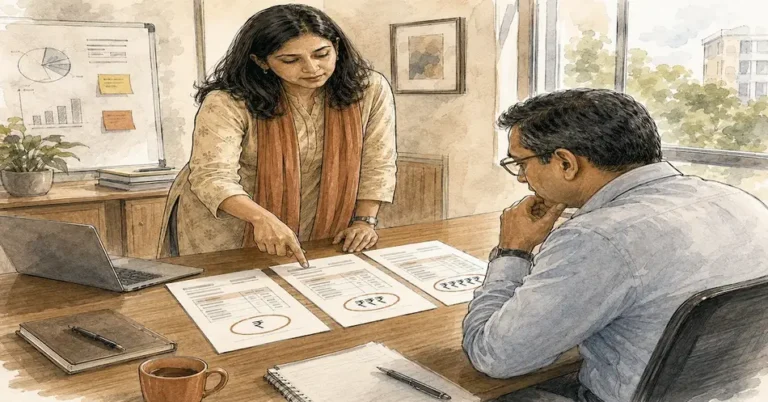
1. Ask, don’t tell. “What do you think?” beats “Do this” every time. Trust means involving people in the decisions that affect them. In Indian hierarchies, where deference is the default, this small shift sends a loud signal: your view matters here. Try it once tomorrow in your next one-on-one. Watch the team member’s posture change.
2. Listen like it’s your job. Put down the phone. Close the laptop. Nod. Repeat their words back to them so they know you heard. “I hear you” builds more bridges than any motivational town hall ever did. Most Indian managers think they are listening when they are actually planning their response. The two are not the same.
3. Delegate to elevate. Hand over real responsibility, not just tasks. “I trust you with this” is rocket fuel for an ambitious team member, especially one who has spent years waiting for the opportunity. The Indian cultural instinct is to delegate execution but retain decisions. Reverse it once and see what happens. This is exactly why the best performers struggle as managers; they cannot let go of the work that got them promoted.
What Happens When Trust Breaks
The cost of low-trust workplaces shows up everywhere, just rarely on the P&L sheet. The high performer who quietly disengages after her third skip-level review. The senior leader who stops sharing his real opinion in strategy meetings because the last time he disagreed, he was overruled in front of the team. The cross-functional project runs three months late because nobody trusts anyone else to make a call without escalation.
Multiply these patterns across an Indian organization of 500 people, and you have a 20-30% productivity drag that no spreadsheet captures. According to Harvard Business Review research on high-trust workplaces, employees at high-trust companies report 74% less stress, 50% higher productivity, and 76% more engagement than those at low-trust companies. The numbers are real. The cost of ignoring them is too.
We covered the operational fallout of broken team trust in our contact centre transformation engagement and the cultural rebuild that followed.
The Practical Trust-Building Habit
Trust does not build itself. It builds through small, repeated, deliberate actions. Three to start this week:
Tell one teammate, “I’ve got your back,” and then prove it the next time they need backing.
Hand one decision to a direct report that you would normally have made yourself. Do not hover. Do not check in five times. Let them make it.
Listen for ten minutes to someone on your team without offering advice. Ask one follow-up question. Then ask another.
If trust-building feels uncomfortable at first, that is the right feeling. Most of us were trained to lead by holding back, keeping authority, withholding decisions, and monitoring outcomes. Leading by holding on requires a different muscle, and our conflict management training covers exactly how to build it for managers who genuinely want to shift their default.
The Father’s Wisdom for the Boardroom
The daughter understood something the father almost missed. If she held his hand, she could let go. If he held hers, she was safe.
Leadership trust at work is the same. The team will let go of a leader who needs constant reassurance. They will follow a leader who holds on to them through uncertainty, through mistakes, through the times when the bridge feels shakiest.
Start with trust. Hold on through the wobbles. The bridge will hold.