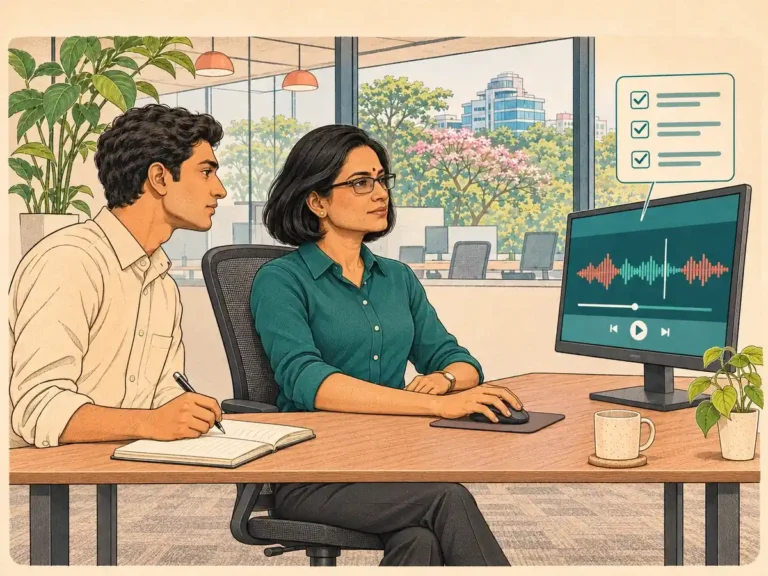


Imagine you head sales at a 40-person B2B software company in Pune. Two weeks ago, your reps finished a two-day workshop. For a fortnight, they used the new call structure, and you saw it in the pipeline notes.
This morning you play a recording of a rep’s call. Four minutes in, you hear the old pitch: product features first, the customer’s problem last.
This is a scenario, not a client story. A short coaching conversation lets the rep hear the old opening. The rep can then practise another one and try it on the next call.
Sales coaching is a manager’s regular, specific feedback and practice with a rep on real calls and deals. It aims to change what the rep does next.
Key takeaways
|
Sales training vs. sales coaching: what is the difference?
A workshop teaches a method to a group, but coaching builds the habit with one rep on one real call. Each supports the other. Reps can leave a workshop with a notebook and good intentions, and the first live call tests those intentions. A manager who listens to that call in the first week gives the method its first real chance.
Agree on what good looks like before reviewing a call. Use the same checklist in training and coaching so reps know which behaviour to practise.
In the Pune scenario, the workshop did its job. The reps learned the call structure and used it for a fortnight. What is missing is the manager’s regular, specific attention on the next real call.
If you are still choosing a workshop provider, read about choosing a sales training company.
Where a rep reports to a senior manager, the rep may hesitate to disagree about a recorded call. Asking the rep to speak first, in the Ask step, makes open talk easier.
What a sales coaching conversation looks like: Watch, Ask, Practise, Check
A coaching conversation can be short. It follows four steps and is built around one call and one behaviour.
Set aside about 20 minutes. Review the call before the one-to-one, bring one short excerpt, and focus the conversation on one behaviour.
Choose a call that is typical, not the best or the worst, because a typical call shows the habit. A lost deal invites blame, and a won deal invites praise without learning.
- Watch: Pick a live call or a recording that your company’s policy allows, and check the call-recording consent policy first. Start with one moment, such as how the rep opens a discovery call.
- Ask: let the rep say what they noticed first. A rep who hears the old pitch for themselves has something specific to work on.
- Practise: replay the moment in a short role play, where two minutes can be enough. The rep says the new opening aloud while you play the customer.
- Check: agree on what you will both listen for on the next few calls. Write it down, and bring it to the next one-to-one.
In the scenario, the exchange might run like this. You ask the rep what they noticed in the first four minutes. The rep says the features came first and the customer’s problem came last. You ask for the opening again, starting with the problem, and you play the customer. Then you agree to listen for that opening on the next few calls.
A three-line observation checklist keeps feedback specific. For a consultative method, the three lines can be:
- The rep checks the customer’s priority before describing the product.
- The rep asks one question to clarify the impact of the problem.
- The rep agrees with an owner and a date for the next step.
Each line is observable on a recording, so the manager and rep can agree whether it happened.
Share the checklist with the rep, so the scoring is open and nobody is surprised by it.
Why managers skip sales coaching
Three situations can explain why coaching gets skipped in a B2B team, and each is easy to recognise.
- First, the calendar fills with pipeline reviews and forecast calls. When a quarter closes, coaching moves to next week, and then to the week after.
- Second, there is no shared checklist. Without one, feedback becomes opinion about style, and the rep and manager leave the conversation disagreeing.
- Third, the manager was promoted for personal sales results. Coaching is a different skill, so the manager may not have practised it.
Pipeline pressure adds a further effect. When a deal is at risk, the manager takes over the call and the rep watches. The deal may move, but the rep learns little. Coaching asks the manager to let the rep carry the call and to step in afterwards.
A small start helps. Choose one rep, one call and one behaviour, and give it twenty minutes. Build a three-line observation checklist from the method your reps learned.
Choose a rhythm you can keep through a closing quarter. Some managers coach one rep each week, while others hold a short fortnightly slot with every rep. A rhythm that survives quarter-end matters more than a perfect schedule. For the checkpoints that follow a workshop, see the 90-day training reinforcement plan.
How to know sales coaching is working
For sales coaching, Excellential applies the Kirkpatrick model as follows. See how Excellential measures training effectiveness for the method.
Level 1 is reaction. Ask whether the rep found the feedback useful.
Level 2 is learning. Compare two similar role plays using the same checklist.
Level 3 is behaviour. Score a small set of comparable live calls before coaching and at the agreed review date.
Level 4 is results, such as conversion or deal size. Set the baseline and the business measure beforehand, and remember that market and pipeline changes also move these numbers.
Write the baseline before coaching starts by noting three calls per rep and scoring them against the checklist. Without a baseline, any later change is harder to judge. Do not judge coaching by the number of sessions held. A calendar full of conversations that change nothing is a poor sign. Count the behaviours observed on live calls instead.
Planning sales coaching for your team?
Excellential designs sales coaching around your own calls and a checklist your managers help to write. A follow-up check on live calls after 30, 60 or 90 days shows what has changed. Share your team’s goals and ask for a quote.
Who should coach: the manager or an external coach?
Both can work, and each has limits. A manager knows the deals, the customers, and the team’s history. The same manager also carries the forecast, which can make coaching feel like an inspection.
An external coach can help a manager practise giving feedback and apply a consistent checklist across the team. The manager still brings the context of the deal and can follow up on the next call.
Bring in an external coach when the manager is new to coaching or the team is learning a new method. The same applies when the manager’s calendar is the constraint. Tell reps which model the team uses so that coaching from two sources does not send mixed signals.
Managers need practice too. A new coach can rehearse the conversation itself with a colleague playing the rep in a short role play.
Excellential offers B2B sales training for established teams and startup sales training for early-stage teams. Compare either against the five questions below.
Five questions to ask any sales coach or training provider
- Whose real calls will the coaching use?
- Which checklist will manager and rep share, and who wrote it?
- Who coaches the manager, so the habit does not depend on the provider?
- Who checks live calls after 30, 60 or 90 days?
- How does the provider measure learning and behaviour, and what does it offer at Level 4?
A provider that answers these from your team’s own calls is easier to judge than one that lists topics.
Sales coaching in a startup team
Early-stage teams have fewer reps and fewer recorded calls. A founder may also act as sales head and best seller at once. Coaching then starts with the founder’s own calls: record two, choose one behaviour, and share the finding with the team. As the team grows, the first sales hire can take over the weekly conversation. The same checklist can then serve both coaching and the new hire’s onboarding.
If reps lack a shared sales process, agree on the stages and next steps first. A founder with two reps can start by observing calls and coaching one behaviour at a time.
What you can ask in your next one-to-one
Return to the Pune recording. In your next one-to-one, ask the rep what they noticed in the first four minutes. Then replay the opening and agree on what to listen for next. One conversation does not decide the rep’s result, but a habit can start there. You can also tell the team what you will do differently. Each rep picks one behaviour, and you listen for it on the next few calls. Then you check back with each rep on the agreed date.
Share the sales behaviour your managers want to improve. Excellential can help you choose a way to practise it and check it on live calls. Schedule a Quick Call.
Frequently asked questions
What is sales coaching?
Sales coaching is a manager’s regular, specific feedback and practice with a rep on real calls and deals. It focuses on one behaviour at a time and uses a recorded or live call as evidence. It ends with an agreed point to listen for next. Its aim is to change what the rep does on the next call.
How is sales coaching different from sales training?
Sales training teaches a method to a group in a workshop. Sales coaching builds the habit on live calls, one rep and one behaviour at a time. They support each other. Training gives the team a shared method, and coaching helps reps keep using it when quarter-end pressure returns.
How often should a manager coach a rep?
It depends on the team size, the call volume, and the manager’s calendar. Some managers start with one rep and one call a week, while others schedule a short slot every fortnight. Pick a rhythm that you can keep through a closing quarter, and review it after 30, 60, or 90 days.
Can sales coaching be done online?
Yes. Call recordings and screen sharing suit coaching well, because the manager and the rep can review the same moment together. Keep the four steps. Watch one call, ask the rep what they noticed, and practise the moment in a short role play. Then agree on what to listen for next.
How do you measure sales coaching?
Use the Kirkpatrick model. Level 2 asks whether the rep can show the skill in a role play. Level 3 asks whether live calls show it after 30, 60 or 90 days. Level 1 is the rep’s reaction, and Level 4 covers results, such as conversion, which needs an agreed baseline.