

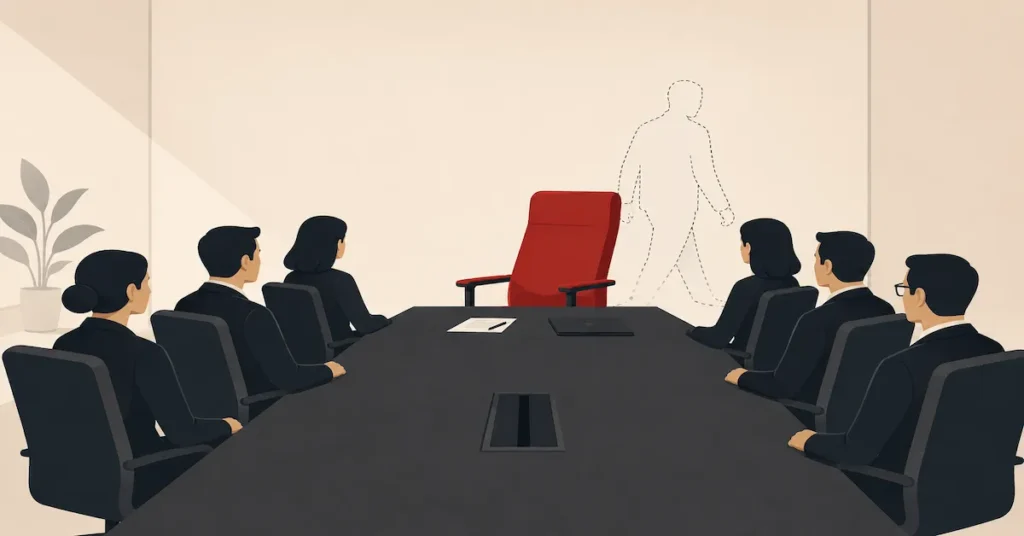
The resignation email took 30 seconds to write. The consequences lasted two years.
The email that emptied a corner office:
At a thirty-year-old engineering and infrastructure company in Mumbai, Mahesh Trivedi had run the projects business for two decades. He knew every major client by name, carried the history of every contract in his head, and could settle a site dispute with a single phone call. When the board worried about a delivery, they relaxed the moment they heard Mahesh was on it. For twenty years, the projects division simply worked, and nobody asked why.
Then Mahesh sent a short email accepting a role at a competitor. Thirty seconds to type. By the end of the quarter, he was gone, and the company learned what his presence had been quietly hiding. Two large projects drifted because no one else understood their commercial history. A client of fifteen years moved on, because the relationship had lived entirely in one man’s phone. The deputy who was meant to step up had never been prepared to and floundered in full view of the board.
It took close to two years and an estimated ₹40 crore in slipped projects and lost business to recover. The gap had existed for the entire twenty years. It only became visible the week it was too late to fix.
Key takeaways
- A strong leader with no successor is an invisible risk. The work still gets done, and the numbers still hold, so nobody sees the gap until the day that leader walks out.
- Leadership bench strength is the honest measure of how many of your critical roles have a credible answer to one question: who steps up if this person leaves?
- In Indian companies, long tenure, promoter trust and the awkwardness of raising succession keep the bench quietly empty for years.
- The only time to build a bench is while the chair is still occupied. After the email arrives, you are no longer preparing anyone; you are managing a crisis.
Leadership bench strength is the depth of ready-now successors an organisation holds for its critical roles, not how many managers it employs, but how many people could genuinely step into a senior seat if it emptied tomorrow.
The risk you cannot see because everything looks fine:
This is the strange thing about a missing successor. While the strong leader is still in the chair, the absence of anyone behind them is invisible. The work gets done. The numbers hold. The very competence of one person hides the fragility of the whole structure.
Leadership bench strength is the simplest test of that fragility, and most companies never run it. Excellential calls it the Tuesday Test: if your most important leader resigned on Monday morning, who could carry the role on Tuesday? When the honest answer is “no one yet,” the organisation is carrying a risk it has chosen not to look at, usually because nothing has gone wrong so far. Nothing going wrong is not the same as nothing being wrong.
Why the bench stays empty:
A leader rarely fails to build successors out of carelessness. The gap forms through ordinary, understandable pressure.
Day-to-day delivery crowds out everything else. Deloitte’s 2025 Global Human Capital Trends found that managers spend only about 13 per cent of their time developing the people who work for them, with the rest consumed by immediate problems and administration (Deloitte). Developing a successor is always important and never urgent, so it waits, year after year, until the day it cannot wait at all.
The strongest leaders often deepen the problem without meaning to. A Mahesh who holds every relationship and every decision becomes more indispensable each year, and an indispensable leader is, by definition, a single point of failure. The more the organisation leans on one person, the less it builds anyone else, and the more dangerous that person’s exit becomes.
Why this trap runs deep in Indian companies:
A few patterns common to Indian organisations make the empty bench especially likely.
We prize the loyal, long-serving senior leader, and rightly so. But long tenure can quietly mask risk: two decades of dependable service can look like stability when it is actually concentration, with all the knowledge and relationships resting on one set of shoulders. Promoter-led businesses often assume their trusted lieutenants will simply always be there, so succession never reaches the agenda.
The conversation itself feels awkward. Raising succession for a respected senior leader can feel like a suggestion that they are on their way out, almost inauspicious, so people avoid it out of politeness and the years slip by. And hierarchy concentrates decisions at the top, which means the people below never get the exposure that would have prepared them. An incumbent who has quietly enjoyed being the only one who can may not rush to groom a replacement either.
None of this is bad intent. It is simply how a bench stays empty while everyone assumes it is full.
What a ready bench looks like:
Set Mahesh’s story against a cold-chain logistics company in Nagpur, where the managing director, Sunita Deshpande, had spent years doing the opposite. She ran a demanding operation of temperature-controlled warehousing and last-mile delivery for pharmaceutical and food clients across central India, and she could easily have held every key relationship herself, the way owners often do. Instead, she made a habit of putting her second line in front of clients, letting them lead the quarterly account reviews while she sat in the room and said little. She handed over the hardest vendor negotiations a full year before she needed to.
When a sudden health scare pulled her out of the business for three months, no client outside the company noticed. Her deputy ran the operation. Two managers carried the relationships they already knew well. The numbers held. The bench was not luck; it was the result of a hundred small decisions to share what she could easily have kept. When Sunita came back, she said the quiet part out loud: the months she was away were the real test of everything she had built, and the business had passed it.
What building leadership bench strength takes:
Bench strength is not a document filed with HR. It is the steady, deliberate work of making sure no critical role rests on a single irreplaceable person. Four habits separate the companies that build it from the ones that only mean to.
It begins with naming the risk honestly. For every critical role, run the Tuesday Test and treat every role without a credible answer as a live exposure rather than a someday concern. Excellential walks organisations through exactly this in its work on building a future-proof leadership pipeline.
It means developing the layer below before the vacancy appears. The deputy who floundered in Mahesh’s place did not lack ability; he lacked preparation, because nobody had stretched him while there was still time. Preparing that next layer deliberately is the work of the Excellential Emerging Leaders Program, and readying people for genuinely senior roles is what Excellential’s Executive Leadership Coaching is built for.
It means spreading what one person holds. Relationships, commercial history and judgement that live in a single head have to move into a team, through shadowing, joint client ownership and handovers that start long before any exit, exactly the way Sunita ran her business. A relationship only one person can service is a liability dressed up as an asset.
And it means making development part of every senior leader’s job rather than an afterthought, so that 13 per cent starts to climb. The systems that hold all this together are the ones Excellential set out in How to Build a Leadership Pipeline in India, and the reason capable performers so often struggle the moment they are promoted is one Excellential examines in Why Your Best Performers Struggle as Managers.
The time to build is before the email arrives:
Mahesh’s resignation took thirty seconds because the real event had already happened, slowly, over the twenty years nobody spent preparing anyone to follow him. The email did not create the gap. It only revealed it.
Every organisation has at least one person whose sudden exit would hurt far more than anyone wants to admit. The quiet work of building bench strength is what turns that exit from a crisis into an inconvenience, and the only time to do that work is while the chair is still occupied.
If you are not sure who would step up when your strongest leaders move on, that uncertainty is worth resolving now, not in the quarter after the email lands.
Frequently Asked Questions
What is leadership bench strength?
Leadership bench strength is the depth of ready-now successors an organisation has for its critical roles. It measures not how many managers you employ, but how many people could genuinely step into a senior position if it fell vacant tomorrow, with little disruption to clients, projects, or results.
How do you measure leadership bench strength?
Apply the Tuesday Test to every critical role: if the person in it resigned on Monday, who could carry the role on Tuesday? Roles with a credible, prepared answer are covered. Roles where the honest answer is “no one yet” are live risks, however smoothly things appear to run today.
Why do Indian companies struggle to build a leadership bench?
Several patterns combine. Long tenure and promoter trust make a senior leader’s presence feel permanent, so succession never reaches the agenda. Raising the subject can feel almost inauspicious, as though hinting that someone should leave. And steep hierarchies keep decisions at the top, denying the next layer the exposure that would prepare them.
What is the difference between a leadership pipeline and leadership bench strength?
A leadership pipeline is the system that develops future leaders over time. Leadership bench strength is the result you can measure at any moment: how ready your successors are right now. A company can run pipeline programmes for years and still have a thin bench if nobody is close to ready.
How long does it take to build leadership bench strength?
There is no quick fix, because readiness comes from real exposure, not a single course. Preparing a credible successor for a senior role usually takes one to three years of stretch assignments, shared ownership, and honest feedback. That is precisely why the work has to begin while the current leader is still in place.