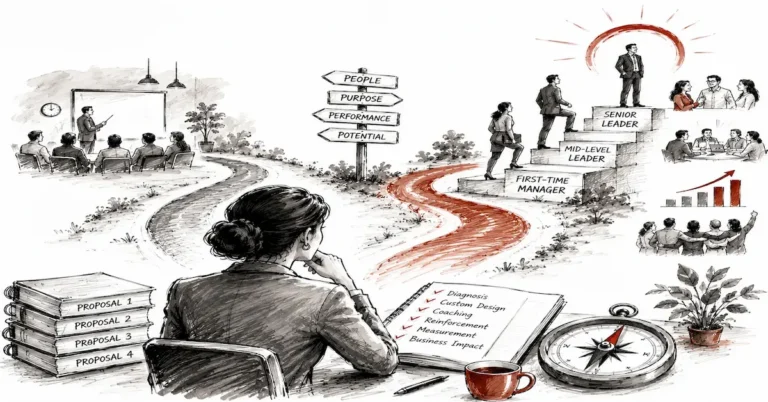
Ritika Anand had four proposals open and eleven days to decide. As VP of HR at a 900-person fintech in Mumbai, she had been asked to fix something nobody could quite name: promising managers who stalled once they reached their first team of ten. Every vendor deck used the same language: transformation, impact, synergy.
She wasn’t buying a workshop. She was buying better decisions, stronger managers and fewer avoidable resignations. None of the proposals made that connection obvious.
If you only read one minute of this guide
|
Choosing a leadership development company in India rests on five checks: confirm the partner diagnoses behaviour before designing content, not a fixed workshop; separate first-time managers from senior leaders instead of one curriculum for everyone; insist on coaching and reinforcement after the session ends, since that is where learning quietly disappears; ask how success gets measured, since attendance and feedback scores reveal nothing about changed behaviour; and check that the partner has delivered inside Indian organisational settings and understands local hierarchy, not a template built for another market.
Ritika is not alone. Across Bengaluru, Pune, Gurugram and Chennai, HR heads and founders sit through the same ritual each budget cycle: a stack of proposals, a shared vocabulary of buzzwords, and a nagging sense that last year’s programme did not move the needle. Choice has stopped being the problem. The India corporate training market reached USD 12.2 billion in 2025 and is projected to reach USD 39.9 billion by 2034, growing at roughly 12.86% a year, according to IMARC Group’s latest market analysis. More vendors, more decks, more promises. What buyers actually need is a reliable way to tell a genuine leadership development partner from a well-produced training vendor.
Whether you are evaluating a leadership development company in India for the first time or replacing an existing training partner, this guide will help you make a more informed decision.
Key Takeaways
|
Leadership Development vs Leadership Training
|
Leadership Training |
Leadership Development |
| Teaches skills | Builds behaviours |
| One-time event | Long-term journey |
| Knowledge transfer | Behaviour change |
| Ends after workshop | Reinforced through coaching |
| Measures attendance | Measures business impact |
Learn: What a Leadership Development Programme in India Should Actually Include
Ask ten HR leaders what leadership development means, and you are likely to hear ten different answers. That confusion is expensive because organisations end up buying classroom training when what they actually need is behavioural change. Training transfers knowledge in a room or over a screen. Development changes what a leader does under pressure, on an ordinary Tuesday afternoon, when the easier choice is to solve the problem themselves instead of coaching a direct report through it. A genuine leadership development programme in India combines four ingredients: a diagnostic phase that identifies the specific behaviours holding leaders back, contextualised content built around real workplace situations rather than generic frameworks, structured practice with feedback, and reinforcement that continues once the last session ends.
Signs your organisation needs leadership development
- Newly promoted managers struggle with delegation.
- Decisions are constantly escalated.
- Employee engagement varies widely across teams.
- Managers avoid difficult conversations.
- High performers leave because of poor managers.
Buyers frequently skip the diagnostic step because it takes longer and costs more upfront. Skipping it, however, turns the programme design into a guess dressed up as expertise. Devika Menon, who leads people operations at a 300-person logistics company in Pune, once told me she picked a programme because the brochure looked professional and the trainer had a strong LinkedIn profile. Eight months later, her regional managers still avoided giving direct feedback to underperforming staff, the exact behaviour the programme was meant to fix. The brochure had promised transformation. Nobody had asked what was actually broken.
What separates a strong leadership development partner from a weak one
| Area | Strong Partner | Weak Partner |
| Diagnosis | Runs interviews, surveys or 360 assessments before proposing content | Sends a standard deck and workshop agenda within a day of the first call |
| Curriculum | Builds separate tracks for first-time managers, mid-level leaders and senior executives | Runs the same generic leadership framework for every level |
| Facilitators | Uses facilitators with real people-management or coaching experience, not just presentation skill | Rotates junior trainers reading from a fixed script |
| Reinforcement | Includes coaching calls, manager briefings and follow-up practice after the workshop | Ends the engagement the day the workshop finishes |
| Measurement | Tracks behaviour change and business metrics such as retention and delegation frequency | Reports attendance numbers and average feedback scores |
| Contracting | Offers phased pricing tied to organisational size and desired outcomes | Quotes a flat per-head fee regardless of context or seniority |
| AI Usage | Uses AI for diagnostics and reinforcement but keeps human coaching central | Sells AI platform as replacement for leadership development |
Ask any shortlisted vendor to walk you through their diagnostic method before they show a single slide of content. If they cannot describe how they will identify the behaviours to target inside your organisation, they are selling a product, not a partnership. This also clarifies price conversations. A partner that customises diagnosis, delivery and reinforcement will cost more than an off-the-shelf workshop, but the off-the-shelf version usually needs replacing within a year.
This gap between intention and practice is not unique to India. ATD’s recent research on leadership development across levels found that fewer than half of talent development professionals, only 47 percent, currently offer leadership development to employees at every level, even though most call it a priority. The skills business leaders rate as most important, according to the same research, are communication, decision-making, and adaptability, in that order. Whatever a partner proposes, check that these three appear somewhere in the curriculum, and not merely as a slide title.
Common mistakes buyers make while selecting a leadership partner
|
Apply: Turning the Programme Into Daily Behaviour
Learning a concept and applying it under real pressure are two different skills, and most programmes only build the first one. Apply is where a leadership development programme in India either proves its worth or quietly fails. This stage should include practice with feedback, coaching conversations tied to actual work situations, and manager involvement, so the learning does not stop the moment a leader returns to their desk.
Naveen Iyer, a newly promoted engineering manager at a Hyderabad SaaS company, struggled to delegate architecture decisions to his senior developers. His organisation’s programme paired him with a coach for six fortnightly calls, each built around a real decision he was avoiding that week. By the fourth call, his team was proposing solutions instead of waiting for his sign-off. That shift happened because the practice was tied to his actual job, not a case study about a fictional company.
This is why leadership development programmes for managers cannot rely on classroom learning alone. Managers improve when they practise new behaviours in the situations they face every day.
Buyers should ask three questions about the Apply stage before signing a contract. How much of the programme happens away from the workshop room? Who coaches leaders through applying new behaviour, and what is that person’s actual coaching experience? Does the leader’s own manager get briefed on what to reinforce afterwards? A programme with strong content and weak application support produces leaders who can describe good leadership convincingly and still fall back on old habits by Friday.
Excellential structures every leadership development programme around career transitions rather than job titles. A first-time manager learning delegation requires a different intervention from a functional leader responsible for organisational strategy, succession planning and cross-functional influence.
Measure: Proving the Programme Changed Anything
Attendance certificates and post-workshop feedback scores measure comfort, not change. A leader can rate a session 4.7 out of 5 and behave exactly as before walking in. Real measurement for a leadership development programme in India should track three layers: behaviour change observed by managers and peers, movement on the specific metric the programme targeted, such as delegation frequency or feedback conversations held, and business outcomes such as team attrition, engagement scores or time to fill open roles.
The cost of skipping this stage shows up later, often in resignation letters. DDI’s Global Leadership Forecast 2025 found that among high-potential individual contributors, the intention to leave within a year rose from 13 percent in 2020 to 21 percent in 2024, and that this group is 3.7 times more likely to leave when their manager does not regularly create growth opportunities. Trust in immediate managers, the same study found, has fallen to 29 percent, a steep decline since 2022. Development budgets that fail to translate into better management on the ground end up funding attrition indirectly.
What should leadership development measure?
- Delegation frequency
- Coaching conversations
- Employee retention
- Engagement
- Promotion readiness
- Decision-making quality
- Internal mobility
- Team productivity
Excellential’s engagement with a large life insurance company shows what measurement looks like in practice. Ambitious leadership targets, stalled engagement scores and a workforce spread across multiple regions had left the pipeline running on inconsistent management practices. The specifics of which behaviours moved and how the business tracked them are easier to see than to summarise here, and the full case study on reigniting leadership spark for a life insurance giant walks through them in detail.
Sustain: Keeping the Change After the Contract Ends
The hardest part of any leadership development programme in India is not the launch. It is month nine, when the initial energy has faded, the coach has moved on to the next client, and an organisation’s usual pressures reassert themselves. Sustaining change requires three things working together: managers who reinforce the new behaviour in everyday interactions, incentive structures that reward it rather than the old habit, and a rhythm of check-ins that outlasts the formal programme.
Sanjay Oberoi runs a 150-person manufacturing unit outside Chennai and learned this the hard way. His first leadership programme delivered strong results for four months, then attrition among his supervisors quietly undid most of the gains, because nobody at the top had changed how supervisors were evaluated. The second programme he commissioned built quarterly manager check-ins and a revised appraisal rubric into the contract from day one. Eighteen months later, the behaviour had held.
Organisations often assume that leadership habits become permanent after a successful workshop. In reality, behaviour changes only when organisational systems reinforce it. Performance reviews, manager check-ins, coaching conversations and recognition programmes should all encourage the new behaviours leaders are expected to demonstrate.
Buyers should treat sustainability as a contractual line item, not a hopeful afterthought. Ask your shortlisted partner what happens on day 91, the day after most programmes officially end. If the answer is that reinforcement becomes the client’s responsibility alone, budget separately for it, because you will need it.
For a deeper look at why so many programmes fail to hold once the workshop ends, see our earlier guide, Leadership Development: What Actually Works (And Why Most Programs Fail).
Still comparing leadership development companies in India?
| If you are comparing leadership development companies in India right now, talk to us before you sign anything. Get started with a conversation about your team and we will walk through your organisation’s specific gaps before recommending an approach.
Prefer a quicker, informal chat? Message us on WhatsApp and we will respond directly. Curious what this looks like in practice? See Reigniting Leadership Spark for a Life Insurance Giant. |
Frequently Asked Questions
How do I choose a leadership development company in India?
Check whether the company diagnoses behaviour before designing content, whether it separates programmes by leadership level, whether coaching and reinforcement continue after the workshop, and whether it measures behaviour change rather than attendance. Ask for a client reference in a similar industry and company size before signing.
What does a good leadership development programme cost in India?
Costs vary widely based on group size, seniority level and whether individual coaching is included, ranging from a few lakh rupees for a short cohort workshop to significantly more for a multi-month programme with dedicated coaching. A future post in this series, What Leadership Development Actually Costs in India, breaks down typical pricing models in detail.
How long does it take to see results from leadership development?
Early behaviour shifts are often visible within eight to twelve weeks when the programme includes structured practice and coaching. Business outcomes such as improved retention or faster decision-making usually take two to three quarters to show clearly, since they depend on the new behaviour becoming habitual.
Is leadership development different for startups versus large companies?
Yes. Startups usually need fast, practical skill-building for founders and first-time managers learning on the job, while larger organisations need structured succession planning and consistent leadership standards across multiple layers and locations. A generic programme built for one rarely works well for the other. Startups also tend to promote technical experts into management roles much earlier than established organisations, so leadership development needs to build delegation, communication and coaching skills before poor management habits become embedded as the company scales.
Should a growing company build an in-house L&D team or hire an external leadership development partner?
Most companies under 500 employees get more value from an external partner, since building in-house diagnostic, coaching and design capability takes years and a dedicated team. Once leadership development becomes a continuous, year-round function rather than an occasional intervention, an in-house team paired with specialist external coaching often works best. The right model depends on how many leaders you develop each year and how fast the organisation is growing.
How do leadership development programmes differ for first-time managers?
First-time managers typically need practical skills such as delegation, feedback, coaching conversations, prioritisation and performance management. Senior leaders, by contrast, focus more on strategic thinking, organisational influence, succession planning and leading change. Effective leadership development programmes recognise these differences instead of delivering the same curriculum to every audience.
Can leadership development be delivered online?
Yes. Virtual leadership development programmes work well when they combine live facilitation, coaching, peer discussions and workplace assignments. However, highly interactive topics such as difficult conversations, coaching skills and executive presence often benefit from face-to-face practice. Many organisations now prefer blended leadership development programmes that combine both formats.
How do you measure the ROI of leadership development?
Track it across three levels: behavioural change, team outcomes and business impact, using indicators such as delegation quality, employee engagement, internal promotions and retention of high performers rather than attendance or satisfaction scores alone. A future post in this series, Leadership ROI Framework, sets out the full model for connecting leadership behaviour to business results.
What industries benefit most from leadership development?
Leadership capability is valuable across industries, but organisations experiencing rapid growth, digital transformation, expansion into new markets or succession planning initiatives often see the greatest impact. In India, leadership development is widely adopted across technology, manufacturing, BFSI, healthcare, retail and professional services.